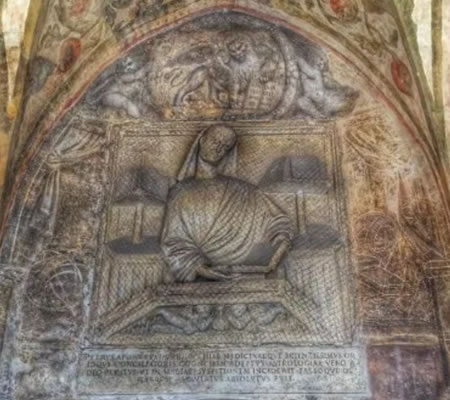
The Purloined Bones of the Magician Pietro d'Abano
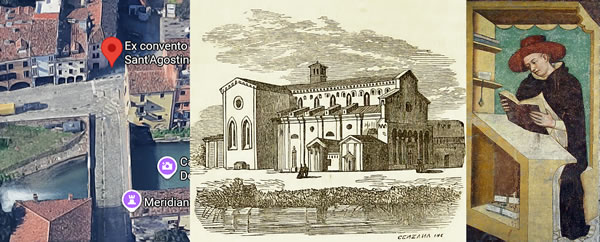
In Padua, at the foot of the Sant'Agostino bridge—where today we find the Riviera Paleocapa and the Piave barracks—once stood the majestic Basilica of Sant'Agostino. It was barbarously razed to the ground in 1819 by order of the Austrian government. Its bricks were reused in the construction of a military hospital, later converted into barracks; while its columns ended up adorning a public slaughterhouse, which now houses an art high school.
And to think that over time, men had singularly respected that august enclosure! It had been respected by the barbarian hordes of the Scaligeri, and even by the frequent and furious uprisings of the common people. This is a fitting case to repeat the old pun directed at Urban VIII (Maffeo Barberini), notorious for systematically plundering the marble and travertine of the Colosseum in the 17th century for the construction of his family palace and other works: "What the barbarians did not do, the Barberini did."
This magnificent edifice was begun in 1227 and completed in 1273, under the patronage of Nicolò di Boccassio (Treviso 1240 – Perugia 1304), Bishop of Padua and future pope for only eight months under the name Benedict XI (1303-1304). It was the church of the adjacent Dominican convent and displayed that serious and robust architecture typically used by the Dominicans for their most important churches.
It was undoubtedly the most beautiful medieval building in Padua, after the Basilica of St. Anthony. It was one of the main places of worship in 14th-century Padua.
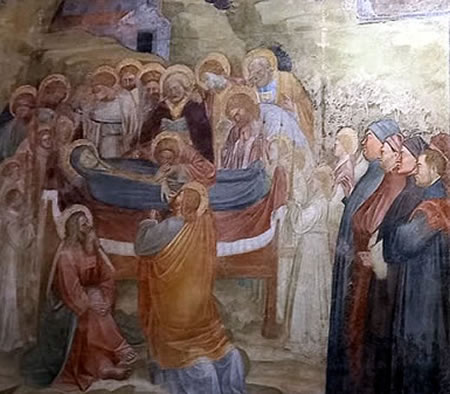
The parce sepultis commandment advises against casting stones at the recent ashes of those most responsible for such a disgrace. And Padua bitterly lamented its loss at the time, for in that basilica it cherished not only the grandeur of the architecture but also the tombs of illustrious Paduans it housed, the paintings that adorned it, and the historical memories it safeguarded. The Da Carrara family, lords of Padua from 1318 to 1405, chose it as the final resting place for some of their illustrious members. There, glorious peace was slept by Jacopo II (died 1350), Ubertino III (Lord of Padua, died 1345), and Jacopo V "the Great" da Carrara (died 1350, a great friend of Francesco Petrarca); there also rested the bones of Pietro d'Abano, weary from scholarly battles; saved from the demolition hammer, they were, through the charity of an illustrious scientist, transported to the church of Saints Philip and James (known as the Eremitani).
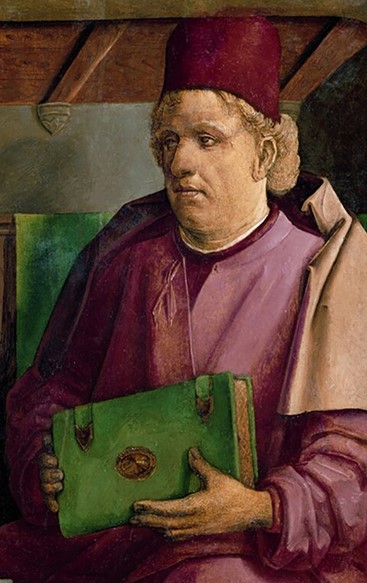
Pietro d'Abano (in Latin, Petrus de Abano or Petrus Patavinus, 1250–c. 1315) was born in the eponymous spa town not far from Padua. We know he was the son of a notary and studied medicine in Padua. Between 1270 and 1290, he made numerous journeys, including one to Constantinople. According to Plinio Prioreschi in A History of Medicine: Medieval Medicine, he also went there to escape a murder accusation. In any case, he lived there for a long time, became a friend of Marco Polo, and, most importantly, was able to learn Greek and Arabic, enabling him to read the works of ancient physicians and philosophers directly. Thanks to this knowledge, he also authored various translations of Greek and Arabic scientific texts into Latin: he translated and commented on the works of Averroes and Aristotle, initiating the tradition of Aristotelian studies.
He became a famous astronomer and thinker, one of the first to teach astronomy and mathematics, a professor of medicine and natural philosophy at the University of Padua, and a highly esteemed, sought-after physician by sovereigns and popes such as Honorius IV, who wanted to be treated by him.
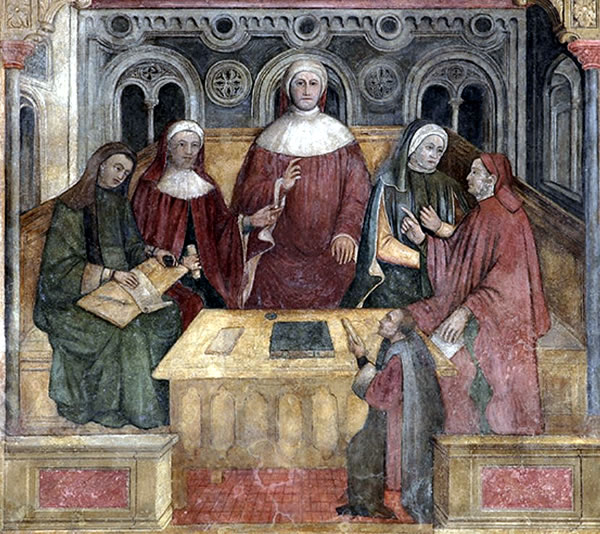
In the last decade of the 13th century, he stayed in Paris, where he continued his studies and began teaching medicine at the University. There was also a compatriot of his there, the Hermit friar Albert, who taught sacred letters. Denounced by the Dominicans of Saint-Jacques regarding his ideas on the origin of the soul or his adherence to astrology, he underwent his first trial for heresy but was released, the exact year unknown, thanks to papal intervention.
In the early 1300s (around 1302, but perhaps also between 1303 and 1307), he returned to Padua, where he was appointed lecturer in medicine, astrology, and philosophy at the city's university. Pietro d'Abano's return to the Veneto city represents a very important moment not only for the university but also for the Italian cultural landscape: the physician and philosopher brought a wealth of knowledge previously ignored in the peninsula. At that time, the University of Padua already hosted considerable talents, such as Giotto and his friend Dante, who was likely there in 1306; or Albertino Mussato, orator, historian, poet, and scholar in every field of study. Pietro was already renowned as an illustrious master in Paris, had completed a major medical work, and began that book, the Conciliator, to which he owes his celebrity.
Pietro d'Abano's teaching notably influenced Dante's thought; Dante was in Padua at the time when Pietro enjoyed the greatest fame, and students from all over Europe flocked to hear him, so much so that Gentile da Foligno, entering the hall crowded with students, prostrated himself, saying: "Hail, O sacred temple of science!"
In many passages of the Convivio, one notes how Dante followed the teachings of the great scholar from Abano, who was certainly in that era the most universally recognized and revered master by the great Italian schools. Padua wanted his marble effigy to be embedded above the door of the magnificent Palazzo della Ragione, as if no one could more worthily symbolize the importance of teaching and the freedom of study.
From the 16th century onward, Pietro was identified as the author of various magical texts—actually apocryphal—earning him a reputation as a powerful necromancer. Among his texts is the Astrolabium planum, whose content Giotto likely drew upon for the astrological depictions in Padua's Palazzo della Ragione, one of the greatest monuments of European medieval art. Knowledge of celestial bodies, from both an astronomical and astrological point of view, was considered indispensable at the time for practicing medicine; the physician necessarily had to master astrology, elevated by Pietro d'Abano to the status of a true science, in order to intervene, at the most opportune moment dictated and indicated by the stars, with the administration of a specific medicine or a prescribed surgical therapy.
Pietro d'Abano represented most completely the characteristic type of the university master of the old Italian school: in an era when medicine, after being almost exclusively monastic, was moving towards a new era of freedom and research. At that time, the Arab conquest of the most important centers in the Mediterranean had given rise to a new civilization that had transformed the medicine and philosophy of Greece. From this Arabist current arose the trend known as Italian Averroism because it takes its cues from the great physician and commentator of Aristotle. Padua was the major center of this Averroist tendency in Italy—which primarily signified a courageous rebellion against scholastic dogmatism—and Pietro d'Abano its most learned master.
For his clinical skill, and because, like any astronomer of his time, he was also an astrologer, his contemporaries believed him to be a magician. Indeed, his fame as a magician and alchemist was common to many other illustrious physicians of the time. It is said that:
• He kept seven familiar spirits sealed in a vial who instructed him in the seven liberal arts;
• Money he spent magically returned to his purse;
• He performed bloodletting during the new moon because the moon's influence was stronger on those days;
• To cure kidney pain, he hung a gold plate around patients' necks, engraved with the figure of a lion, when the sun entered the sign of Lion;
• Once, while being hanged, he substituted a donkey for himself;
• One night, with the help of his demon friends, he had a well moved from the street into his house because he was annoyed by the constant comings and goings of people drawing water;
• He advised the Paduans to destroy the city and rebuild it under a favorable conjunction of stars, which he himself would indicate.
The last decade of his life was also marked by controversies and trials. On two separate occasions, he was accused by the Dominicans before the Inquisition tribunal:
• In 1306: He was denounced for heresy and necromancy by the physician Pietro da Reggio; however, there is no evidence that this accusation actually led to a proper trial;
• In 1312, an inquiry was initiated by the inquisitor Ruggero de Petriolo, who consulted doctors and ecclesiastics to examine an accusation of magic, occultism, and heresy against him. The merit of the accusation is unclear in this case as well. The outcome of the trial cannot be determined. The preserved documents—including a profession of faith dated May 24, 1315, and Pietro's own will (two days later), in which he left his property not to his heirs but entrusted it to the protection of the Commune, and acts concerning the possession of these properties by his sons (1318 and 1321)—suggest that Pietro, who died in prison (where he had been since 1314, before the sentence was even pronounced) while the proceedings were ongoing, was acquitted. Acquittal would indeed have allowed his family to take possession of the inheritance. We know he had three sons: Benvenuto, involved in a brawl in 1325, Pietro, and Zuffredo, attested in property and testamentary acts. Given the lack of documentation regarding a probable marriage of Pietro, the hypothesis has been advanced that they were born out of wedlock; however, this hypothesis can neither be confirmed nor refuted.
According to a popular legend, Pietro was posthumously found guilty by the Church, so the Inquisition tribunal ordered his body to be exhumed and burned; but a friend had secretly removed the corpse, forcing the Inquisition to "content itself" with staging a burning in effigy.
Pietro d'Abano's work was eclectic both in its sources and in the fields it covered, and, also by virtue of this nature, represented an initial distancing from theology and scholastic philosophy. His main work, of a medical-philosophical nature, was the Conciliator (1303-1310), in which Pietro examined 210 questions (differentiae) of practical and theoretical medicine, attempting to "conciliate" the opinions of ancient authors, both classical and Arab, and modern ones. The text had 17 editions between 1472 and 1621, making it one of the most important European university textbooks over this long period. In the Conciliator, besides the great importance given to the stars in influencing human destiny, one finds the conception that incantations, prayers, spells, and sacraments could have power over diseases because they served to win the patient's trust, influencing their spirit and, consequently, their body. Although of Arabic inspiration, it contains an early conceptualization, at least in the Western context, of the importance of the doctor-patient relationship for the actual realization and effectiveness of treatments. Also interesting is the space reserved for anatomy, defined as a scientia incisionis. In particular, there is a complete description of the abdominal muscles, based on both classical sources and the direct experience of the physician, and moreover, aimed at a practical purpose, namely the performance of the "bezel," the evacuation of abdominal fluid.
To understand the importance Pietro gave to verifying sources and, in general, to "checking" knowledge through direct experience, it can be significant to cite his meeting with Marco Polo (1254-1324), which Pietro describes in differentia 67. The Apennine physician wanted to meet the famous traveler in person precisely to test him, through his questions, on the truthfulness of his tales, as well as to confirm some geo-astronomical theories learned from Arabic sources. Pietro was so struck by the conversation that he described Marco Polo as the greatest navigator of the terrestrial globe and the most diligent observer. In conclusion, the most innovative aspect of Pietro's scientific production lies precisely in the control of knowledge. In his time, knowledge was understood essentially as the reading and study of canonical sources, mainly Arabic, whether directly or indirectly classical. Pietro does not overturn this scheme but reforms it from within. He is among the first, for example, to show dissatisfaction with the Arabic-Latin translations of Greek scientific texts and to understand the need to consult the originals. He was among the first to attempt to verify classical conceptions both through direct experience and through the use of what we would today call secondary sources, that is, the writings—and especially the experience described in them—of authors contemporary to him whom he considered reliable.
Among the corpus of his works are also several translations of Greek texts which, though literary and in some ways almost amateurish, certify an early and innovative attention to the philological recovery of classical science. Even in this respect, Pietro seems to differ from the knowledge of his time, characterized by simple commentary on past works, through an attention to the direct verification of the sources of knowledge itself. This is something new that would have a disruptive effect on the entire subsequent history of the West—philosophical, scientific, political, and even religious—in the following two centuries.