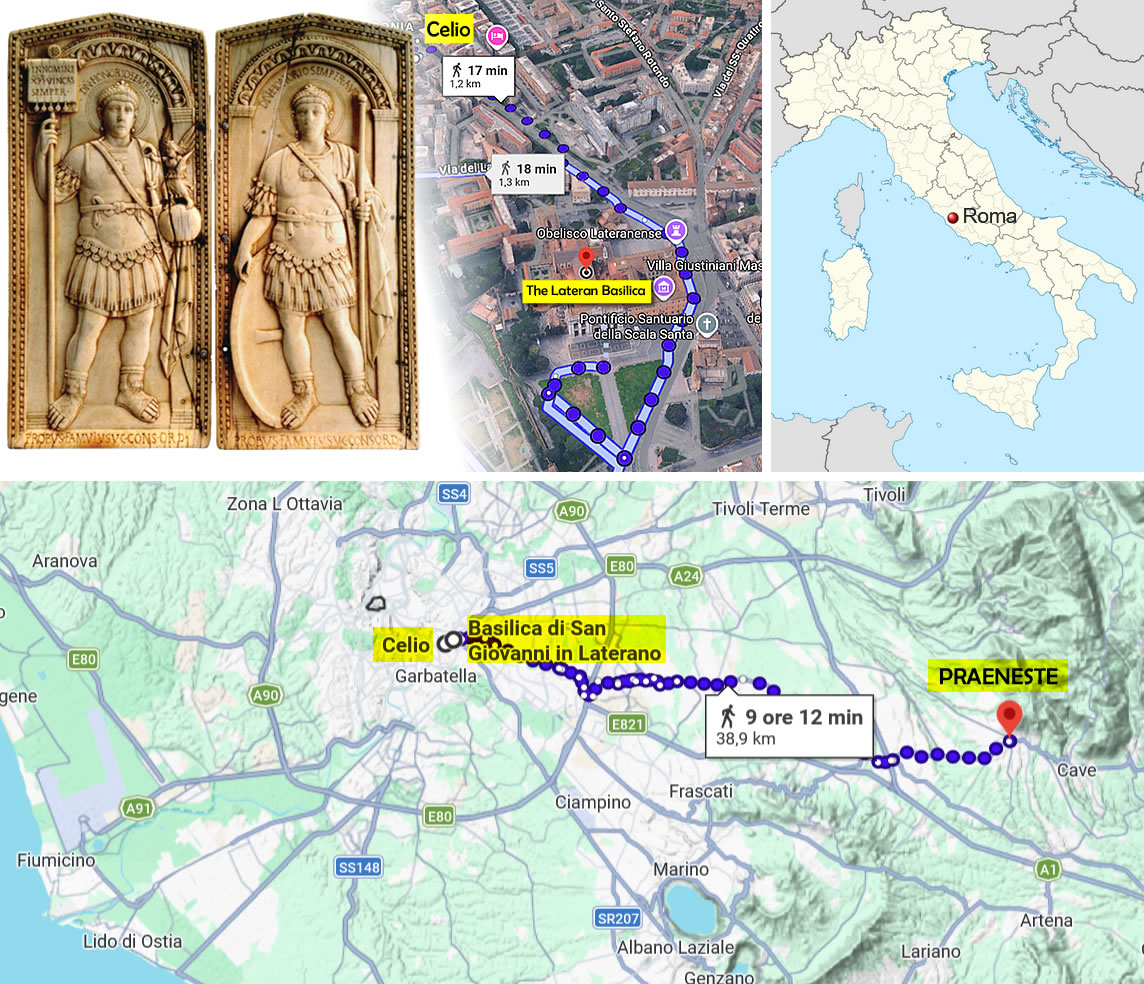
Ivory diptych of consul Anicius Petronius Probus with the depiction of Emperor Honorius, Aosta, Cathedral, Museo del Tesoro

The gens Anicia was a Roman family active on the political scene as early as the late 4th century BCE, but it was particularly prominent between the 4th and 6th centuries CE, when it reached the apex of its fortunes. Evidence suggests that the Anicii originated from the city of Praeneste (modern-day Palestrina), as indicated by the cognomen "Praenestinus" appearing in the names of its earliest members, such as Quintus Anicius Praenestinus, who lived in the 4th century BCE.
Already flourishing in the 8th century BCE, ancient Praeneste was part of the league of thirty Latin cities and was conquered by Rome along with its Latin League allies in 338 BCE, after putting up fierce resistance during which it had formed an anti-Roman alliance with the Gauls. Its Romanization, coupled with new trade opportunities facilitated by its strategic location—a mandatory passage on the routes between Latium and southern Italy—fueled its growth. Urban development began with the construction of the forum, and in 90 BCE, Palestrina received Roman citizenship. This progress was abruptly halted in 82 BCE during the civil war: the city sided with Gaius Marius and Lucius Cornelius Sulla, who, in retaliation, slaughtered all its male citizens and confiscated their properties. Sulla assigned the seized lands to his veterans and founded a colony on the plain at the foot of the hill where Praeneste once stood. During the imperial era, the city regained its colonial status, becoming a resort destination for Roman aristocrats, who built lavish suburban villas there. It even became one of Emperor Augustus’s favorite holiday spots.
Since the 2nd century AD, the gens Anicia, a immensely wealthy landowning family with estates in Italy and the Roman provinces, had its domus on the Caelian Hill in Rome. Having converted to Christianity no later than the mid-4th century, from then until the end of the 6th century it played a crucial role in the history of both Rome and the Empire: a series of marital alliances made it influential on the Roman political scene, producing numerous prominent figures in public life and culture. Some scholars argue that this family is not related to the one from the Republican era and that this is a case of homonymy. Be that as it may, this gens also counts among its members three popes: Felix III, Agapetus I, and Gregory I.
Felix III was most likely born in Rome into a senatorial family in the first half of the 5th century. His father, Felix, was the priest whom Pope Leo the Great had entrusted with overseeing the restoration of the Basilica of St. Paul Outside the Walls—one of the four papal basilicas of Rome and the largest after St. Peter’s in the Vatican. Nothing certain is known about Felix’s life until he succeeded Pope Simplicius in 483. However, it appears that before entering holy orders, he was married to an aristocratic woman named Petronia and had several children, including Gordian, who fathered the future Pope Agapetus I and a son named Palatinus. Palatinus, in turn, fathered a second Gordian, who became the grandfather of Pope Gregory I.
Papal elections were customarily conducted by the people of Rome, followed by imperial ratification. However, with no Western Emperor, Odoacer claimed that right for himself. He therefore sent the official Caecina Basilius to Rome, who presented a decree allegedly signed by the late Pope Simplicius, prescribing that future papal elections should be held with the counsel of royal delegates. No one opposed the supposed decree, and the consultations resulted in the election of Felix, who was consecrated on March 13, 483. The newly ordained pontiff immediately engaged in the already tense relations between the rex gentium (Odoacer) and Byzantium, pursuing a firm policy of intransigence toward the latter regarding the Monophysite controversy.
At that time, the Church was still embroiled in its long conflict with the heresy of Eutyches. The previous year, Emperor Zeno, at the suggestion of Patriarch Acacius of Constantinople, had issued an edict known as the Henotikon (or Act of Union), declaring that no creed other than those established at Nicaea, with the additions of 381, could be recognized. The edict was interpreted as a mandate for reconciliation between Catholics and Eutychians but instead provoked even graver conflicts, splitting the Eastern Church into three or four factions. When Catholics rejected the edict, the emperor replaced the patriarchs of Antioch, Martyrius, and Alexandria, John Talaia. Peter the Fuller, a known Monophysite, took the see of Antioch, and Peter III Mongus occupied that of Alexandria. In his first synod, Felix excommunicated Peter the Fuller, who was also condemned by Acacius at a synod in Constantinople. In 484, Felix also excommunicated Peter Mongus—an act that sparked a schism between East and West that would not be healed for 35 years. However, Peter Mongus curried favor with the emperor and Acacius by subscribing to the Henotikon and, much to the dismay of many bishops, was readmitted to full communion by Acacius.
The Acacian Schism, named after Acacius, Patriarch of Constantinople, was a decisive religious and political rift between the Christian Churches of Rome and Constantinople. Lasting from 485 to 519 CE, it stemmed from Acacius’s controversial support of the Henotikon, a document aimed at reconciling divergent Christian theological perspectives within the Eastern Roman Empire. Its consequences reshaped the relationship between the Eastern and Western branches of Christianity, solidifying the divide that would eventually lead to the Great Schism of 1054.
The roots of the Acacian Schism lay in unresolved theological disputes surrounding the nature of Christ—an issue dividing Christian leaders in the Eastern Roman Empire. The main controversy centered on whether Christ had one nature (Monophysitism) or two distinct but unified natures—divine and human—a doctrine upheld by the Council of Chalcedon in 451 CE. The Chalcedonian position held that Christ exists "in two natures, without confusion, without change, without division, and without separation." However, this view was controversial among many Eastern Christians, particularly in Egypt and Syria, who adhered to Monophysitism, seeing it as a truer expression of Christ’s divine mystery.
The theological landscape in the East was dominated by two major schools: the Alexandrian and the Antiochene. The School of Alexandria, influenced by theologians like Cyril of Alexandria, emphasized the unity of Christ’s divine nature, leaning more toward Monophysite thought. Conversely, the Antiochene School upheld the distinctness of Christ’s human and divine natures, closer to the Chalcedonian definition. These divergent views created a fault line that the Council of Chalcedon attempted to resolve but only intensified.
In the West, the Henotikon’s omission of the Chalcedonian formula troubled the Roman Church, which saw the Council of Chalcedon as essential to orthodox doctrine. Pope Felix III, determined to defend Chalcedonian orthodoxy and resist perceived encroachments by Constantinople, opposed Acacius’s compromise. The Pope’s opposition was further fueled by Acacius’s support of Peter Mongus. Felix, after convening another synod, sent legates—Vitalis, bishop of Truentum (La Civita in Picenum), and Misenus, bishop of Cumae—to the emperor and Patriarch Acacius. The delegation was to deliver letters to the emperor, intended as the new pope’s contribution toward normalizing relations between the Apostolic See, the Empire, and the Church of Constantinople. Furthermore, they were to demand that Peter Mongus be expelled from Alexandria and that Acacius appear in Rome to explain his conduct. Acacius not only refused their demand but humiliated them by publicly denouncing them. The legates were arrested, imprisoned, and then, under pressure from threats and promises, entered into communion with the heretics by inserting Peter Mongus’s name into the reading of the sacred diptychs. When their betrayal was made known in Rome by Simeon, one of the Acoemetae monks, Felix III did not wait for his legates’ return to act. On July 28, 484, he convened a synod in Rome at the Lateran Basilica, which met the same day and was attended by 77 Italian bishops. The synod’s main decision was the excommunication of Patriarch Acacius of Constantinople for his constant support of heretics, his essential role in the rise of the heretic Peter Mongus to the see of Alexandria, his treatment of the papal legates Vitalis and Misenus (first violently, then corrupting them), and his final refusal to grant an audience to the defensor Ecclesiae Felix. The excommunication was for life and extended to anyone who had any kind of dealings with the excommunicated patriarch. Vitalis and Misenus were likewise subjected to the same penalty.
The excommunication of Acacius marked a historic moment in the relationship between the Churches of Rome and Constantinople. Supported by the emperor, Acacius ignored the excommunication, removed the pope’s name from the sacred diptychs—lists of names commemorated during the liturgy—thus formalizing the schism, and remained in his see until his death in 489.
Acacius’s excommunication and his subsequent retaliation triggered a power struggle between Constantinople and Rome, further deepening the schism. In the Eastern territories, Acacius, with the support of Emperor Zeno, launched a campaign to enforce acceptance of the Henotikon, often using imperial power to suppress resistance. Monastic communities and religious leaders who resisted the Henotikon suffered persecution, and Acacius’s influence grew, making him the de facto leader of Eastern Christianity. This period saw Constantinople’s growing autonomy and set a precedent for future disputes with Rome. The schism not only allowed Monophysitism to gain strength in the Eastern provinces but also solidified the political and theological divisions that would characterize the relationship between Eastern and Western Christianity. This episode underscored the growing assertiveness of the Byzantine Church and state in shaping Christian orthodoxy independently of Rome.
The Acacian Schism continued for three decades after Acacius’s death in 489. Succeeding Patriarchs of Constantinople, while sometimes sympathetic to Chalcedonian doctrine, struggled to reconcile with Rome due to the entrenched support for the Henotikon within the Byzantine state. Acacius’s successor was Fravitta, who sent messengers to Felix assuring him that he would not be in communion with Peter Mongus. But when the pope realized this was false, the schism continued. Peter Mongus having died in the meantime, Euphemius, Fravitta’s successor, sought to return to communion with Rome, but the pope refused because the new bishop did not remove the names of his two predecessors from the sacred diptychs. The schism, known as the Acacian Schism, ended only in 518, during the reign of Justin I.
In Africa, the Vandals Genseric and his son Huneric had persecuted the Church for over 50 years and forced many Catholics into exile. When peace was restored, many of those who had fallen into heresy out of fear and been rebaptized as Arians wished to return to the Church. Rejected by those who had remained faithful, they appealed to Felix, who convened a Lateran synod in 487 and sent a letter to the bishops of Africa outlining the conditions under which these individuals could be readmitted to the bosom of the Church. Felix died in 492, after 8 years, 11 months, and 23 days of his pontificate. He was buried in the family tomb in the Basilica of St. Paul Outside the Walls. Felix Anicius, who bore no numeral during his lifetime, should have been known as Pope Felix II, since Felix II was actually an Arian antipope against the legitimate pope Liberius. However, because the antipope Felix II was confused with a martyr of the same name venerated by the Catholic Church as a saint, for many centuries he was considered legitimate and thus included in the papal numbering.
This page was last edited on 21 March 2026
Ivory diptych of consul Anicius Petronius Probus with the depiction of Emperor Honorius, Aosta, Cathedral, Museo del Tesoro
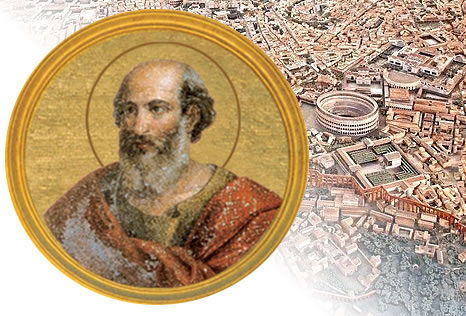
Pope Felix III - Model of Imperial Rome. In the foreground, the Temple of the Divine Claudius on the Caelian Hill and the Neronian Aqueduct.
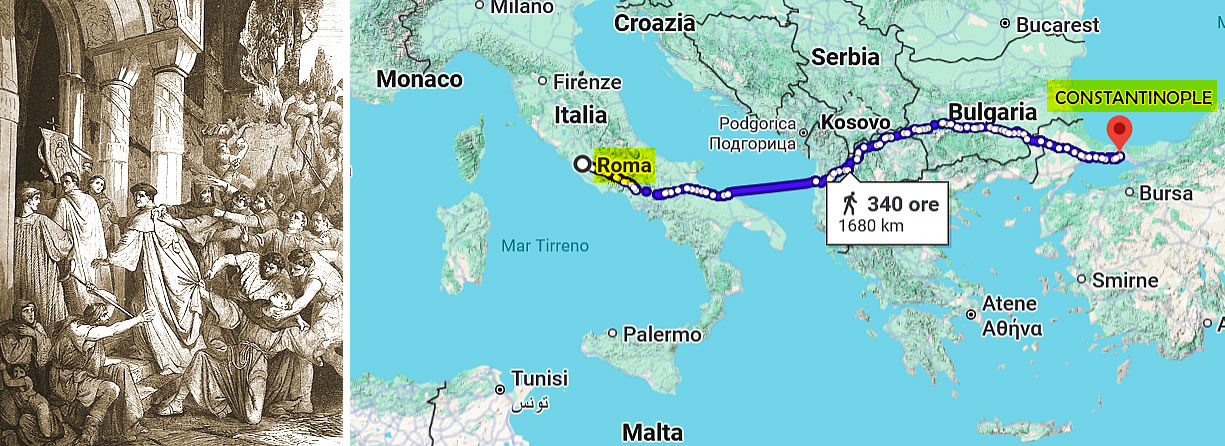
Emil Jakob Schindler - Monks putting the bill on the coat of Acacius, 1868
The Basilica of St. John Lateran stands near the Celian Hill. It was the first church ever built and is located in one of Rome’s most important areas, rich in history and culture. Here, among ancient walls, the villas of Rome’s ancient aristocracy, and majestic basilicas, stories of emperors, battles, and faith intertwine. The Basilica derives its name from the Laterani and Pisoni families, who owned villas on this site. Both properties were confiscated by Emperor Nero following a conspiracy hatched against him in 65 CE. In the 3rd century CE, Septimius Severus used part of that land to build the barracks of the elite cavalry guard, the Castra nova equitum singularium. Later, these lands passed to Fausta, sister of Maxentius and future wife of Constantine, who built for her the new palace on the Lateran, the Domus Faustae, as a private residence in Rome. After his victory over Maxentius at the Milvian Bridge in 312 CE, Emperor Constantine donated the *Domus Faustae* to the Pope and had the great Lateran Basilica built on that site as a sign of gratitude to the God of the Christians, who had granted him that victory. Thus began the construction of the Lateran Basilica, or Basilica of the Most Holy Savior.
From here, the Pope governed the Church for many years before moving permanently to the Vatican in 1377.
© andmorestory.eu - All right reserved