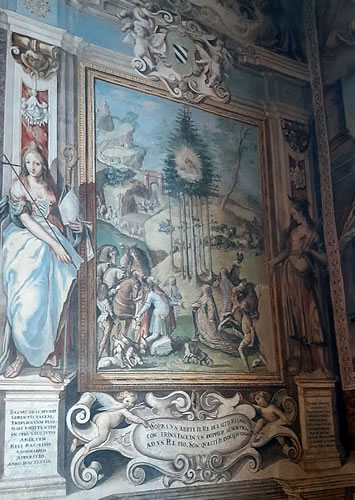
'The Vision of King Rachis', inscription and frescoes by Francesco Nasini (1652) - Chapel of the Holy Saviour, Abbey of San Salvatore (Siena, Italy)

Mount Amiata, with its forests, is a somewhat distinct area due to its high mountain configuration rising from plains and valleys. Of volcanic origin, the mountain conceals hot springs and steam vents, waters, and basaltic boulders that give the landscape a singular appearance. In this evocative place, legends have been invented since ancient times about demonic and angelic apparitions; slumbering dragons that suddenly awaken, spewing fire and flames; religious figures; knights; saints; fairies; vanished worlds hidden by landslides; and sovereigns such as King Rachis, founder of the Abbey of San Salvatore, and Charlemagne, who found the Carlina thistle there. An old legend tells that while the Lombard king Rachis (or Ratchis) was near Amiata, three lights appeared one night on the mountain, so bright that one could distinguish the surrounding landscape. The sovereign sent his men to investigate, and the messengers had a marvelous vision, which repeated itself when the king went to the place in person. Troubled by what had appeared to him, the king decided to build a monastery there. Another legend recounts when King Rachis, a passionate hunter, arrived on Mount Amiata. He was still pagan and wanted to rename it Mount Diana, in homage to the splendid forests rich with game that covered it. One morning in May of 743 AD, while wandering alone, a magnificent white doe with blue eyes appeared to him and led him through forests, valleys, and ravines until it stopped beneath a huge chestnut tree. On that chestnut tree, as if on a throne, Rachis saw a radiant figure appear with a crown and royal mantle, holding a globe surmounted by a cross in its right hand and a bundle of arrows in its left. The Saviour said to him, "I am the King of Kings. I command you to build a church in this place in my honour." The Lombard then donned the monk's habit, and with his soldiers built a church, then an abbey—which still exists and is called San Salvatore—and led a holy life there. When he felt his final hour approaching, he went to lie down in the grave he had dug for himself and peacefully fell into eternal sleep. At that moment, a splendid doe was seen, standing out white as snow against the peak of Amiata.
Rachis, Duke of Friuli from 737 for seven years, became King of the Lombards in 744. Pious and well-educated, he promoted a legal reorganization of the kingdom. The historical figure of Ratchis is exalted when he is appointed Duke of Friuli by the Lombard king Liutprand, replacing his father, Pemmone, following Pemmone's arrest of Patriarch Callisto. Ratchis accepts the position but simultaneously asks for forgiveness on behalf of his father. King Liutprand pardons Pemmone but wants Ratchis as Duke of Friuli. In the period between 737 and 744, when Ratchis was elected King of the Lombards, the duke completed what his father had begun, finalizing the rich donation to the church of San Giovanni in Cividale with the lavishly decorated altar that has become known by his name. Advocate, together with his wife Tassia, of a policy of peace towards the Byzantines, he faced opposition from the Lombard military and nationalist faction, led by his brother Astolfo, which finally pushed him to resume war against the Byzantines. In 748-49, he invaded the Pentapolis and besieged Perugia. It is said that Ratchis, during the siege, met Pope Zachary, who advised him to abandon the siege, relinquish the title of king, and retire to the monastery of Monte Cassino. Practically forced by the military faction to leave the throne, he decided, also due to the Pope's exhortations, to become a monk, leaving the kingship to his brother Astolfo (Dandolo, book VII, chapter 9, paragraph XI). The 8th century was a period in which many nobles and princes chose to become monks, renouncing power for monastic life. Thus, Rachis in 749 renounced his position after a reign of about five years, became a monk, and his daughter Ratrude and his wife Tasia followed his new life path by founding a monastery at Piumarola, near him at Monte Cassino. In 756, Astolfo died following a fall from his horse, without a successor, after eight years of reign. King Rachis, now a monk at Monte Cassino, upon learning of his brother's death, left the cloister and worked to regain the throne. But the scene of the monk-prince lasted only three months. Seeing that his ambition found no support, he was thus forced—and also persuaded by Pope Stephen II—to return to the abandoned cloister, where he then ended his days in holiness. Rachis remained at Monte Cassino until his death in 759. He is venerated in the church of San Faustino Maggiore in Brescia at the altar of Saint Benedict, together with Saint Petronax, his wife Tesia, and his daughter Ratruda. Their cult spread to the monastery of Leno. The Latin inscriptions accompanying the effigies of the remembered persons, translated, read: "Saint Rachis, voluntarily from the soft delights of the Lombard sceptre, reduced himself to the harsh frugality of Monte Cassino under Petronax"; "Saint Tesia embraced the same institute as her spouse, King Rachis, in the convent of Saint Scholastica, renewed by her at Piombarola"; "Saint Ratruda, born from the marriage of Rachis and Tesia, imitated the example of both at Piombarola."
As often happens, legend blends with history, and there are corrections or differing opinions, though the enchantment of its tradition remains intact. Some scholars indicate another Lombard lord as the founder of the church: Duke Erfo of Friuli, who, together with his brother Marco and other Benedictine monks, built the ancient monastery and the abbey, also called the "Church of pillars." The nickname derives from the crypt beneath the Lombard church, characterized by the presence of thirty-five columns with capitals, 24 of which are original. The capitals and columns are of singular and diverse forms, with a prevalence of basket- and chalice-shaped ones, rich in vegetal motifs, zoomorphic and symbolic figures. The visitor encounters a harmonious alternation of columns with arches and cross vaults, a rare architectural design for the historical period to which it dates. It is certain that the abbey became one of the most powerful in Tuscany, belonging first to the Benedictines, then to the Camaldolese, and for a long time to the Cistercians. The church was consecrated under Abbot Winizzo in 1035. The abbey had its period of greatest splendor from the 10th to the 12th century. The spiritual and temporal power of the Abbey is underscored by the presence of workshops for weaving and carding wool, and for wood and ironworking. Added to this was assistance to pilgrims traveling along the Via Francigena, the great medieval artery, on their way to Rome, and care for the sick, while in its schools, professions were taught and the study of ancient letters was conducted, transmitting and copying classical and religious culture.
'The Vision of King Rachis', inscription and frescoes by Francesco Nasini (1652) - Chapel of the Holy Saviour, Abbey of San Salvatore (Siena, Italy)
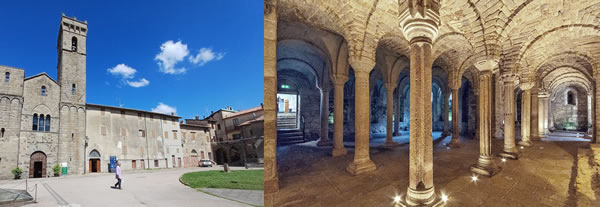
'Chiesa delle Colonne' (Church of pillars) or Abbey of San Salvatore (Siena, Italy)
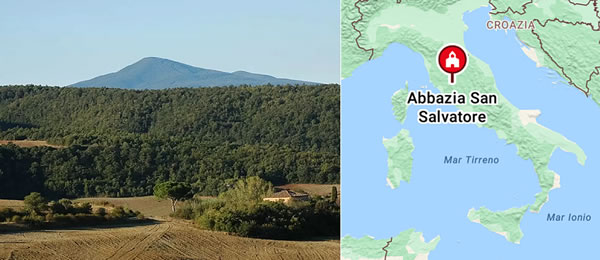
Mount Amiata and location of the nearby Abbey of San Salvatore (Siena, Italy)
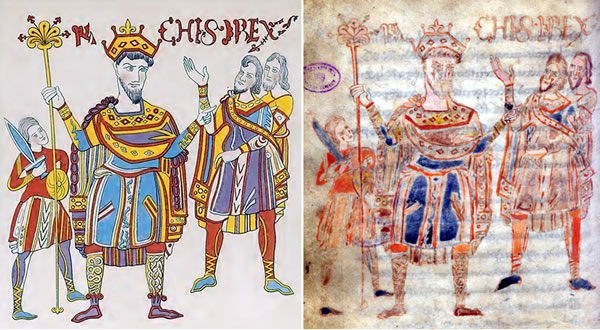
The start of Ratchis' laws in a codex of Lombard law from Benevento, c. 1005 - Cava de' Tirreni, Biblioteca della Badia.
This page was last edited on 14 March 2026
© andmorestory.eu - All right reserved