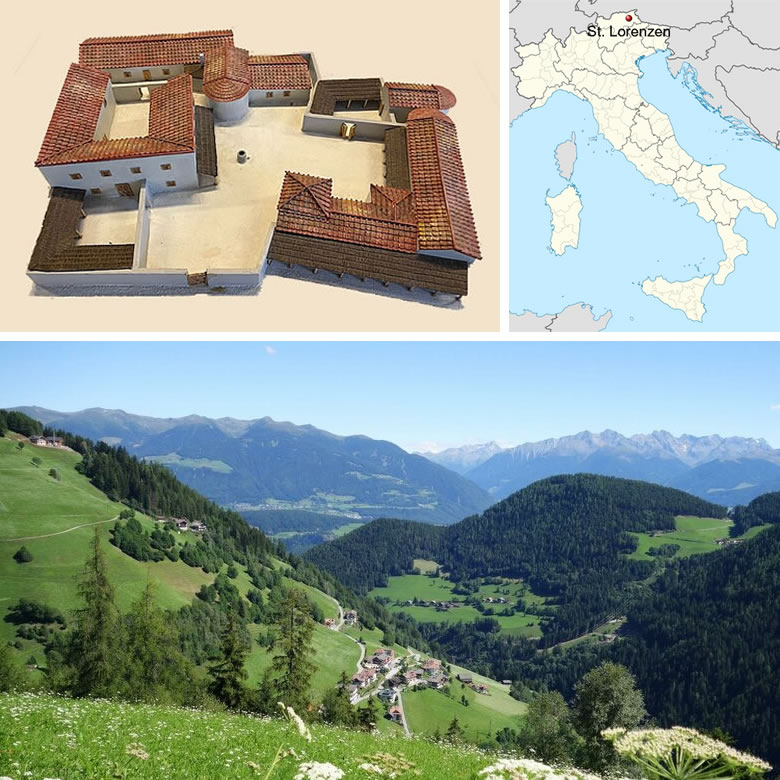
The Mansio Sebatum (Lorenzen, Bolzano, Italy)

In 1934, during roadworks in St. Lorenzen (San Lorenzo, near Brunico), a Roman settlement was accidentally discovered along an important Roman road that crossed the Puster Valley, although some of its structures were destroyed. This was an ancient Roman mansio. Given the archaeological evidence found, four years later new systematic excavations were carried out, revealing a villa rustica, a market (macellum), and nearby the remains of residential buildings, some rooms of which were used for agricultural purposes.
Between 2001 and 2002, two large burial areas were brought to light: 82 tombs, which can be classified into three types: masonry cist graves, cremation urns, and inhumation tombs. Based on traces of wood fibers and the morphology of some pits, it can be hypothesized that some individuals were buried in sarcophagi made from tree trunks (so-called Baumsärge), while others were buried in wooden coffins. In 2008, a Roman-era tombstone was discovered by chance, a commemorative stele dating to around 100 AD:
TI(berius) CR[ISPVS?] / TI(berii) F(ilius) I(H?) / IIVIR / IVLIAE TI(berii) FIL(iae) [VXORI?] / ET TI(berio) VIRITIO / ET G(aio) VIRITIO / VOLVSIAE / P
Tiberius Cr[-], son of Tiberius I[-] (or H[-]), II vir iure dicundo, had this funerary monument made during his lifetime for himself, his wife Iulia, daughter of Tiberius, for Tiberius Viritius, Gaius Viritius, and for Volusia, daughter of Gaius [...]
All the artifacts unearthed over the years – pottery, coins, and everyday objects – are now preserved in the Mansio Sebatum Museum in St. Lorenzen.
The Latin term mansio (plural: mansiones) derives from mansus, the past participle of manere, meaning "to stop" or "to remain." In the Imperial era, it referred to a stopping station along a Roman road, but it was often used to define the entire settlement that grew up around such a station. The mansio was managed by the central government and placed at the disposal of dignitaries, officials, or those traveling on state business. Identification of guests was made possible by documents similar to passports. Permanent military camps or even towns often sprang up around mansiones.
Mansiones were not intended for legionary stops; legions were able to provide both lodging and provisions on their own. They carried an entire baggage train (impedimenta) and built their own camp (castrum) each evening along the roadside. Instead, the hospitality offered by mansiones was limited to official use. The purpose of these stations was to guarantee suitable accommodation in a structure entirely dedicated to travelers on official business.
For the Roman Empire, these stations were vitally important for colonizing new provinces and extending its territorial dominion. As true masters of road construction, the Romans not only built a dense network of roads but also created complex structures at key junctions, including buildings for travelers (such as baths, stopping stations, and horse-changing posts), lodgings for postilions, and settlements for residents, who at the time lived mainly by farming.
The main roadside stations were on average 40 km apart, and every 17 km there were minor stations for changing horses, complete with rudimentary shelters. In reality, the term mansio for a stopping station and mutatio for a horse-changing post only came into common use starting from the 4th century AD.
In antiquity, message transmission systems were based on the use of couriers:
• In Egypt, it was established as early as around 2400 BC to disseminate royal edicts throughout the state;
• In the Persian Empire, from the 4th century BC, there is documented evidence of a postal service (in Greek, angaréia) whereby public authorities requisitioned forced services from the population for a relay system with couriers and horses stationed along the royal roads;
• Among the Hellenistic states, many poleis used official couriers called hémerodromoi (from heméra, day, and the verb "to run");
• In the Roman Empire, initially, there was the cursus publicus, while later the transport of important or confidential messages was handled by the frumentarii. Messages were information, orders, etc., initially written on wax-coated bone or metal tablets, then on papyrus scrolls with vegetable inks.
The cursus publicus or fiscalis was a public postal service consisting of a fast service with light horse-drawn carriages (rhedae) and a regular service with two-wheeled carts (birolae) pulled mainly by oxen. It is defined as public in the sense that this service was for the exclusive use of the State, which, tailored to military and political needs, maintained continuous contact between the central government and the peripheral military and civil leaders of the provinces. Therefore, it was used by the emperor, high officials, governors, and military commanders.
Initially, it was overseen by the praetorian prefect, to whom the officials responsible for the various "postal districts" into which the entire Roman Empire was divided reported. Under Constantine, the praesides of the provinces were also involved. Tasked with supervising the service, they had under their command a magistrate (praefectus vehiculorum) dedicated exclusively to the postal office. He then provided everything necessary for the service's needs, from road pavement to bridges and local offices. An inspectorate office (curiosi) ensured everything was efficient. The central officials supervised the managers of the local postal offices (mancipes), who were entrusted with the local postal service. Under them was a large staff, consisting of subordinate employees (apparitores) and personnel assigned to specific services, such as the change of post horses (stationarii), animal handlers (hippocomi or muliones), veterinarians (mulo medici), cart controllers and repairers (carpentarii), and stable workers.
The public service guaranteed the transport of messages or letters via mounted couriers (stratores or veredarii sometimes with two horses, or with a horse and mule if the postal load was heavier than usual), with a regular daily service; the transport of travelers was via light vehicles pulled by horses or mules (cursus velox); for the transport of goods, heavy carts pulled even by oxen were used (cursus clablarius).
The State's organization of public assistance was particularly well-developed, especially in the imperial era, and could be used primarily by the numerous magistrates and government officials. It also extended widely to private individuals, either directly through special authorizations or indirectly through assistance related to general road traffic.
The operating costs of the public postal service, which also included the maintenance of Roman roads, were borne by local administrations and thus by the population. Under Hadrian, the imperial treasury took direct charge of the service.
The Latin word for "post" translates to positum (site, position) and designates the network of stations located along the consular roads. Indeed, the regularity of the service was initially ensured by public slaves or soldiers, then by a proper "corps" of couriers, on horseback (cursores) or in postal carts (angarii), who, along the most important roads and at specific intervals, delivered what they received to the next station as quickly as possible. Couriers traveled alone or in small groups; they were distinguished by the wide-brimmed hat (petasus) they wore for protection from rain and sun.
In the imperial era, the postal system developed parallel to the empire. From Augustus (63 BCE-14 CE) onward, the management of Roman postal offices was entrusted to the prefect (praefectus) , who provided for all service needs (roads, bridges, local offices). The central officials oversaw the managers of the local postal offices (mancipes).
Couriers performed their duty in relays at regular intervals (usually about ten miles) with a relay system and frequent horse changes at designated stations.
There were relay stations called mutationes, regularly placed every seven or ten miles (every ten or twelve in less populated areas), perfectly organized to handle horse, ox, or mule changes, with stable hands, veterinarians (equari medici), and equipped workshops for animal shelter and cart maintenance and repair. Consider that the average provision for each station was as many as 40 animals between horses and draft animals. They also satisfied every other service need, such as traveler refreshment or local policing.
There were larger postal stations called mansiones every six or eight mutationes. EThey offered lodging (cubicoli) to public officials and were genuine stagecoach inns placed a day's journey apart, with a station master (praepositus) overseeing all the numerous personnel, including, besides couriers, animal drivers or carriage drivers, the entire hotel staff for meals and overnight stays for travelers; with a bath complex, a retail shop, a small local shrine, a doctor, a police station; and, naturally, all personnel assigned to animals for their stabling and handling, sheds, and the mechanical workshop.
These lodgings were so well-equipped and complex that they sometimes became true local centers of collective life, becoming focal points for information and trade: often, settlements grew around them, or conversely, by inserting themselves into an existing cluster of houses, they became its determining part. The lodgings could be inserted among building complexes occasionally encountered along the route, such as sanctuaries or bathhouses, or even be part of imperial palatia or praetoria. Under the Severans, the mansiones were used for troop movements and the annona (grain supply) transport. The postal service was reorganized several times under Nerva, Trajan, Diocletian, Antoninus Pius, Constantine, and Valentinian I.
The costs related to the postal service were borne by local administrations: the ordo decurionum (the provincial senate of cities, municipalities, colonies) provided the funds needed for the service, distributing the expense among the citizens.
Private individuals were excluded from benefiting from this public postal organization and had to provide for themselves with their own means or through another private service if they had correspondence or shipping interests. Each person had to fend for themselves using their own "specialized" slaves (tabellarii) or by resorting to friends, merchants, or other passing travelers headed to the desired location.
Naturally, all this was rather complicated, uncertain, and costly, so it was not uncommon for several people to take turns making a slave available to all, who would travel a common itinerary until reaching the final destination.
However, the speed of the service in this case left something to be desired, since, for obvious economic reasons, one had to wait for a certain amount of mail to accumulate for the same destination. Cicero, a great user of the Roman postal service, confirms this for us, justifying the delay in his response to his brother Quintus as follows:
I have had this letter in my hands for many days awaiting the availability of the 'postmen'
Communications managed by private individuals saw wide development, although not as regulated and generalized, being based on individual initiative or its corporate services. Transport was handled, for example, by specific local guilds, with branches in various countries as needed, while the courier service for letters could be undertaken by personnel specialized in this sense.
One could use passing friends or guests, often merchants, or foreign couriers from places where the letters were not addressed. In the Roman world, men of rank had many political and social connections, so they maintained their own couriers, sometimes in considerable numbers. The magistrates themselves, for official correspondence, even though they had state couriers at their disposal, often preferred to use their own for reliability, who then traveled using public postal means.
As for letters, they were written on sheets of papyrus or parchment folded so that the written part remained inside (no type of envelope was used) and then tied with a cord and sealed. Cicero himself informs us that he received one in Cappadocia (in the heart of modern-day Turkey) from Rome in fifty days, while some of his correspondence sent, also from Rome, to his son studying in Athens sometimes took up to three months to reach its destination.
Private messengers were not allowed to stay in the mansiones, so they settled for lodging in the disreputable tabernae or cauponae, private inns built near the mansiones, to enjoy, as they warned, their protection or services.
To get an idea of message delivery times, consider that in antiquity, a common pedestrian traveler (pedestrian traffic was extremely intense then) could cover 25 to 30 miles per day (about 35-40 km, given a Roman mile equivalent to 1478 m): the journey along the Via Appia, from Rome to Brindisi, 365 miles, or 530 km, therefore required 13 to 14 days (Horace, in the journey recounted in his famous satire, took 13 days). Cicero recalls, with a fast guide service, hence with a light carriage, from Rome to Ameria, 88 miles, or 118 km, taking one night. The public postal service allowed, when needed, speeds that are still impressive today: Tiberius Nero, from Rome to Germany, took 5 days to cover 541 miles, almost 800 km.
Regarding the time taken for epistolary correspondence, we have, for example, some data offered by Cicero, via private service: a letter from Rome to Athens in 46 days; one from England to Rome in 83 days. Naturally, the public service was much faster: a letter from Trajan from Bithynia to Rama, i.e., from northern Turkey presumably through Thrace, Salò, the Balkans, Brindisi, 9 days.
This page was last edited on 21 March 2026
The Mansio Sebatum (Lorenzen, Bolzano, Italy)
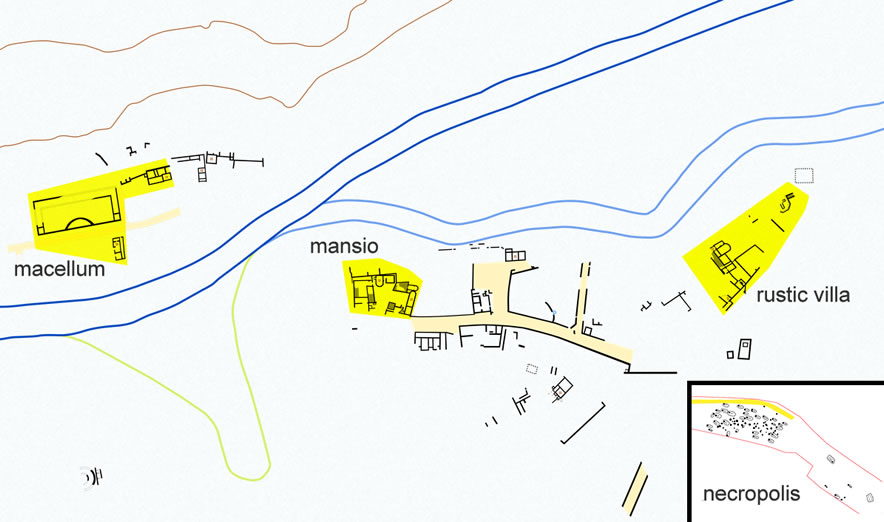
Map of Archaeological Area of Sebatum (Lorenzen, Bolzano, Italy)
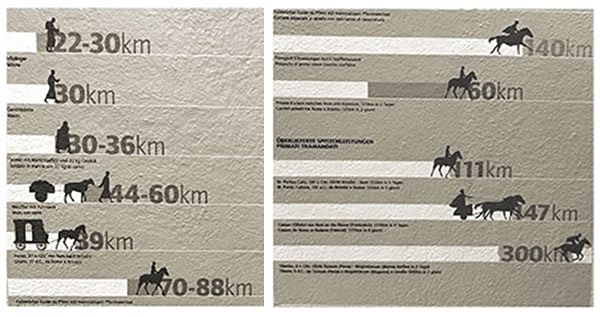
Travel times for distances in one day - panel in the Museum Mansio Sebatum (Lorenzen, Bolzano, Italy)
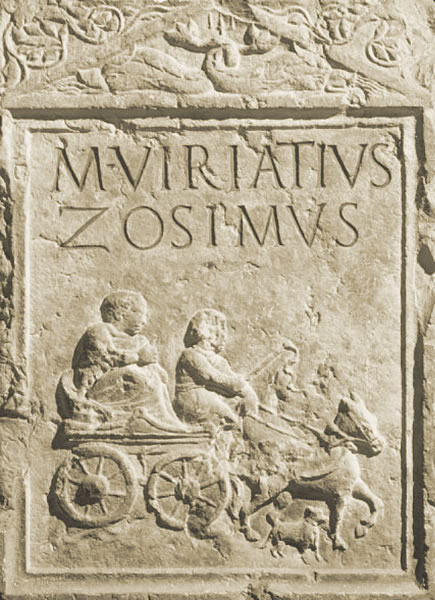
Funerary slab (1st century CE) belonging to a larger monument. The deceased is seated on a fast travel chariot (raeda) with a charioteer (auriga), a young man holding the whip and reins. The funerary monument was made by Viriatius Zosimus, a freedman, most likely for his master, who must have also been the commissioner. The stele has an ambiguous meaning, wavering between the depiction of a real-life scene, related to the deceased's profession, and a journey to the world of the dead. The scene is depicted within the epigraphic field and below the inscription. Between the legs of the horse pulling the chariot, a small dog is represented. Above the epigraphic field, there is a pediment framed by a flat band moulding and decorated inside with two opposing dolphins intertwining their tails around a central trident. - Archaeological Museum, Verona, Italy
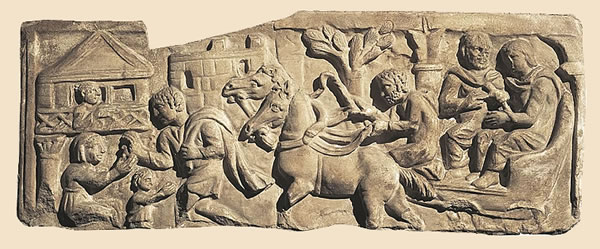
Fragment of a sarcophagus depicting the arrival of a traveling carriage at a post station: on the horse-drawn carriage, driven by a coachman, two travelers are seated, while an outrider precedes them to book the hotel, which is depicted on the left—a two-story building with a front colonnade and a balcony (National Roman Museum, Rome) - The Mansio Sebatum (Lorenzen, Bolzano, Italy)
© andmorestory.eu - All right reserved