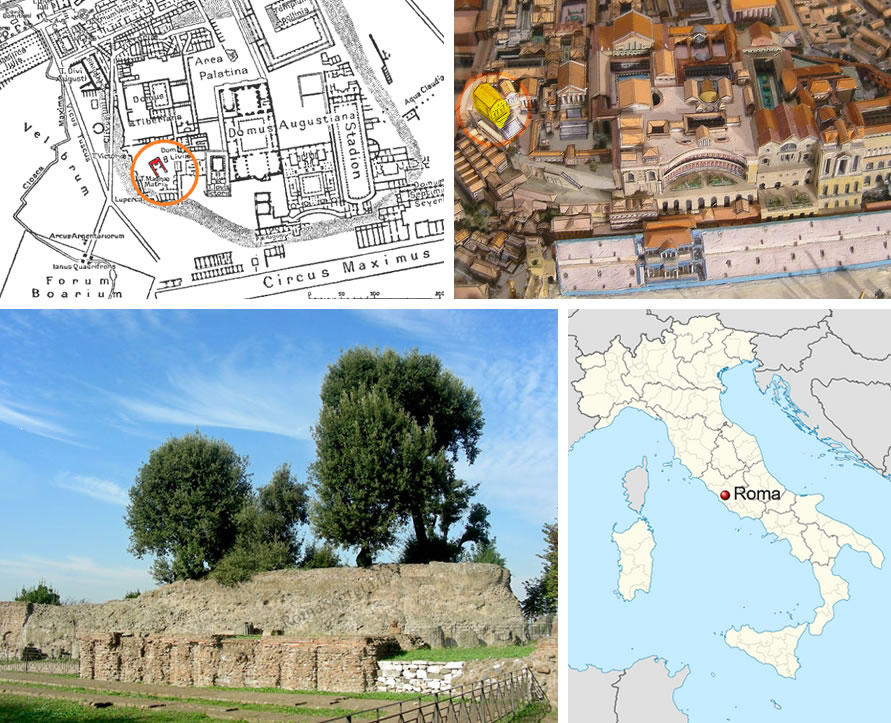
Location of the Temple of Magna Mater on the Palatine Hill and its remains

Villa Medici was one of the most beautiful Renaissance villas in Rome. It stands on the Pincian Hill, overlooking the Eternal City. It is located in a place that has held great historical value since antiquity. Initially, the area was inhabited by the Etruscans, who built a temple there dedicated to the deities of Fortune and Hope. Later, in Roman times, the Roman general Lucullus (117–56 BCE) built his vast and luxurious residence on this site, of which a network of underground cisterns remains today, known as the Horti Luculliani. The ancients compared this villa to a dwelling of the gods.
With the expansion of the Empire, Lucullus's estate passed through various owners. The villa was so beautiful that the Empress Messalina fell in love with it; to acquire it, she had its new owner condemned and killed. But the villa brought her no luck: it was precisely there that Messalina, just twenty years old, was executed on the orders of Claudius.
The villa, having become imperial property, was later sold back to private owners. By the end of the 4th century, the owners were the Pincii family, from whom the hill derives its name (Pincian Hill). During that period, the Western Roman Emperor Honorius (384–423 CE) decided to build a palace on the hill to reassert his authority over Rome after the city was sacked by Alaric in 410. Emperor Honorius seems to have stayed there in 403–404 CE, when he came to Rome to celebrate his triumph over the Visigoths, as did the general Belisarius.
After the 6th century, the villa fell into a state of neglect. It was during the Renaissance (c. 1400–1550) that the Crescenzi family built a structure on the remains of the ancient estate, which had been turned into a quarry for recycled stone, using it as a foundation for the current residence.
In 1564, Cardinal Giovanni Ricci of Montepulciano (1497–1574) purchased the property, which at the time was merely a vineyard with a small building used for summer stays. Work began to transform the small house into a residence. He initiated the first modifications, entrusting the architects Nanni di Baccio Bigio and Giacomo della Porta with the project; Michelangelo is also believed to have collaborated. The cardinal's nephews, who inherited the villa, further renovated and embellished it.
In 1576, Cardinal Ferdinando de' Medici (1549–1609) acquired the villa. At just 26 years old, he was a passionate collector. He commissioned the sculptor and architect Bartolomeo Ammannati, a friend of Michelangelo, to enlarge and beautify the existing buildings and gardens in order to display his prestigious collection of ancient marbles, which he had just acquired. These were joined by the statues and bas-reliefs that emerged during the villa's expansion. In 1584, the cardinal acquired the prestigious collection of antiquities belonging to Cardinal Andrea della Valle, which included numerous bas-reliefs. He then commissioned Ammannati to set the reliefs into the facade facing the gardens. Arranged symmetrically around the three Serlian windows of the loggia, these bas-reliefs date back to the 2nd and 3rd centuries and reflect the Renaissance taste for antiquity, paying homage to Roman sculpture of the imperial era.
On the central section of the facade, two ancient Roman reliefs can be admired. They depict the Temple of the Mother of the Gods on the Palatine – Magna Mater, or Cybele (Aedes Matris Magnae). One relief shows victimarii (sacrificial attendants) leading a bull toward the temple (perhaps from the Ara Gentis Iuliae). The other depicts the temple as Corinthian and hexastyle, with a high staircase and no columns on the sides (prostyle), dating to the age of Emperor Claudius. Also visible are decorations featuring rounded acanthus leaves.
The acanthus plant (from the Greek akanthos: ak- "sharp, pointed, piercing" and anthos "flower") is a plant with large, spiny leaves. It entered the world of art as a striking decorative element. Two rows of acanthus leaves adorn the capitals of columns as a distinctive motif of the Corinthian order. Its inclusion in the capital, and therefore the invention of the Corinthian order, is attributed by Vitruvius (IV, 1, 10) to Callimachus. Around 415 BCE, according to tradition, Callimachus saw a cone-shaped inverted basket accidentally covered with such leaves on the tomb of a young girl in Corinth. This vision inspired the essential elements of his invention.
The remains of the Temple of Cybele have been securely identified among the archaic huts and the Domus Tiberiana, near the House of Augustus. Here, both the statue of the goddess and an inscription on the right side of the facade were found, reading: M(ater) D(eum) M(agna) I(daea).
The surviving foundation of the temple most likely relates to the original construction, built in very rough opus incertum, with later restorations in nearly reticulate work related to repairs for damage sustained in 111 BCE. Also dating to this phase are several peperino columns now lying near the podium, while the Corinthian capitals and fragments of the pediment date to the Augustan age.
The temple was built as a result of the very difficult period of the Second Punic War (218–202 BCE), which had led the Romans to feel persecuted by the gods. The war lasted sixteen years and was initiated by the Carthaginians, who aimed to recover the military power and political influence they had lost after their defeat in the First Punic War. Historians consider it the most important armed conflict of antiquity due to the number of peoples involved, its economic and human costs, and above all the decisive historical, political, and social consequences for the entire Mediterranean world. Some scholars even regard it essentially as the first world war in history, at least concerning the Mediterranean area. Unlike the First Punic War, which was fought and won essentially at sea, the Second was characterized above all by great land battles.
Rome, although ultimately victorious, paid a heavy price for the long conflict and was forced to draw on all its resources of men and money. The war effort was extremely burdensome, both economically and civilly: for years, entire Italian regions were plundered and devastated by continuous military operations, with enormous damage to agriculture and trade, which remained blocked for a long time. Nearly 8% of the Italic population (200,000–300,000 men) died or were reported missing.
According to Florus, the conflict proved so harsh that the victorious people were not so different from a defeated people (Florus, I, 22.1). Meanwhile, Appian of Alexandria adds that as many as four hundred cities were destroyed by Hannibal (or otherwise came under Carthaginian control); some of these were set on fire and razed to the ground, many were conquered by both sides with all the consequent suffering; entire populations were eventually deported en masse.
The Romans felt abandoned by the gods. Therefore, among the various attempts to regain divine favor, they decided to introduce the cult of the Great Mother, Cybele, into the city (204 BCE) after consulting the Sibylline Books – a collection of oracular responses written in Greek and kept in the Temple of Jupiter Optimus Maximus on the Capitoline Hill. The response was that to drive the foreigner from Italy, it was necessary to bring to Rome the Magna Mater, the deity venerated at Pessinus in northern Asia Minor, in the form of a black stone, likely a meteorite. An embassy sent by the Senate to the sanctuary obtained the delivery of the statue, which was brought to Rome by ship and temporarily placed in the Temple of Victory on the Palatine, of which only scant remains survive, once located in the southwestern corner of the hill, near the current podium of the Temple of Cybele.
Thus, in 204 BCE, construction began on the same hill of the temple dedicated to the Magna Mater, and it was completed in 191 BCE. On the occasion of its dedication, which took place on April 11, the Ludi Megalenses (Megalensian Games) began, for which Plautus and Terence wrote some of their most beautiful works.
The cult could be established directly within the city's pomerium (sacred boundary) because the goddess Cybele originated from the Troad, the ancient region of Anatolia where the ruins of the city of Troy lie – the mythical homeland of the Romans, with Aeneas as their direct ancestor, connected to Romulus. The temple burned twice: first in 111 BCE, after a fire, when it was restored by a Metellus (probably the former consul Gaius Caecilius Metellus Caprarius); and again in 3 CE, when it was rebuilt by Octavian Augustus.
This page was last edited on 21 March 2026
Location of the Temple of Magna Mater on the Palatine Hill and its remains
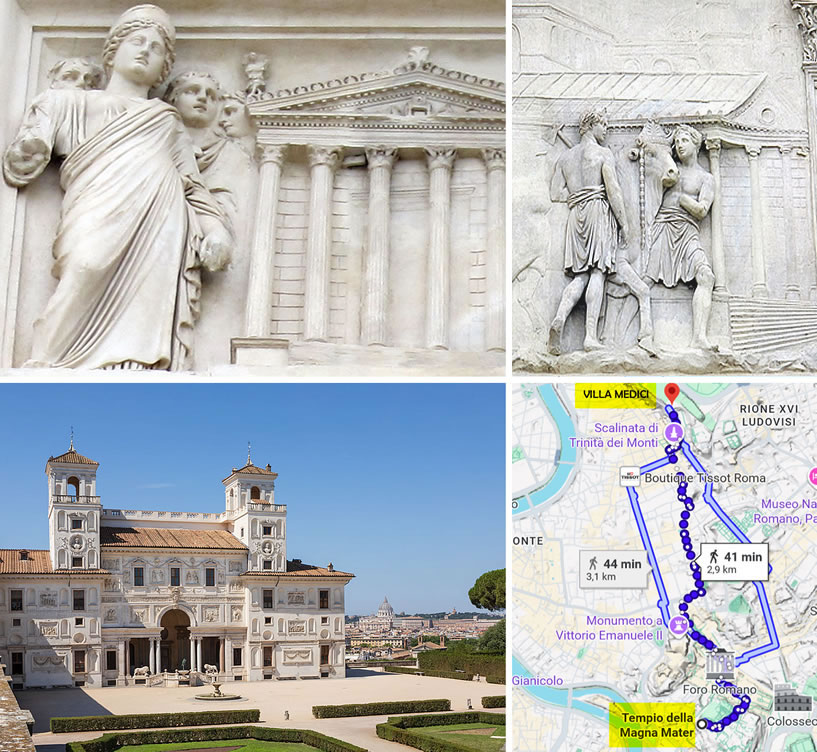
Reliefs depicting the Temple of Magna Mater on the facade of Villa Medici, Rome, Italy: the temple is depicted as Corinthian and hexastyle, with a high staircase – victimarii leading a bull toward the temple (perhaps from the Ara Gentis Iuliae)
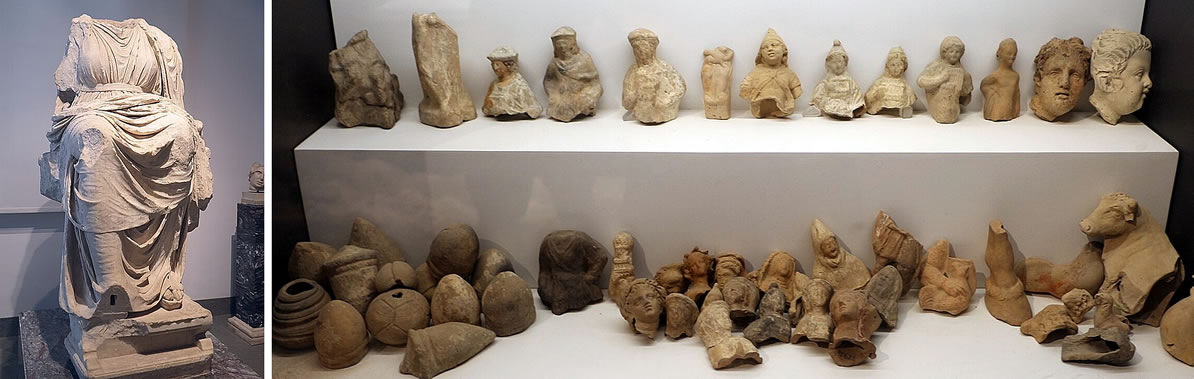
Votive deposits, c. 210–100 BCE – Palatine Antiquarium, Rome, Italy – Headless statue of the Magna Mater found near the temple, now housed in the Palatine Museum
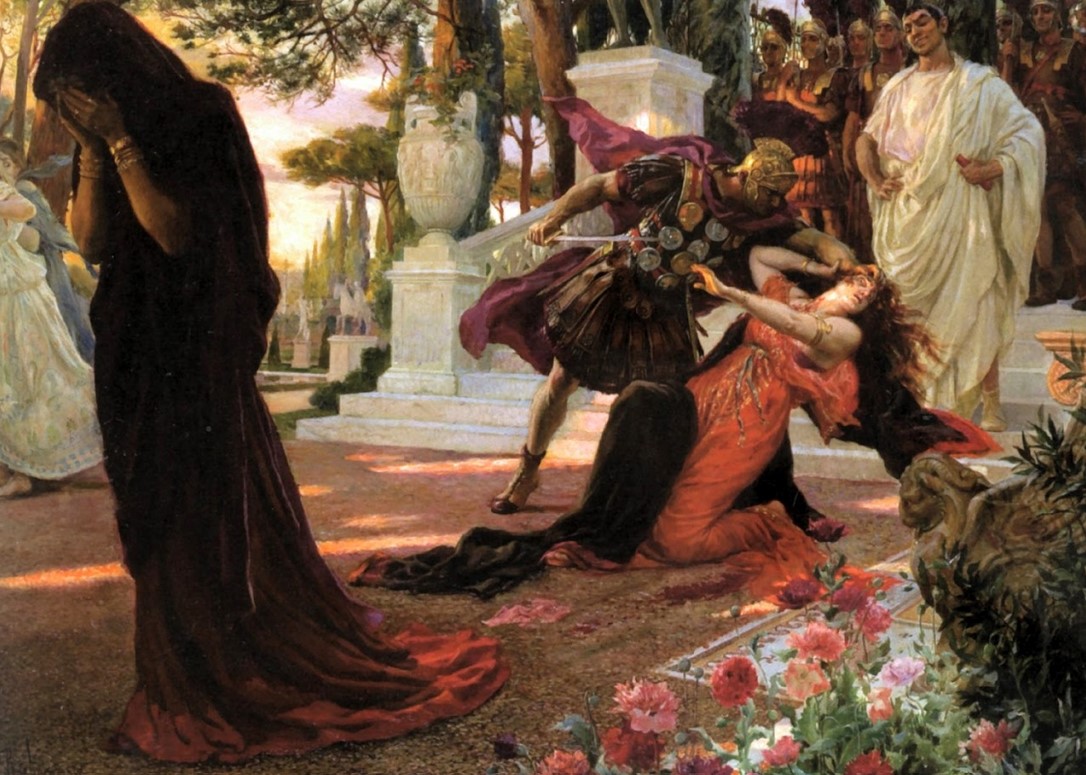
The Death of Messalina 1916 by Georges Antoine Rochegrosse
© andmorestory.eu - All right reserved