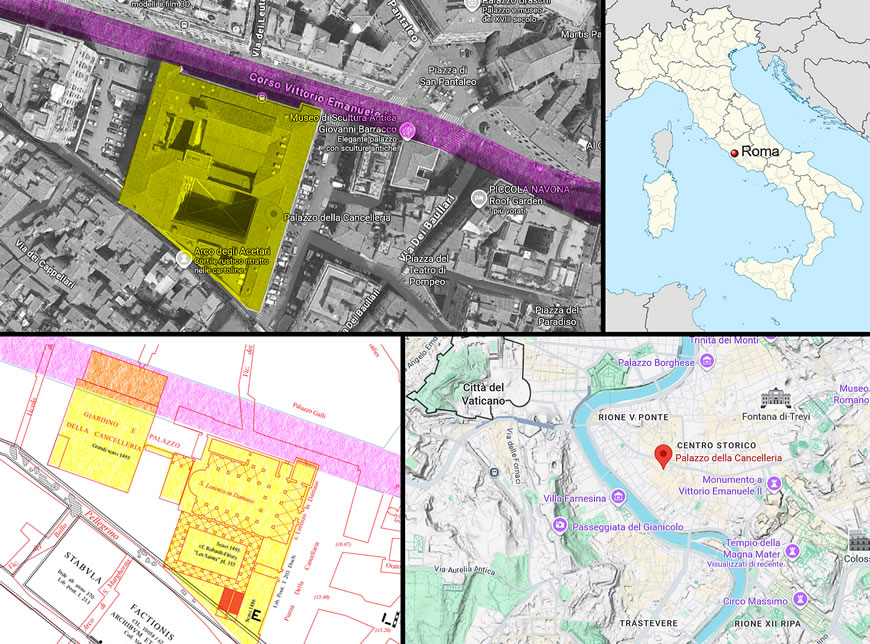
Location of the Palazzo della Cancelleria

The Palazzo della Cancelleria Apostolica (Palace of the Apostolic Chancellery) is located in the area of the ancient Campus Martius in the center of Rome. Although it stands on Italian soil, it is as if it were part of Vatican territory. Indeed, as the exclusive property of the Holy See, it enjoys the immunities granted to foreign embassies as an extraterritorial zone of the Holy See.
The palace was designed and built between 1486 and 1496 at the behest of Cardinal Raffaele Riario (1461–1521), the nephew of Pope Sixtus IV. A lover of the arts and a patron, Riario is primarily credited with initiating Michelangelo’s activity in Rome. It is said that the cardinal managed to complete the building’s construction thanks to his winnings from a single night of gambling with Franceschetto Cybo, the naturally born (and fully legitimated) son of Pope Innocent VIII. According to Vasari, Donato Bramante took part in the work, which involved the demolition of a pre-existing church (later rebuilt and incorporated into the new building). Most of the construction materials came from the ruins of the nearby Theater of Pompey, including the columns reused for the portico of the inner courtyard, considered one of the most beautiful of the Renaissance.
In 1517, a group of cardinals plotted to kill Pope Leo X, the first Medici pope, and replace him—according to some sources—with Riario himself. The alleged conspiracy was discovered, however, providing the pope with a pretext to indict his most formidable adversaries. Cardinals were arrested; some were executed, while others, like Riario, were imprisoned in Castel Sant’Angelo, stripped of their cardinalate, and deprived of numerous benefices. His palace was confiscated and became the seat of the Apostolic Chancellery, which to this day—over 500 years later—houses the tribunals of the Holy See.
In 1937 and 1939, during work to reinforce the palace’s foundations, numerous remains of structures, mosaics, inscriptions, statue fragments, sarcophagi, and reliefs—dating from the Republican era to the 15th century—were accidentally brought to light in the basement.Among the various discoveries was a tomb partially submerged in the waters of an underground artificial lake, formed by the obstruction of a man-made channel called the Euripus. This channel originally crossed the Campus Martius area, ran alongside the Palace of the Apostolic Chancellery, and connected the Stagnum Agrippae to the Tiber River near what is now Vittorio Emanuele II Bridge. The Euripus served to regulate the water level of the Stagnum Agrippae, a natatio (a type of swimming pool with a purely decorative function, of garden landscaping) located on the western side of the Baths of Agrippa and fed by the Aqua Virgo—the same Roman aqueduct that would later supply the Trevi Fountain. The channel’s outflow was obstructed by the construction of the Tiber embankments at the end of the 19th century, contributing to water stagnation and the formation of the lake beneath the Palace of the Apostolic Chancellery, which has also been fed by the water table.
The tomb, partly cut through by the palace’s foundations, consists of a square enclosure (6 meters in length) with a tufa base, a brick wall, and a double-pitched travertine roof. Several boundary stones marking the funerary area bear the name of the consul Aulus Hirtius (90–43 BCE), a Roman military commander, historian, and politician who assumed the consulship after the assassination of Gaius Julius Caesar—for whom he had served as legatus (a deputy commander of a legion in place of a consul). He died alongside his colleague Vibius Pansa at the Battle of Modena against Mark Antony in 43 BCE. After the heroic deaths of the two consuls, the Roman Senate decreed that two public tombs be built for them in the Campus Martius. Vibius Pansa’s tomb should therefore be located nearby.
Furthermore, leaning against the tomb, several carved marble slabs from the
Between 1988 and 1991, further excavations were conducted beneath the palace courtyard, revealing foundations from the 4th and 5th centuries of the great Basilica of San Lorenzo in Damaso, founded by Pope Damasus I—one of the most important early Christian churches in Rome. In addition, an adjacent cemetery was identified, in use from the 8th century until shortly before the palace’s construction.
The reliefs found beneath the Palace of the Apostolic Chancellery were part of the decoration of a public monument dating to the reign of Domitian (81–96 CE).
• Relief 1 depicts the arrival (adventus) of Emperor Vespasian in Rome, welcomed by a togate figure, likely his son Domitian. The scene includes the Genius of the Senate and the Genius of the Roman People, while on the left are the Vestal Virgins and the seated goddess Rome.
• Relief 2 shows the departure (profectio) for a military campaign. The emperor, preceded by Minerva and Mars, advances accompanied by the goddess Rome, the Genius of the Senate with a scepter, and the Genius of the Roman People with a cornucopia. On the left, the wing of a Victory is visible, alluding to the success of the undertaking. The face of Emperor Domitian was reworked as Nerva following the damnatio memoriae that came after his violent death.
The marble relief found in the garden near the sepulchral enclosure of Hirtius is 1.04 meters high and approximately five meters long. Given its size, it must have served as the base for an altar or a statue group. It features a figurative frieze bounded above and below by pod and Lesbian kyma motifs. It depicts (at the top) a religious scene with four camilli (young attendants), heads covered and feet bare, three of whom carry in procession the statuettes of the Genius and the two Lares. What the fourth camillus (whose head and both hands are missing) carried is unknown. Below, on the left, is the Mithraic altar, and on the right, a detail of the relief with the Vicomagistri, reminiscent of the procession on the Ara Pacis. The relief dates to the early Julio-Claudian period, when the institution of the Vicomagistri was at its height—specifically the early Tiberian age, between approximately 20 and 40 CE.
Observing it closely, the procession is led by two togate figures, one holding a rotulus (scroll), the other an object now broken off, perhaps a patera (sacrificial bowl). In the background, at a very low relief, are three lictors. Returning to the foreground, two attendants in tunics and three trumpeters follow. Then comes the substantial group of victimarii, with three sacrificial animals: a bull, a steer, and a cow. Among the figures are recognizable those carrying an axe, a hammer (malleus), and a knife—the three instruments of sacrifice. In the background, behind the first animal, an attendant carries a ram’s head on a tray, perhaps alluding to a previous sacrifice (a piaculum), while another bears a situla (bucket).
The next group is a procession of togate figures, with a tibicen (flute player) and a lyricen (lyre player). The figures in the background have laureate heads, while those closing the procession in the foreground are magistrates in togas and high calcei shoes, dressed similarly to the two leading figures.
Remaining are the four figures among the togate ones, who are barefoot, wearing short, unbelted tunics, with their heads covered by a ricinium. These are pueri riciniati—young men who have not yet assumed the toga of manhood. On three of the surviving heads, a short beard is also visible. These figures hold a scroll, statuettes of the Lares, and a statuette of the Genius Augusti.
The interpretation of the entire scene has been made possible by ancient sources and crisons with similar works. It is clearly a sacrificial procession, opened by two magistri vici (who had taken office that year), accompanied by lictors bearing the insignia of their (fictitious) power.
This page was last edited on 21 March 2026
Location of the Palazzo della Cancelleria
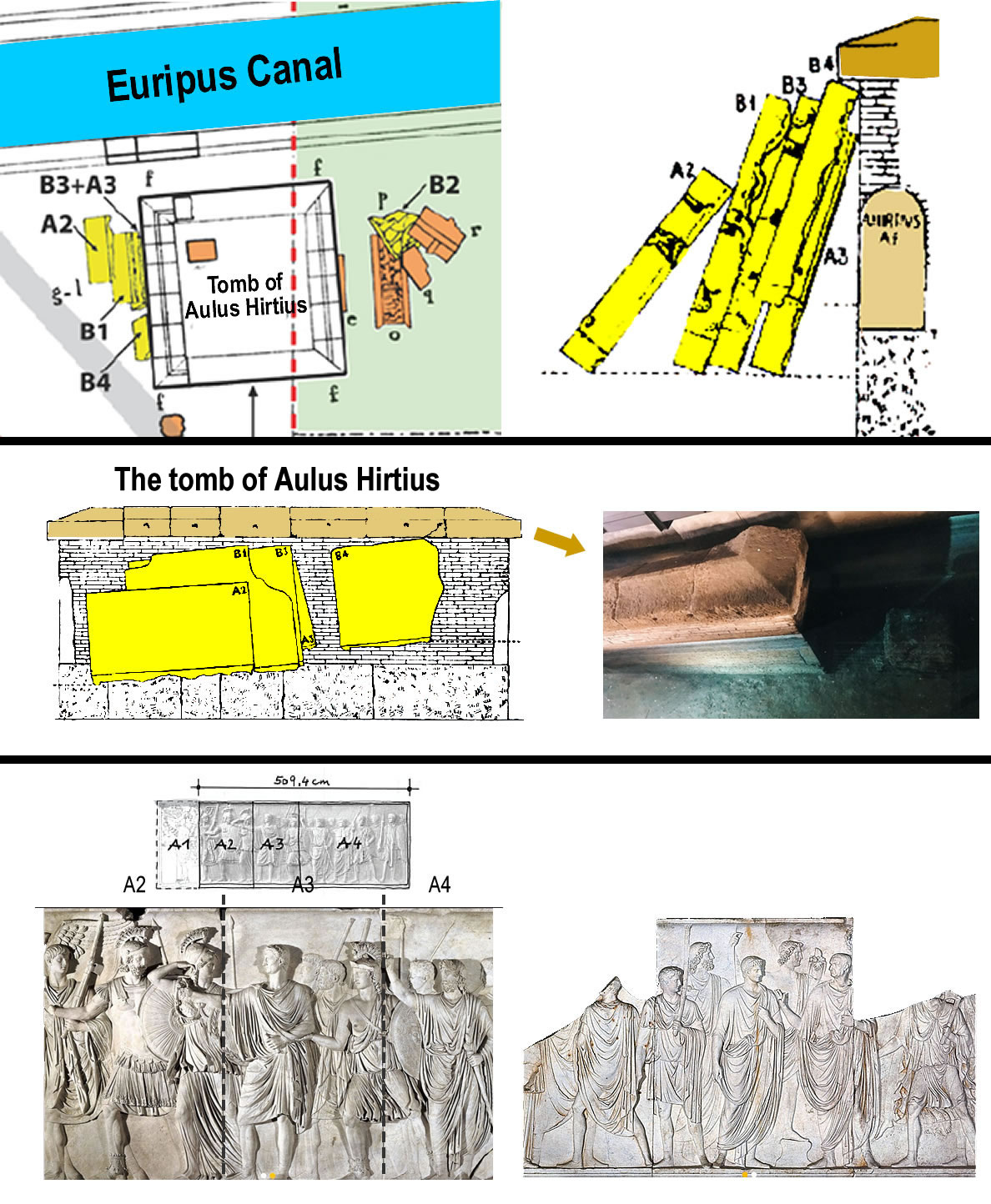
Part of the sepulcher of Aulus Hirtius, partially submerged by the water of the Euripus canal, Rome, Palazzo della Cancelleria – Cancelleria reliefs (profectio and adventus)
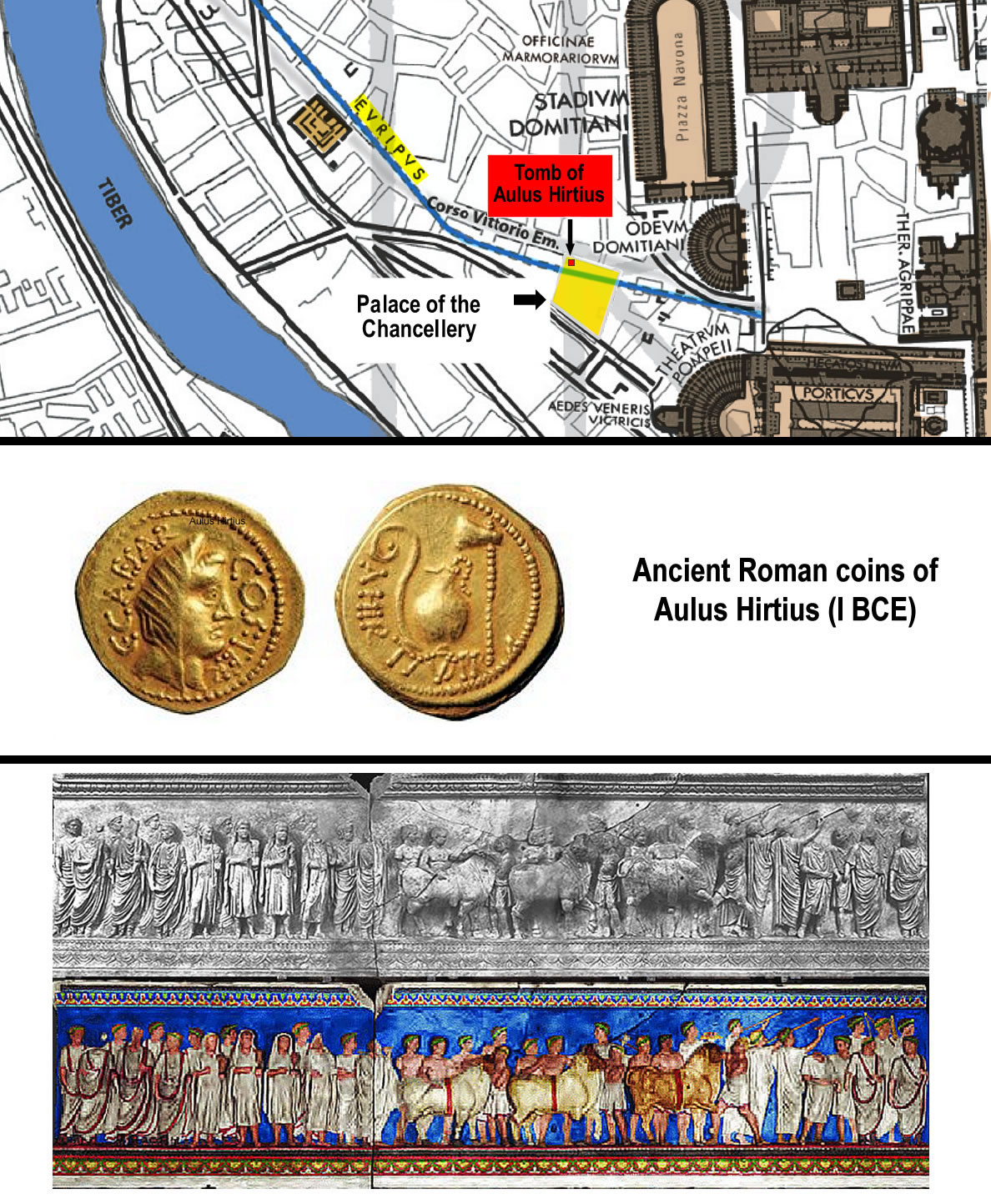
Coin of Aulus Hirtius (1st century BCE) – Marble base of the Vicomagistri (c. 20–40 CE) – Vatican Museums, Rome
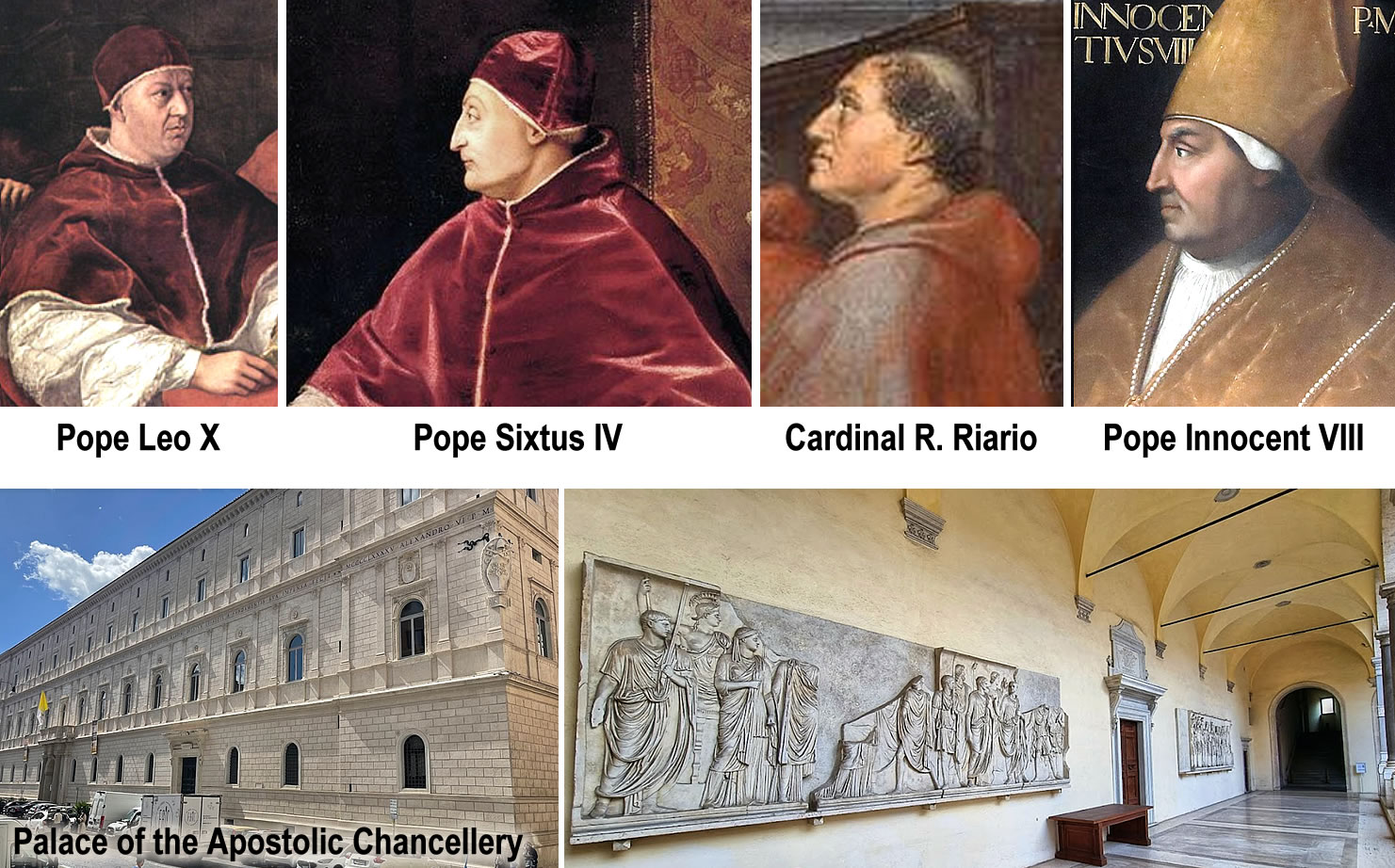
The Palazzo della Cancelleria and Its Key Figures
© andmorestory.eu - All right reserved