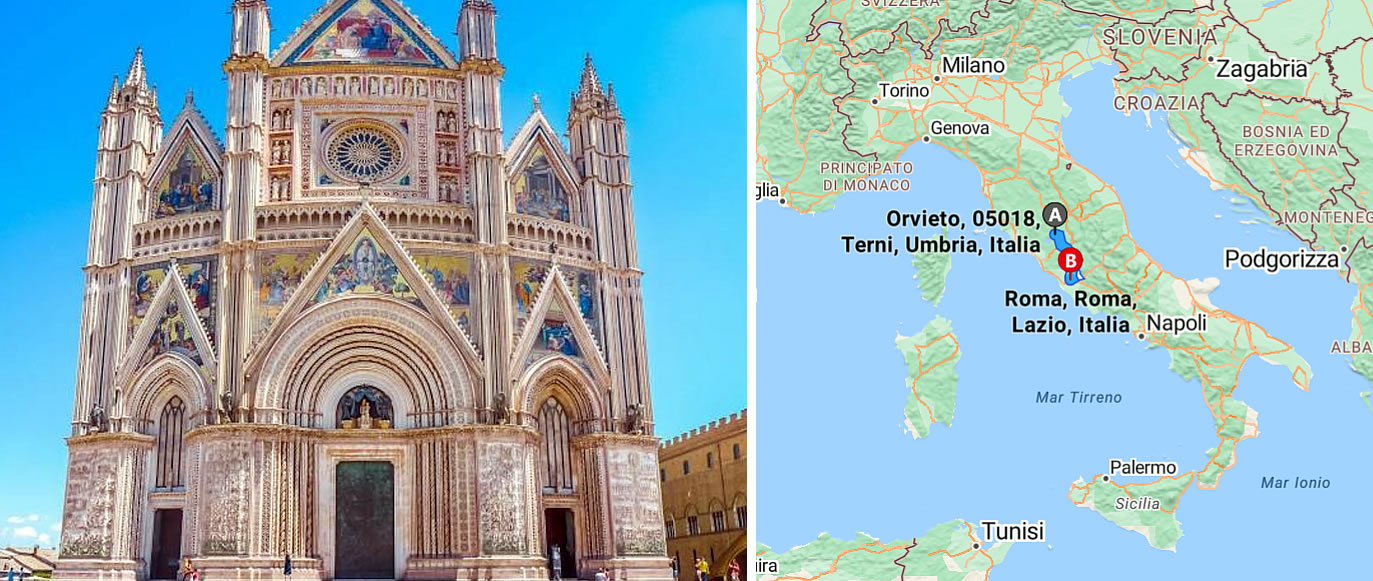
Cathedral of Orvieto - Map with Orvieto and Rome

From the earliest times until the end of the nineteenth century, small boats could navigate from the river's mouth and travel upstream along the Tiber for a long distance, thanks to the modest flow of the river and the regularity of its water level in every season. Merchants from the sea and those from inland populations met near the Tiber Island, a natural ford on the river, even before the founding of Rome (753 BCE).
We can imagine how many goods passed through here in antiquity, as well as during the Middle Ages when Rome's monuments were stripped. A great deal of architectural material was loaded onto rafts and transported to new construction sites for churches and Roman palaces, or to other locations in Italy. An example is the transport of marble and travertine necessary for the construction of the Duomo in Orvieto, which traveled over 100 km up the Tiber River.
Over time, loads often shipwrecked along with the boats transporting them, becoming true wrecks hidden by the riverbed silt, which surfaced during the Tiber dredging. Here are some examples:
Art historian Hans von Hülsen wrote:
If the Tiber were drained today and thoroughly explored with every caution, it would be revealed as a great warehouse of ancient works of art of every kind.
Today, many of the artifacts accidentally found on the bottom of the Tiber River are visible at the National Roman Museum. Among them, there are many that come from the depths around the Tiber Island, where the Temple of Asclepius was located. Those who received grace from Asclepius would make votive offerings (reproductions in terracotta or stone of the diseased body parts that were believed to have been healed), duly inscribed and hung on the walls of the temple as a sign of their gratitude.
The custom of offering anatomical ex-votos to the gods, to invoke their help in times of particular need, or to thank them for favors received, is attested in all civilizations. Already in Crete during the First Palace period, ex-votos reproducing parts of the human body appeared. In Greece, they were especially dedicated to Asclepius, in the god's sanctuaries in Athens, Epidaurus, and Cos.
In Italy, especially in Etruria and Rome, this practice developed in the 4th-3rd century BCE. The oldest terracottas found near Tiber Island, dedicated to the god Asclepius, are dated to the 3rd century BCE. These ex-votos depict external body parts such as eyes, ears, breasts, phalluses, hands, feet, and internal parts such as intestines and uteri. Generally, it is noted that for external parts the reproduction is faithful, as the artist could easily observe the human body; however, when internal organs are depicted, anatomical accuracy is altered.
The Basilica of St. Bartholomew on the Tiber Island (Basilica S. Bartholomaei in Insula) is a titular minor basilica, located in Rome. It was founded at the end of the 10th century by Otto III, Holy Roman Emperor called the bloodthirsty. It contains the relics of St. Bartholomew the Apostle, and is located on Tiber Island.
Between 2006 and 2007, an archaeological excavation was carried out in the area of the crypt with six columns of the church. Approximately 3.50 meters below it, two rows of large tuff blocks were discovered from one of the temple courtyards. In the center of this area (as it still is today), there was a marble well that reaches a water vein at approximately 9 meters depth. The decorated well in the early medieval period establishes continuity with the source of health-giving water in the ancient temple.
The excavation has identified for the first time the remains of the sanctuary of Asclepius inaugurated in 289 BCE. It was one of the most important sacred sites of Repubblican and Imperial Rome of which all trace seemed lost.
The marble well is nine meters deep and the water level rises depending on the seasons. We know that it was made to embellish by Otto III.
Asklepios (Asclepius) was adored by the Greeks as the god of medicine. He was also the patron god, and reputed ancestor, of the Asklepiades (Asclepiades), the ancient guild of doctors. His sons, Machaon and Podalirius, treated the Greeks during the siege of Troy.
According to legend, Asclepius was the son of Apollon and the Trikkaian (Triccaean) princess Koronis (Coronis) and daughter of the mythical king of the Lapiths, Phlegyas. His mother died in labour and when she was laid out on the pyre, Apollon cut the unborn child from her womb. From this Asklepios received his name which means "to cut open." But, according to the legend, when Koronis was pregnant, Apollon left a corvus , the crow (korônê in Greek) to guard her so that no one would approach her, but during his absence, she met Ischys and allowed herself to be loved. The corvus flew to Apollon to report. The god, offended, decided to change the color of the corvus' feathers from white to black and killed her with an arrow (in another version, he had her killed by the goddess Artemis, Apollon's sister). Hermes extracted the small Asclepius from her womb, and his father entrusted him to the centaur Kheiron (Chiron) who instructed him in the art of medicine.
Having become a true master in the practice of medicine, he dared to bring the dead back to life, and Zeus, enraged, struck him down with a lightning bolt for having violated divine laws. After his death, Apollon asked Zeus to place his son among the stars. Thus, Asclepius and the serpent were placed in the sky, depicted in the constellations of Ophiochus (the Serpent Holder).
The other attributes of Asclepius were the book scroll, the bundle of poppies, and the serpent. According to legend, a serpent brought him the miraculous herb that was used to resurrect Hippolytus, the son of Theseus. There are several reasons why the serpent was chosen as the symbol of the god Asclepius:
He began to be worshiped as the god of medicine, whose primary attribute was the staff with a serpent coiled around it, a symbol that has become associated with the medical profession.
In the Iliad, Homer refers to Asclepius as Amymonos, which in Greek means infallible, without blemish.
According to the author, he was mortal and was trained in the medical arts by the centaur Chiron.
He was born in Epidaurus in the Peloponnese, where his cult became established, and where a school of medicine was founded. Although it was still anchored in magical practices, this school laid the groundwork for a more scientific discipline.
In ancient Greece, it was believed that simply sleeping in a sanctuary dedicated to Asclepius could cure any illness. Every temple had at least one serpent, which came from the sanctuary of Asclepius in Epidaurus, where his priest-physicians practiced their art and raised serpents. These serpents were considered sacred animals to the deity, symbolizing renewal, as the serpent changes its skin. Killing a serpent in a temple of Asclepius was considered a great sacrilege.
No new temple dedicated to him in the pan-Hellenic world could be without a serpent from Epidaurus, as it was believed to personify the god of medicine.
The same occurred in Rome, where the god, known to the Romans as Aesculapius, arrived in the form of a serpent. This legendary event is said to have happened following the outbreak of a terrible plague in 293 BCE. After consulting the Sibylline Books, the Roman Senate decided to build a temple dedicated to the god in an isolated place, to separate the sick from the rest of the population until the end of the epidemic. The Tiber Island is particularly suitable for medical activities and is the appropriate place for quarantines, as it is accessible only by boat. Thus, a delegation of ten men was sent to Epidaurus to obtain the statue of the god (Livy, X, 47; Pliny, Nat. Hist., XXIX, 16). It appears that on that occasion, a serpent came out of the shrine and boarded the Roman ship. On the return journey, as the boat carrying the statue ascended the Tiber, the serpent, symbolizing the god, left the ship, swam towards Tiber Island (Metamorphoses, Book XV, Ovid); there it landed and disappeared into the vegetation, miraculously ending the epidemic. A temple was erected precisely at the spot where the reptile disappeared, and on its remains, the church of St. Adalberto (later of St. Bartholomew) was built. His cult was introduced to Rome on Tiber Island in 291 BCE.
Tiber Island or Insula serpentis Epidauri is a fundamental element in the history of Rome: being a ford for crossing the Tiber, it guaranteed communication. This area thus became a zone of exchange and commerce as early as the 9th century BCE, as evidenced by the discovery of ceramic fragments dating back to that period. Various legends tell the origins of the island which, when observed from a distance from the banks of the Tiber, resembles a ship sailing on the river:
Tiber Island appears as a stone ship. The bow of the ship faces the sea (southeast), and the existing marble reliefs are visible. On the island, to the left, you can see the ancient hospital and the Temple of Asclepius (Esculapio), while to the right, there are the temples of Jupiter Lycaeus (Giove Licaone) and Faunus (Fauno) at the northwest end. An Egyptian obelisk completes the design, suggesting the idea of a mast necessary for a true vessel.
This page was last edited on 21 March 2026
Cathedral of Orvieto - Map with Orvieto and Rome
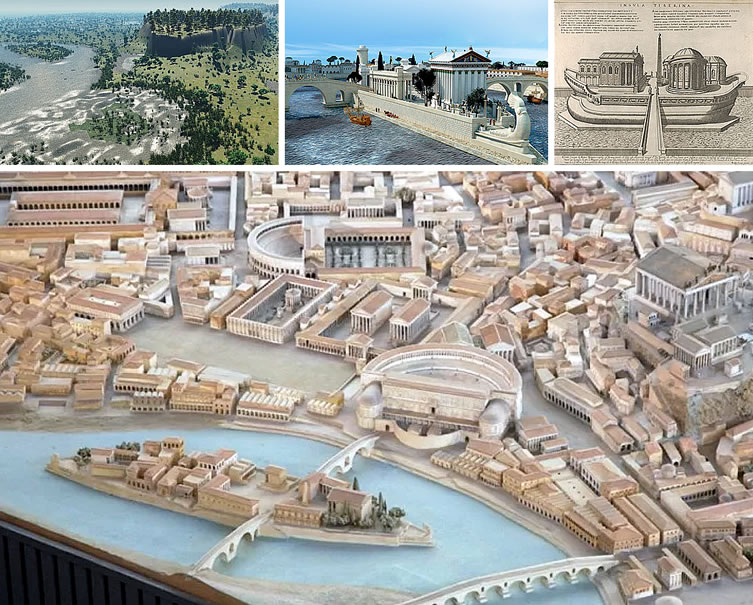
The Tiber Island before and after the foundation of Rome. - An engraving by Nicolaus van Aelst (16th century) based on a drawing by E. du Pérac
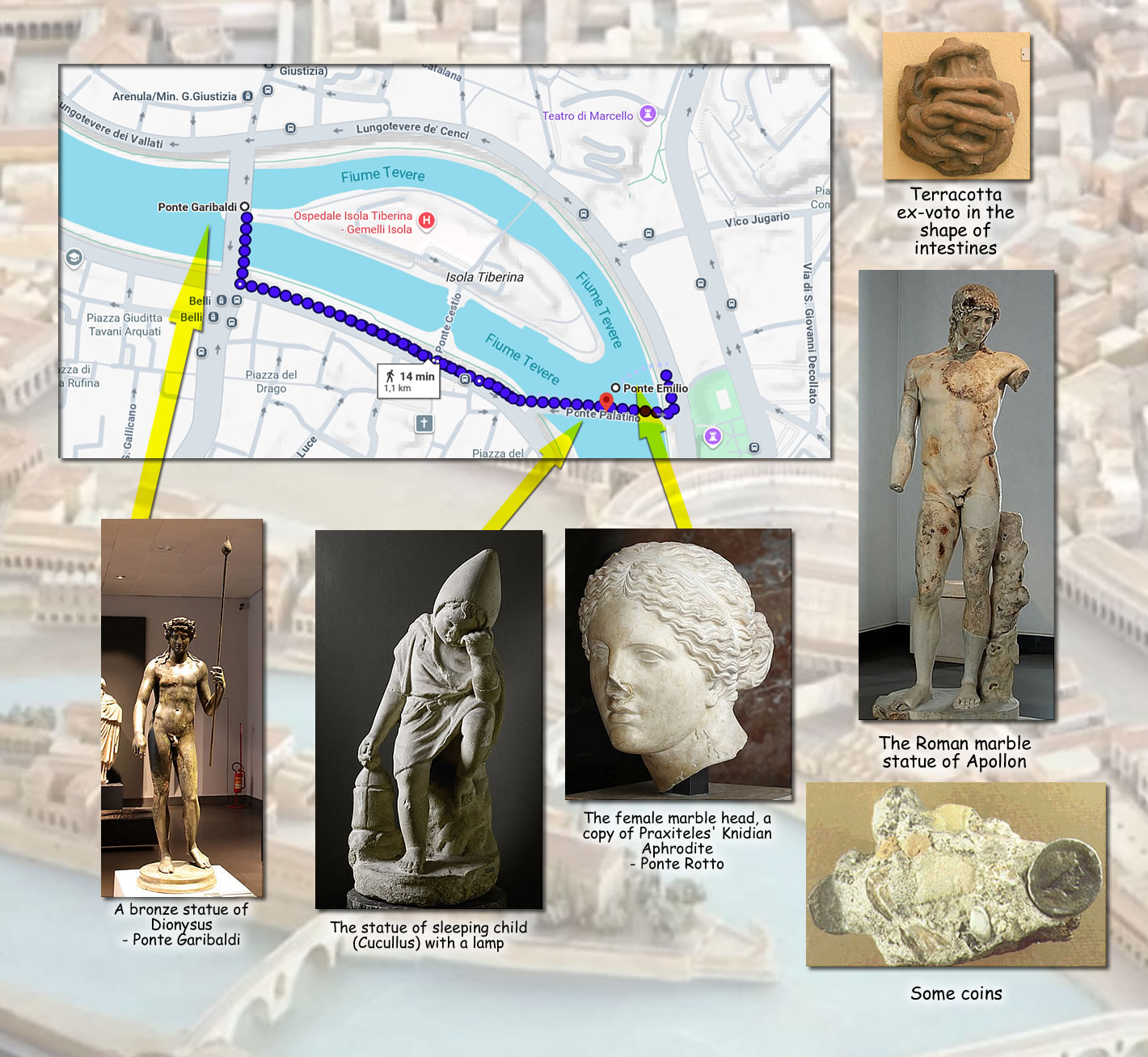
Some artifacts accidentally found on the bottom of the Tiber River
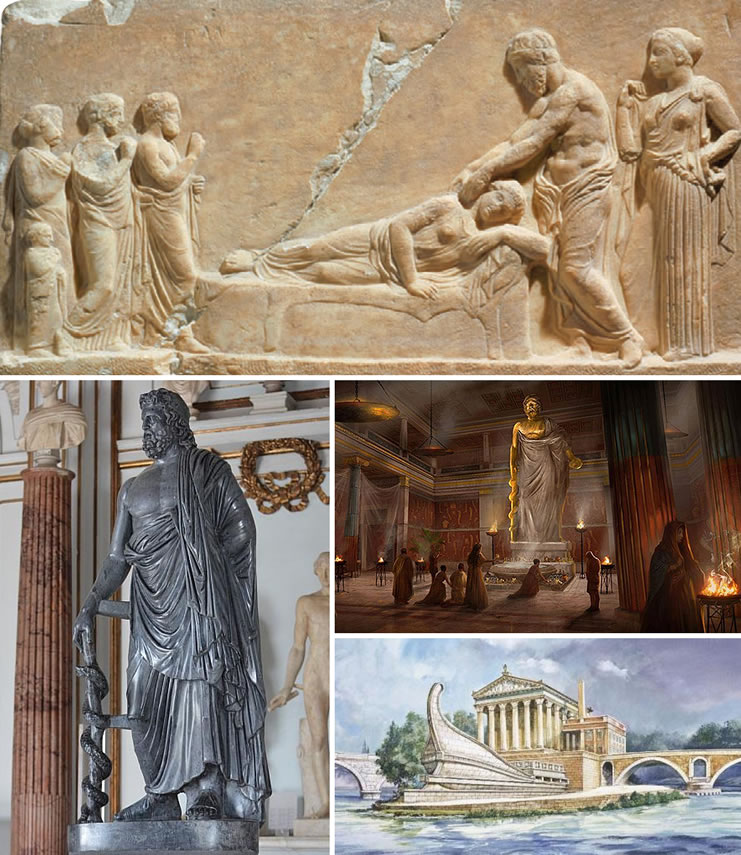
Asclepius treats a sleeping patient, 4th century BCE - Asclepius or Asklepios, 2nd century CE, Capitoline Museums (Musei Capitolini), Rome - Inside of a temple of Asclepius - Tiber Island
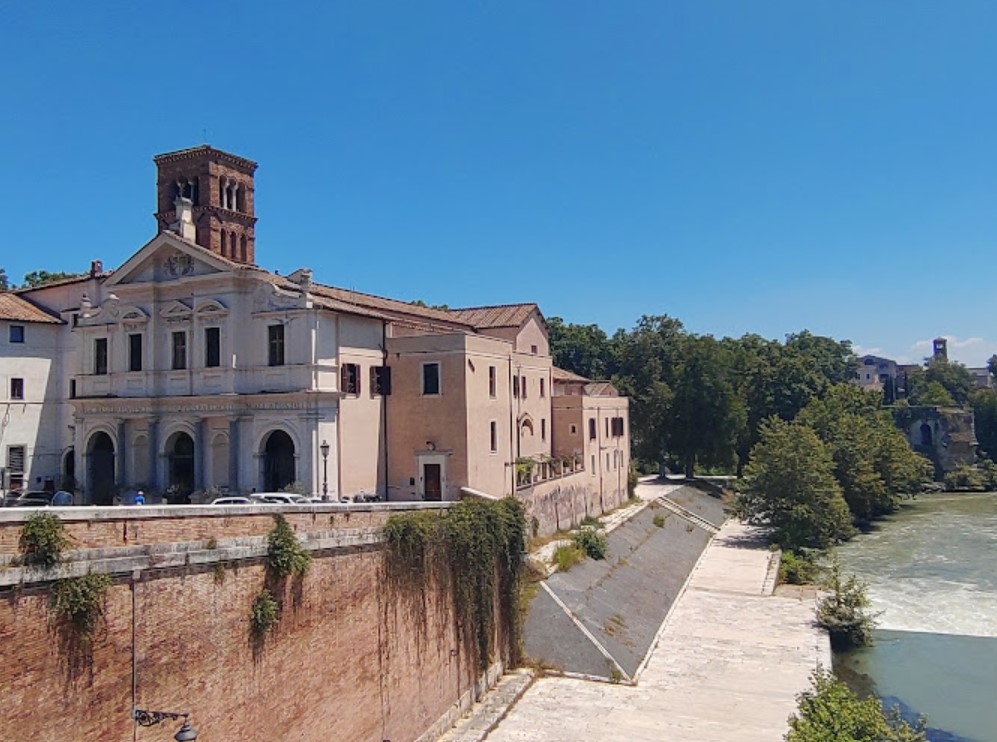
The Basilica of St. Bartholomew
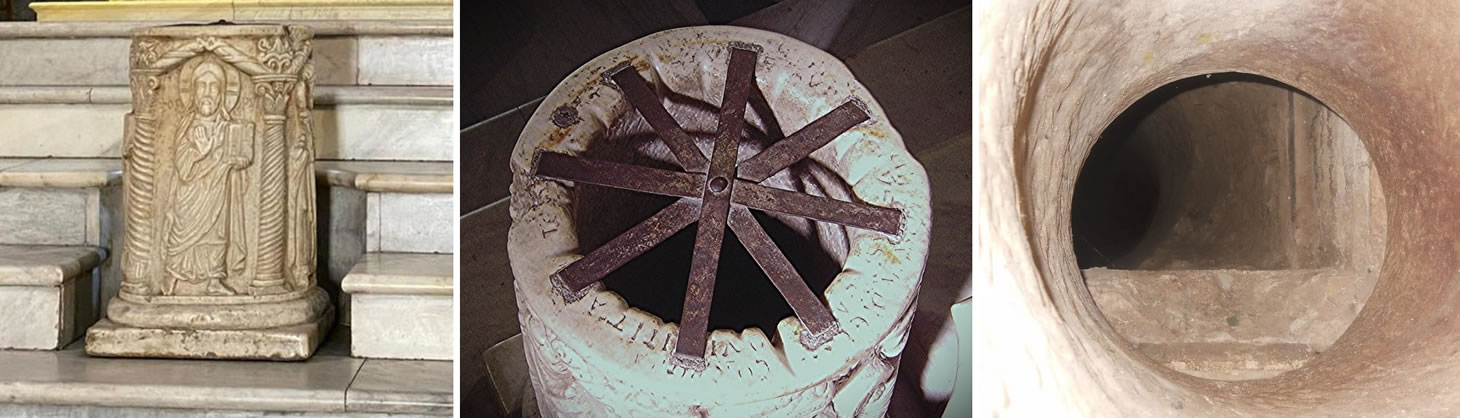
The marble well
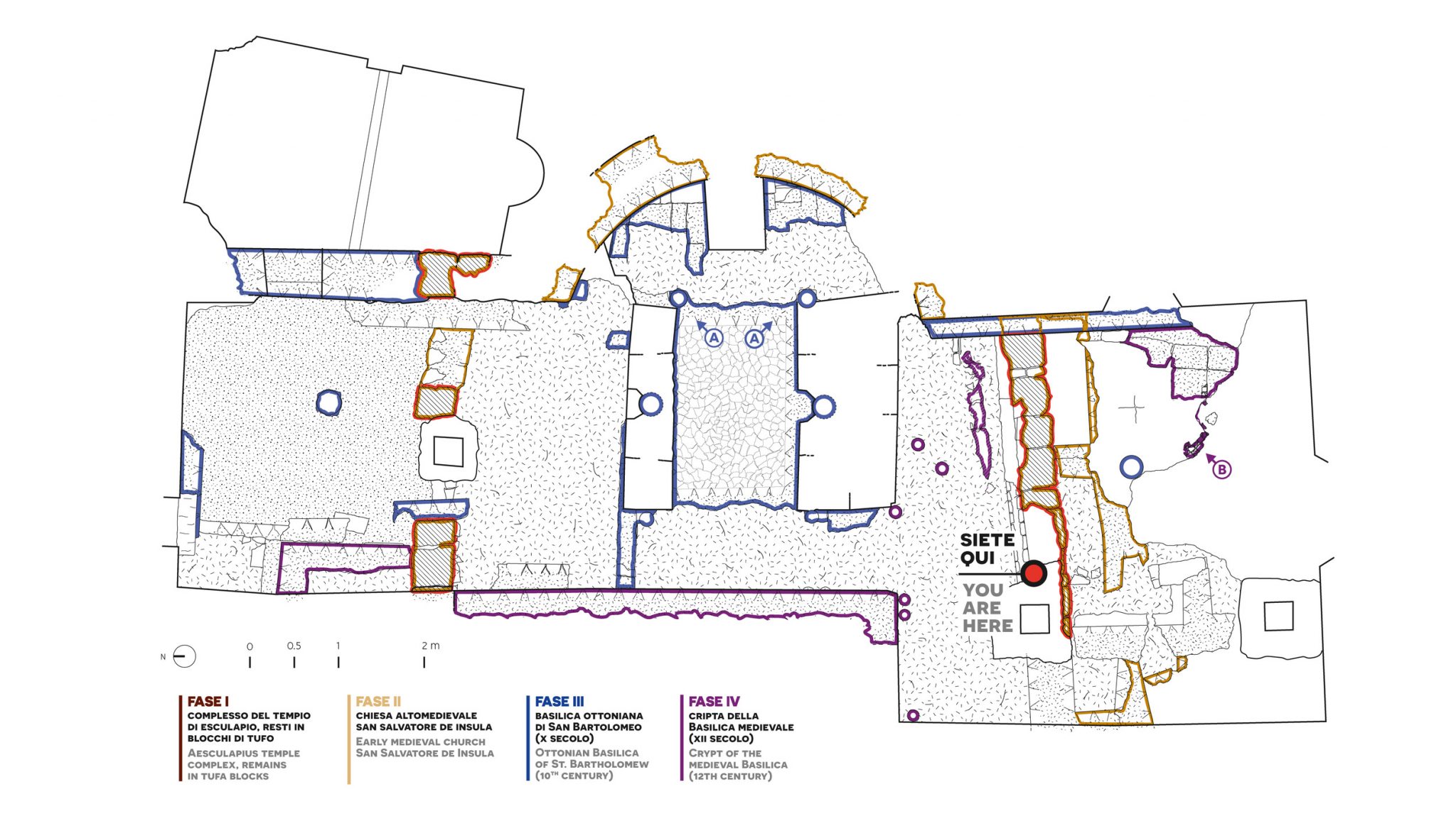
The Basilica of St. Bartholomew and its underground
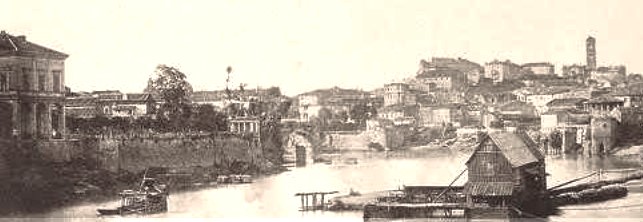
On right, a floating mill (XIX century)
© andmorestory.eu - All right reserved