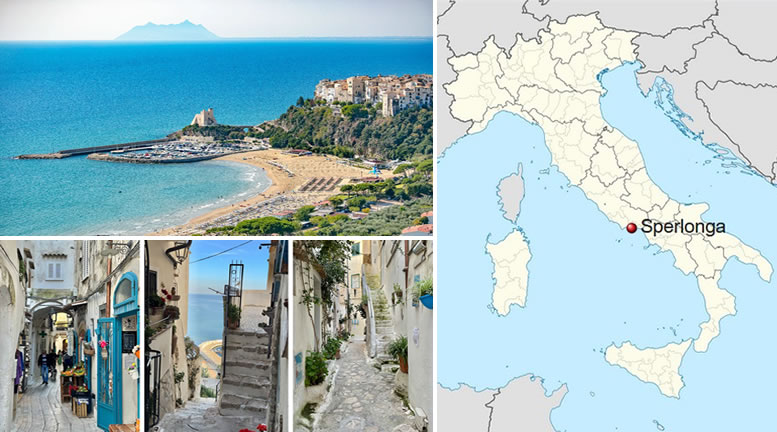
Sperlonga (Latina, Italy)

Sperlonga is today a renowned tourist destination, perched on a small limestone promontory that drops sheerly into the sea. This charming fishing village, made up of attached houses and narrow alleyways, takes its name from the Latin word speluncae – "grottos" or "caves" – due to the 102 natural cavities that dot the local coastline. The most famous of these is the Grotto of Tiberius, a wide, deep cavern facing west, almost at sea level. In Roman times, it served as the nymphaeum of a large imperial villa from the 1st century AD, belonging to Tiberius (42 BCE - 37 CE). The residence extended for three hundred meters along the beach and included quarters for troops, baths, fish-breeding pools, and court spaces. It was built on top of a late-Republican villa, possibly belonging to Aufidius Lurco, the maternal grandfather of Livia (wife of Augustus, mother of Tiberius and Drusus the Elder, grandmother of Germanicus and Claudius, great-grandmother of Caligula, and great-great-grandmother of Nero).
In 1957, during construction work on the coastal road between Terracina and Gaeta, an engineer named Bellante – a cultured man sensitive to the allure of the past – made an extraordinary discovery. He had already ensured that the work would not damage the caves; driven by curiosity, he did some research and read that beneath the floor of the cavern might lie the ancient Roman pavement of the nymphaeum. Accompanied by a few workers, he descended into the grotto and carried out initial test excavations. Immediately, a large circular pool paved with mosaic emerged, followed by hundreds of marble fragments of the highest quality, both small and large, including torsos and a large hand. Bellante understood the importance of the find and called Professor Jacopi, the Superintendent of Antiquities. Two days later, the expert recognized on the fragments the names of Agesander, Athenodorus, and Polydorus – the three sculptors from Rhodes known as the authors of the celebrated Laocoön group, previously known only through the copy in the Vatican. The excitement was immense: perhaps the remains of the lost Greek original had come to light.
The people of Sperlonga followed the excavations with admiration but also alarm. For four days, the residents crowded around the grotto, demanding that "their treasure" be preserved and hindering with hostile shouts and cries the scholars who were trying to transport the ancient statues' remains to Rome. It had long been known that Tiberius and his court had transformed this stretch of coastline – a cheerful arc of beach and hills enclosed between two rocky promontories – into a place of delights, filling villas, pools, and temples with riches and works of art. The emperor, always journeying between Rome and Capri, loved to stop here. A famous episode, handed down by Tacitus and Suetonius, recounts that during a banquet in the grotto, a rockfall killed some servants; the favorite Sejanus saved Tiberius by shielding him with his own body. That event marked Sejanus's rise to the consulship, but soon his fortune reversed: the distrustful emperor condemned him to death.
The imperial villa was abandoned in 26 AD, probably due to a flood that compromised its stability, prompting Tiberius to move permanently to Capri. In the following centuries, invasions, looting, and neglect erased every trace of its splendor. However, local tradition had preserved the memory: the fishermen of Sperlonga still hauled their boats for shelter into the "Grotto of Tiberius," and some remnants of Roman walls and plaster indicated the cavern's ancient function as a nymphaeum.
The statues discovered in 1957 may have been smashed by the monks who settled among the ruins of the villa in the Early Middle Ages. Over fifteen thousand fragments were patiently reassembled. Initially, it was thought to be a second Laocoön group, similar to the Vatican one: an epigraph found on site indeed bore the names of Agesander, Athenodorus, and Polydorus.
The myth recounts that Laocoön, a Trojan priest of Apollo, opposed the entry of the wooden horse into Troy; as punishment, Athena and Poseidon sent two sea serpents that entwined him and his two sons. In a Roman perspective, the death of these innocents enabled Aeneas's flight and thus the founding of Rome.
When the famous group emerged in 1506 near Nero's Domus Aurea in Rome, Pope Julius II (1443-1513) immediately acquired it for the Cortile delle Statue, making it the ideological centerpiece of his decorative program. Pliny the Elder considered it superior "to all other plastic works of sculpture."
But the systematic reconstruction of the Sperlonga finds led to a surprise: the marble groups did not illustrate Laocoön, but rather episodes from Odysseus's return home.
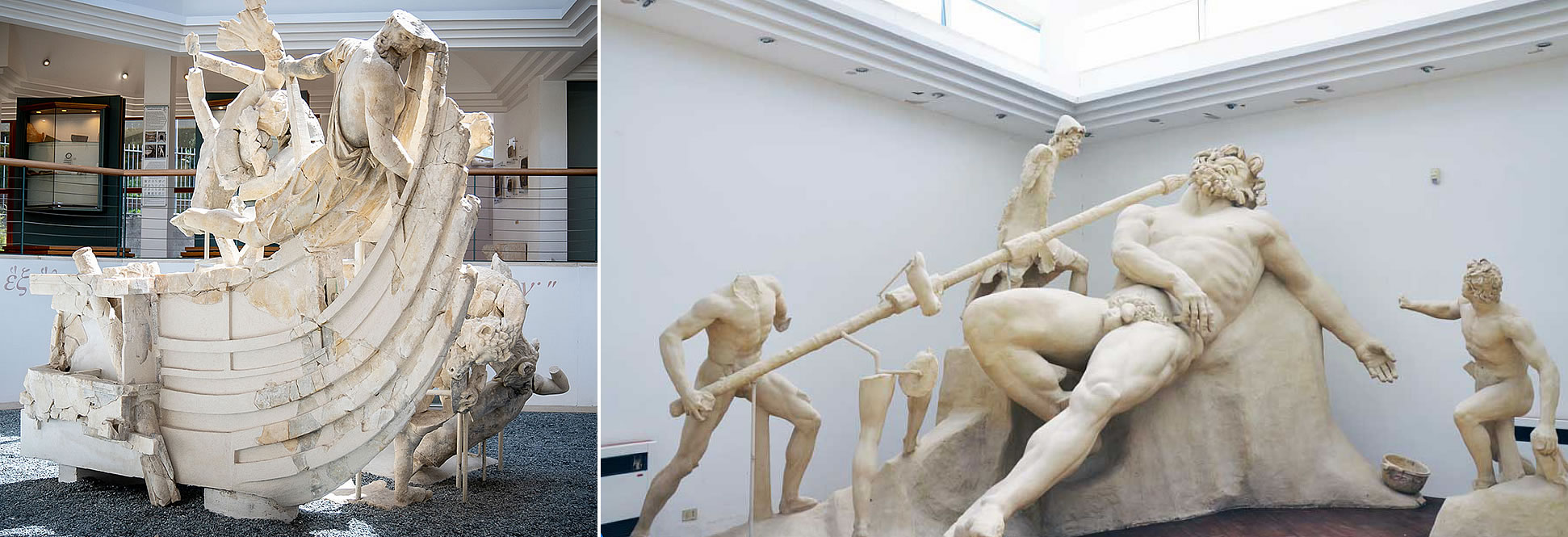
Among the most spectacular is the Scylla group, one of the most complex ancient sculptures ever to come down to us, reassembled from casts of countless fragments (made using a mixture of resin and marble dust). The monster envelops Odysseus's ship in the coils of its tail and devours the crew with its many ferocious heads.
A second group shows the blinding of Polyphemus, of extraordinary realism: the tension of the stake driven into the Cyclops's single eye is almost tangible. Nearby are the gigantic monolithic fragment of Polyphemus's leg and the expressive head of Odysseus with flowing beard and pileus cap. Another fragment probably depicts Odysseus dragging Achilles's body out of the fray, the hero's foot twisted unnaturally to reveal the fatal heel wound.
Yet another group represents the theft of the Palladium, while a splendid polychrome marble statue, which beautifully renders the youth's luxurious clothing and the bird's plumage, immortalizes Ganymede abducted by Zeus's eagle, originally placed in a large niche above the grotto to adorn its opening.
It is assumed that all these sculptural groups were placed inside the large cavity, with its mosaic floor, which formed a sumptuous scenic environment for banquets, opening outward onto a quadrangular pool at the center of which – like an island – stood a wide platform used as a dining area (triclinium). The most recent studies tend to consider these works as marble copies of bronze originals made during the time of Tiberius, though some believe them to be original creations. The debate is complicated by the artists' signature inscribed on the Scylla group, on a marble tablet protruding from the ship's stern: Athenodorus son of Agesander, and Agesander son of Paionius, and Polydorus son of Polydorus, Rhodians, made [it].
The same names – without the patronymics – are cited by Pliny as the authors of the Vatican Laocoön. According to the scholar Bernard Andreae, the Laocoön itself would be a copy from the early Imperial period, derived from a 2nd-century BC bronze original from the Rhodian school, executed by the same three artists mentioned by Pliny – the same ones from Sperlonga. Others, especially in the past, have proposed a dating to the era of Emperor Domitian, based on an inscription in hexameters composed by a certain Faustinus (possibly the poet friend of Martial). The text reads: If Mantua could give us back the divine poet [Virgil], he, impressed by the immensity of the work, would depart defeated from the grotto and would himself acknowledge that no poetry could represent the wiles of the Ithacan, the flames and the eye torn from the half-wild [Polyphemus] alike heavy with wine and sleep, the caves and the living lakes and the Cyclopean rocks, the cruelty of Scylla and the ship's stern broken by the whirlpool as the artist's skill has rendered them, which only Nature [their mother and genitrix] surpasses. Faustinus joyfully [dedicates this] to his lords.
Today, it is believed that this slab is later than the grotto's arrangement, but it remains a valuable document for the iconographic interpretation of the complex.
This page was last edited on 18 April 2026
Sperlonga (Latina, Italy)
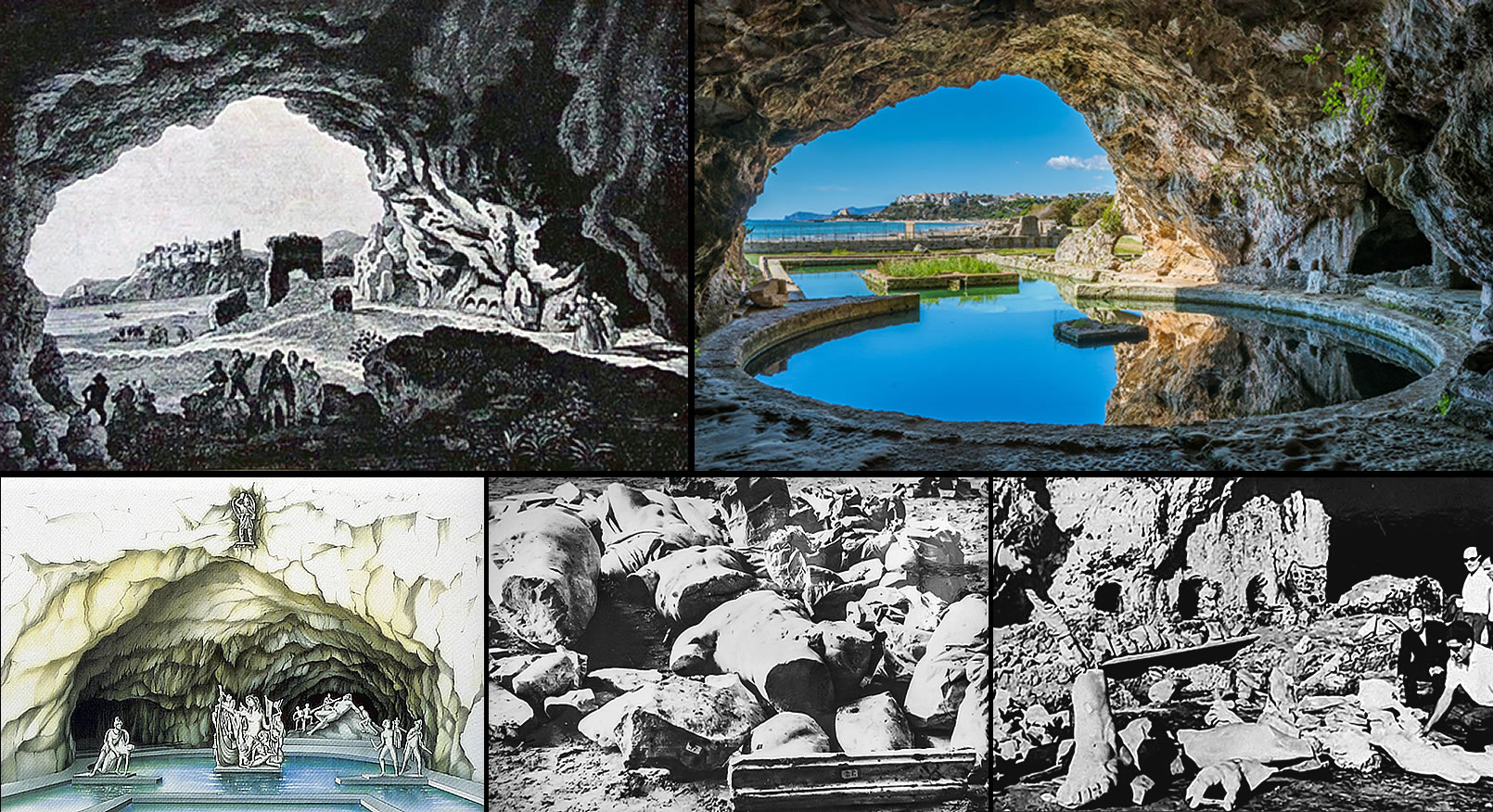
Tiberius Cave as it appeared in the early twentieth century and today - Reconstruction of the Tiberius Cave with the statues - Discovery of the fragments of the statues in 1957
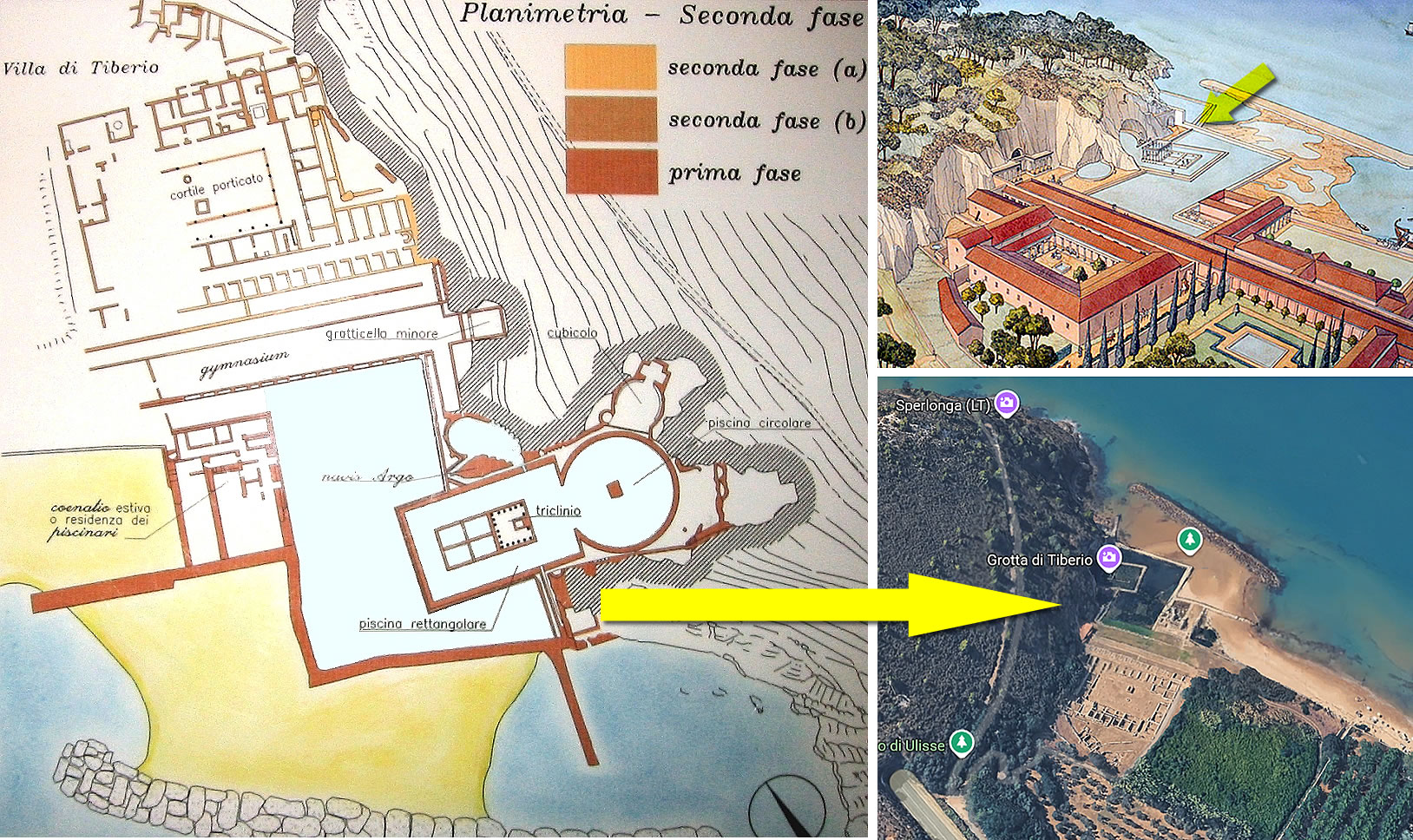
Plan and 3D of Tiberius Cave near Sperlonga, Italy.
Laocoön and his sons, also known as the Laocoön Group. Marble, copy after an Hellenistic original
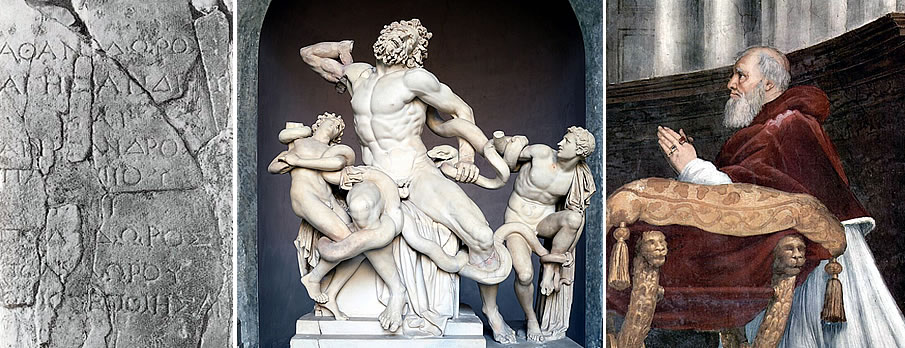
Engraving of the names of Rhodes sculptors found in Sperlonga - The Vatican Laoconte - Pope Julius II
© andmorestory.eu - All right reserved