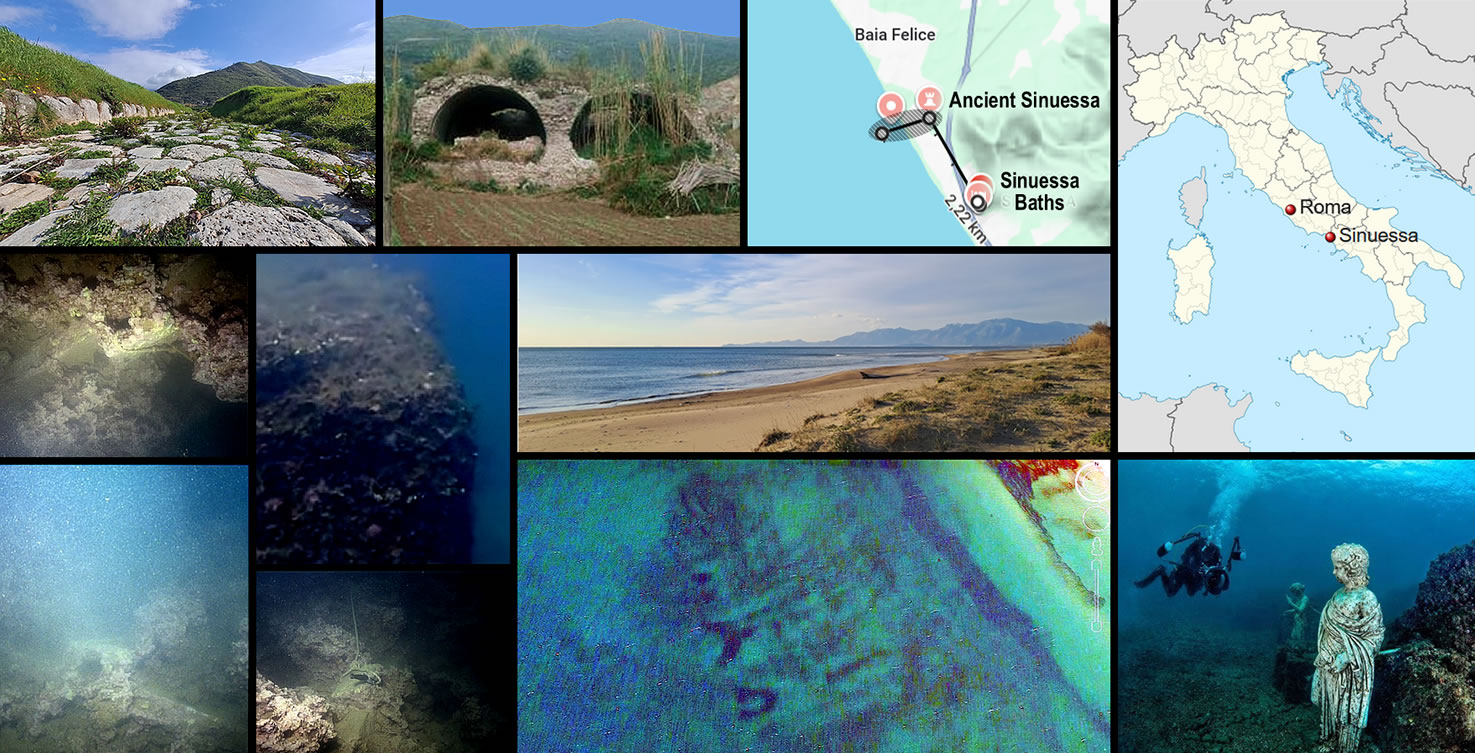
Remains of a Roman villa and the submerged city - Sinuessa

Sinuessa was an ancient Roman colony located in Latium adiectum, on the border with ancient Campania (near modern-day Sessa Aurunca in the province of Caserta). It was founded in 296 BCE with two main objectives: to defend the Tyrrhenian coasts and to produce the famous Falernian wine, one of the most prized wines of ancient Rome, so much so that it was the most celebrated by the writers of the era.
At first, however, it was difficult to find colonists willing to settle there, due to the continuous incursions of the Samnites. After their final defeat, a new enemy made life precarious at Sinuessa: in 217 BCE, Hannibal's Numidian cavalry unsuccessfully besieged the colony but plundered the entire surrounding countryside, causing enormous damage. Between 207 and 191 BCE, the city even refused to provide soldiers for the war against Antiochus of Syria, claiming it needed to protect its own territory and promote the region's economic recovery. Finally, in 133 BCE, Sinuessa was the scene of a bloody slave revolt, crushed with the execution of four thousand rebels.
The period of greatest splendor coincided with the 1st century BCE and the 1st century CE, when the city became extremely famous among the Roman aristocracy, who built numerous villas there. As Strabo wrote (V, 4, 8):
The villas followed one another in an unbroken progression, and the coastline had taken on the appearance of a city ...
Sinuessa was divided by two bridges and boasted an important thermal complex, whose springs were known as theAquae Sinuessanae, much frequented by the wealthy classes for their numerous therapeutic properties. It was not only a place of leisure and wellness: thanks to its strategic position, it became a significant commercial hub. Ships loaded with Falernian wine set sail from its port to all corners of the empire. The city remained populated and vibrant until the time of Vespasian, a destination for travel and carefree escapes from the walls of Rome, Capua, and other major cities.
The decline began in the 6th century CE, until the city's memory completely vanished in the 9th century CE. With the fall of the Western Roman Empire, Sinuessa suffered destruction from barbarian invasions, but according to some studies, the main cause of its end was natural: earthquakes, tsunamis, and bradyseismic phenomena caused much of the city to sink into the sea. Today, unfortunately, little remains to be seen of Sinuessa: only a few ruins emerge from the ground, because the site has been investigated but not yet fully brought to light. Yet this brilliant, wealthy city was the setting for major historical events. In 37 BCE, Maecenas, Horace, Virgil, Plautius Tucca, and Lucius Varius met there—intellectuals who acted as mediators between Octavian and Antony. In 54 CE, Claudius Narcissus, a powerful freedman, visited. In 69 CE, Ofonius Tigellinus, former praetorian prefect of Nero, was forced to commit suicide there on the orders of the new emperor Otho.
In 1954, during agricultural work at San Limato, north of the Roman colony of Sinuessa, important sculptural finds were accidentally brought to light, now preserved in the National Museum of Naples. Among them stand out a marble head of Emperor Claudius, a girl's head stylistically traceable to the same Claudian era, and a fragment of a comic silenic mask. In 1971, new archaeological excavations led to the identification of a partially unearthed villa, probably belonging to Tigellinus himself. This is a luxurious maritime residence, presumably built at the beginning of the imperial era along the low, sandy coast of northern Campania, characterized by structures extending into the sea and fishponds for fish farming. Its surviving remains are partly incorporated into an 18th-century farmhouse.
Gaius Ofonius Tigellinus (born around 10 CE in Agrigento, ancient Akragas), of humble origins and probable Greek descent, was accused in his youth of adultery with Emperor Caligula's sister, Agrippina. Exiled in 39 CE by Caligula, he was recalled by Claudius, under whom he made his fortune managing racetracks in Apulia and Calabria. Under Nero, he became prefect of the vigiles and, in 62 CE, praetorian prefect. A loyal and ferocious official of Nero, he distinguished himself in the suppression of the Pisonian conspiracy (65 CE), which forced Seneca, the emperor's tutor, to commit suicide. According to Tacitus, Tigellinus also drove the writer Petronius to suicide in 66 CE through slander. When Nero fell from favor, Tigellinus abandoned him to side with Galba, but after a few months Galba was replaced by Otho, who ordered his execution. Tigellinus killed himself in Sinuessa by slitting his throat. Tacitus, in his Histories (I, 72), recounts his infamous end in detail, describing the people's contempt and the shame of a slow, ignoble death, surrounded by his mistresses. Who knows, then, how many Romans rejoiced and acclaimed at the death of Tigellinus.
Originally, an acclamation (acclamatio in Latin;aktologhia in Ancient Greek) was an expression of a desire or a prayer for divine intervention. Among the Romans, it came to denote any verbal manifestation of joy, approval, or good wishes, often expressed through clamor and even unruly noise. Acclamations could be collective or individual, taking place in public gatherings or private events.
Tacitus also recalls how the Romans felt at home in the circus and theaters, places where they freely expressed their opinions to the emperor through acclamationes. Pliny defined these spaces as "the seat of the people," where citizens gathered to express approval or dissent. The Circus Maximus, in particular, was often used to acclaim the emperor. This tradition is documented by coins and bas-reliefs, showing figures beside the sovereign in deferential poses, raising their right hands. The practice extended from Rome to Byzantium, influencing ceremonies at the Hippodrome of Constantinople and even Christian liturgical practices. Acclamations accompanied weddings (Talassio!), public spectacles, successful speeches (Bene et praeclare!), imperial appearances (felicissima! felicissime!), proclamations of new emperors (omnes, omnes!), triumphs (Io triumphe!). With Christianity, expressions like Hosanna, Benedictus, Amen, Alleluia became common, and acclamation was even used to elect bishops and popes (such as Pope Fabian in the 3rd century). In the Byzantine Empire, imperial acclamations became more elaborate, while sometimes retaining simple formulas like Tu bene vincas! A famous example of acclamation is also found on the wooden door of the Basilica of Santa Sabina in Rome (5th century), depicting Christ handing the Law to Peter, with Paul in an acclamatory pose. The Germanic tradition adopted these forms to approve laws and royal appointments: during the coronation of Charlemagne at St. Peter's, the crowd shouted: "To Charles... Augustus, crowned by God, great and peaceful emperor of the Romans, life and victory!", demonstrating the continuity of the Roman imperial ideal in the new empire.
This page was last edited on 21 March 2026
Remains of a Roman villa and the submerged city - Sinuessa
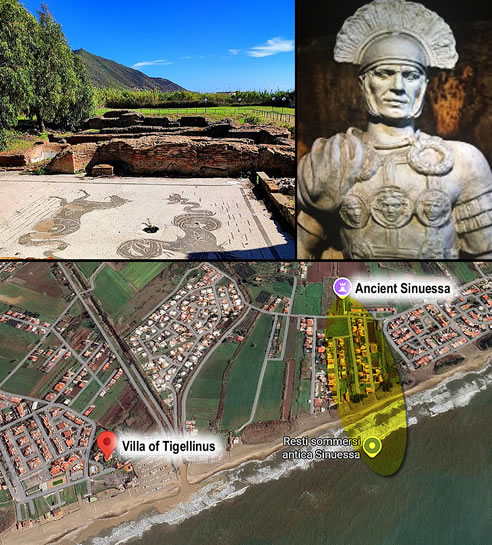
Bust of Tigellinus and his villa, 1st century
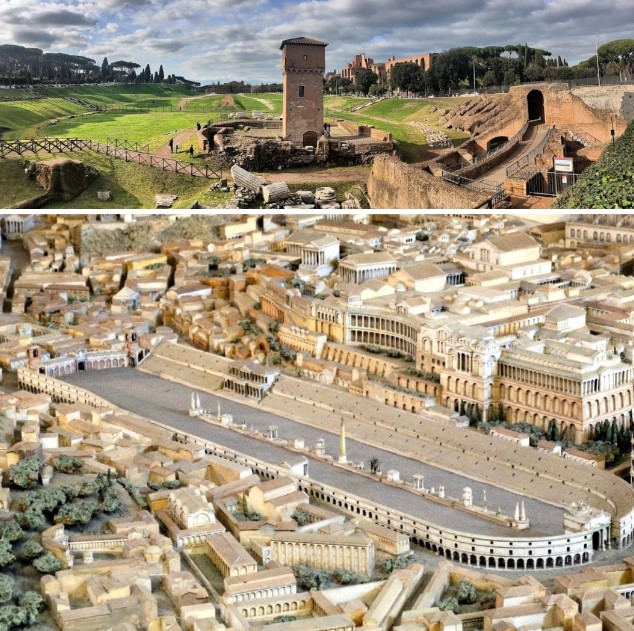
The Circus Maximus is the largest building for public entertainment in antiquity and one of the largest of all time (600 metres long by 140 metres wide) and is related by a legend to the very origins of the city: the Rape of the Sabine Women took place here.
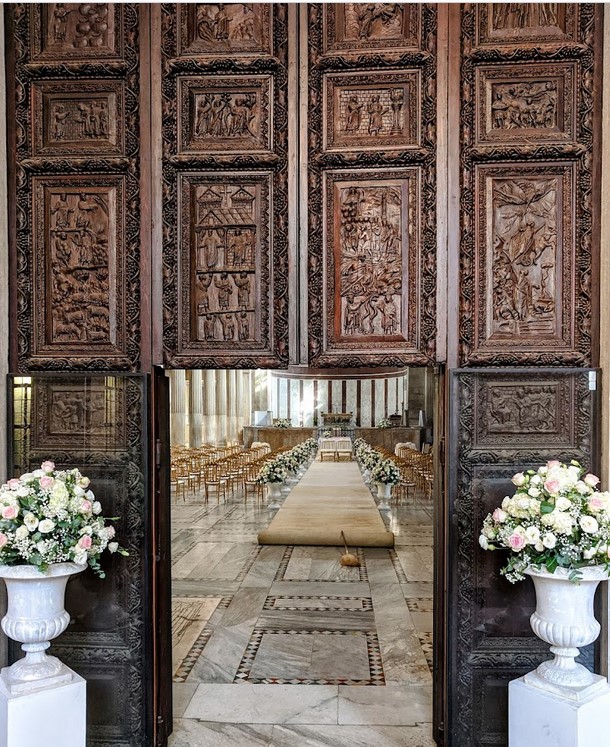
Wooden door of the basilica of Santa Sabina in Rome. A figuration of acclamatio from 425-450 CE is in a panel of the wooden door of the basilica of Santa Sabina in Rome, where it depicts the presentation of a sovereign to the people. The doorposts of this portal are made from frames of Roman age; its 18 panels carved in relief (but once, the original ones were in all 28) depict Scenes of the Old and New Testament.
© andmorestory.eu - All right reserved