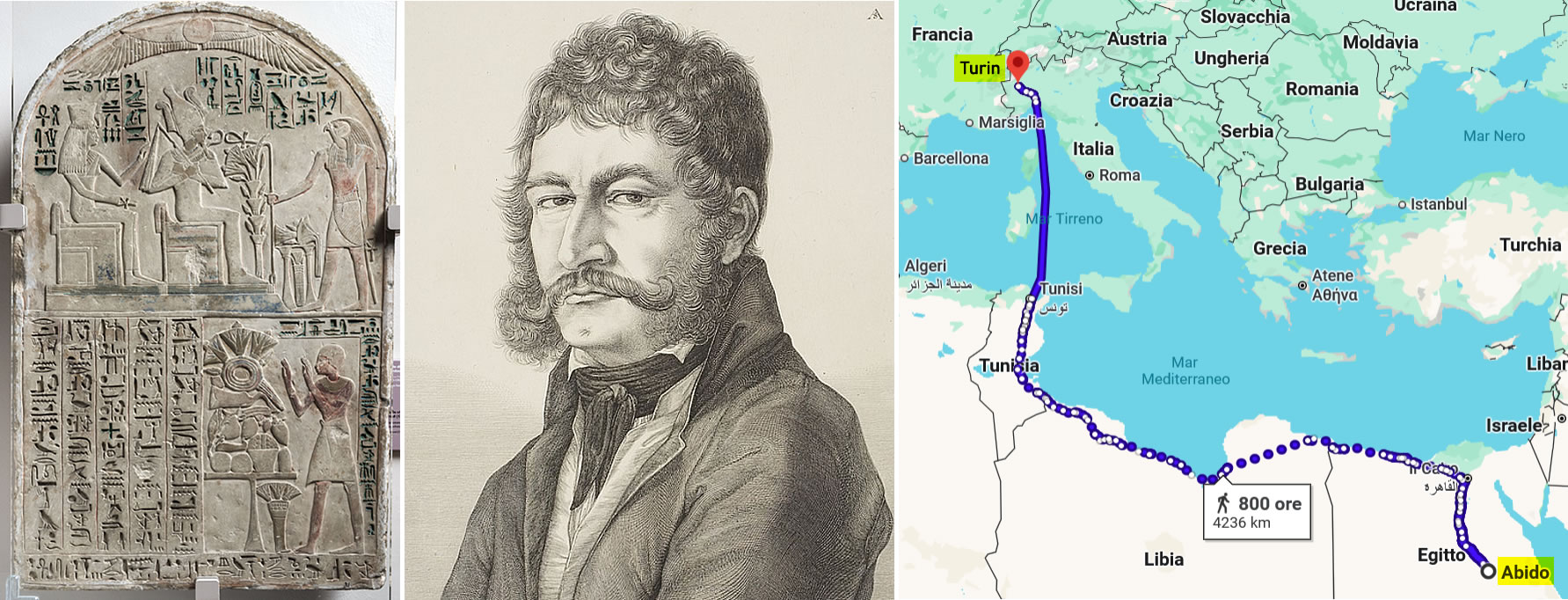
'Stele of Saaset adoring the Abydos triad: Osiris, Isis, and Horus' - Bernardino Drovetti engraving, 1810s

Bernardino Drovetti (1776–1852) was an Italian art collector, explorer, and diplomat from Piedmont, serving France. After graduating in law in 1795 from the Royal University of Turin, Drovetti entered Egypt in 1798 as an officer in Napoleon’s army during the Egyptian Campaign. This was followed by a long diplomatic career and a rapid rise through the consular ranks until 1829, when he resigned due to health reasons and returned to Europe. Over the course of more than thirty years, Drovetti dedicated himself to the search for antiquities, digging deep trenches among the ruins of temples and tombs, especially in the Theban region east and west of the Nile. In a short time, the Piedmontese amassed a significant and extraordinarily rich collection, which he offered to European courts for their museums. His first collection was purchased by King Charles Felix of Sardinia in 1824 and became the initial core of the collection of the Museo Egizio in Turin—the world’s first museum dedicated solely to the art of Ancient Egypt, from the Pharaonic to the Greco-Roman period. Among the many artifacts from his collection acquired by the King of Sardinia is the 'Stele of Saaset adoring the Abydos triad: Osiris, Isis, and Horus,' purchased by the museum in 1824.
At the top, Horus is depicted offering lotus flowers to his parents, Osiris “who resides in Abydos,” and Isis. Below, a guardian (of the temple) of Osiris, Saaset, also called Pankhu, son of Mesetnetjer, presents rich offerings to the triad, to which the hymn in front of him is dedicated: “Give praise to Osiris, kiss the ground before great Isis, revere Horus, avenger of his father ...” The name of Amenhotep III, written at the top in a cartouche surmounted by a double Maat feather, between Osiris and Horus, allows the document to be dated: 1390–1353 BCE, i.e., the New Kingdom period under Amenhotep III of the 18th Dynasty.
Abydos, one of the most important cities in ancient Egypt, was a significant religious and cultural center. Located in Upper Egypt (southern Egypt) on the western bank of the Nile, Abydos was the seat of the Eighth Nome (an administrative division) and lay approximately 530 kilometers south of Cairo and 11 kilometers west of the river.
Its original Egyptian name E' bôṣe derived from the Sahidic Coptic Ebōt. Its pronunciation Abdju from the Arabic Abdu means “hill of the temple,” because it was believed that in that ancient city, in the temple symbol of the primordial hill emerging from the Nun, the head of Osiris (sun god and god of the dead) was preserved as a version of his myth.
By assonance the Greeks called it Abydos as its namesake placed on the Hellespont.
Its modern Arabic name is Arabet el Madfuneh or El Araba El Madfuna (historically al-Khirba).
The origins of Abydos predate recorded history. The region has been inhabited since prehistoric times, and a village of 5000 BCE was found near el-Alāwnah. Instead, the city was precisely located at el-Khirbah.
By the pre-dynastic period, Abydos was already recognized as a significant settlement and the center of the Upper Egyptian region. During this early phase, Abydos was home to powerful rulers, many of whom were associated with Ho
Abydos’ importance continued into Egypt’s First and Second Dynasties (3193-2701 BCE), as many early Egyptian rulers who resided in the nearby town of This (el-Khirbah) chose to be buried here. Among these are the tombs in the necropolis of Umm el-Qa’ab, which translates to “Mother of Pots” for the fragments of pottery left by ancient pilgrims who visited to honor the departed. It served as the final resting place for pharaohs of the First Dynasty. Excavations of these tombs reveal a glimpse into the funerary practices of the era, with structures built of mudbrick, offering chambers, and surrounding pits that likely served as burial spaces for the pharaohs’ attendants, demonstrating an early form of royal burial complexes.
The architectural evolution of tombs during the Second Dynasty marks a shift towards increasingly elaborate structures. For example, royal tombs from this period featured central burial chambers with surrounding side chambers, possibly accommodating ceremonial objects and offerings.
Initially, Abydos was a center for the worship of the local deity Khenti-Amentiu, a god of the dead. As religious beliefs evolved, Khenti-Amentiu became closely identified with Osiris, the widely venerated god of the underworld and resurrection. This assimilation enriched the city’s spiritual legacy, and by the end of the Old Kingdom, Abydos was a focal point for Osiris worship. Pilgrims from across Egypt flocked to Abydos, undertaking journeys that were later commemorated in the art and inscriptions on their tombs. To complete this spiritual pilgrimage to Abydos was considered an honor, reflecting a deep connection to the divine.
Throughout Egypt’s history, Abydos witnessed extensive architectural developments. Under various dynasties, the city saw the construction of numerous temples and monumental structures, each reflecting the religious and political climate of its time. The most significant remains are those of the temples of Seti I and his son Ramses II, built during the Nineteenth Dynasty. Seti I constructed a large temple dedicated to Osiris, and its elaborate reliefs depict pharaohs making offerings to gods and goddesses, reflecting both royal power and piety. Ramses II’s temple, situated nearby, is comparatively smaller but is also richly decorated with scenes of battles, possibly underscoring the king's military achievements alongside his devotion to Osiris.
The Temple of Seti I, also known as the Great Temple of Abydos, serves as one of the most iconic monuments of the site. Constructed on a large scale, it was meant as a memorial for Seti I and as a sacred place for venerating ancient kings. It also houses the famous “Abydos King List,” a comprehensive list of past pharaohs, which has been invaluable for modern historians in reconstructing Egypt's dynastic chronology. The temple includes seven chapels with vaulted ceilings, each dedicated to a different deity, including Osiris and the king himself. At the rear of the temple lies a series of chambers linked to the Osiris cult, which were likely used for the mysterious rites connected with his myth.
Adjacent to Seti I’s temple is the Osireion, a unique underground structure believed to symbolize the tomb of Osiris. A large hall with sarcophagi pits, the Osireion was central to the ritual reenactment of Osiris’ death and resurrection. Osiris’ connection to Abydos was so profound that this site was considered his symbolic burial place, making Abydos the central location for rituals that focused on death and rebirth. The structure’s symbolism, combined with its distinctive architectural style, underscores Abydos' status as a focal point for Osiris worship.
During the Twelfth Dynasty, Sesostris III ordered the construction of an elaborate tomb at Abydos, which involved carving chambers into the rock—a notable feat of engineering. This tomb added a new level of grandeur to the necropolis, as it showcased innovative burial methods and symbolized the increasing importance of Abydos as a royal burial ground during the Middle Kingdom. The design and size of Sesostris III’s tomb signified the pharaoh's desire to be associated with the sacred aura of Abydos.
Despite its former grandeur, Abydos began to decline during the Ptolemaic period, as new centers of worship and political power emerged in Egypt. By the first century BCE, it had diminished to a modest village. The remnants of its former temples and structures faded into obscurity until they were rediscovered during Napoleon's campaign in Egypt in 1798. Subsequent archaeological work in Abydos unearthed remnants of palatial structures from the Second Dynasty and numerous stelae from the early royal necropolis, sparking a renewed interest in ancient Egyptian history and Abydos’ role in it.
This page was last edited on 21 March 2026
'Stele of Saaset adoring the Abydos triad: Osiris, Isis, and Horus' - Bernardino Drovetti engraving, 1810s
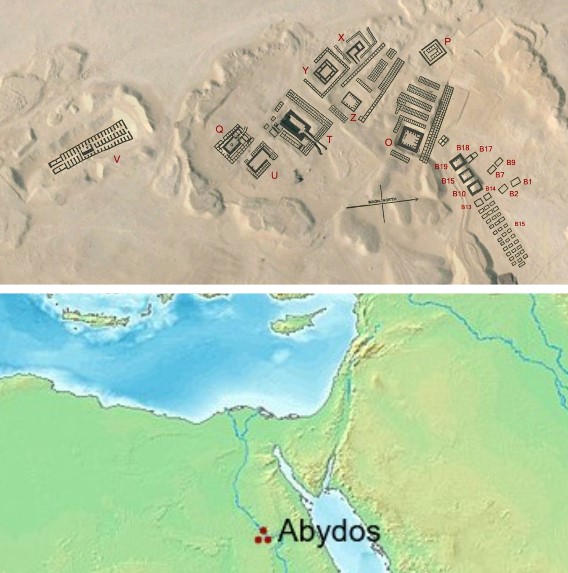
Abydos and the Royal tombs (Umm el-Qa'ab)
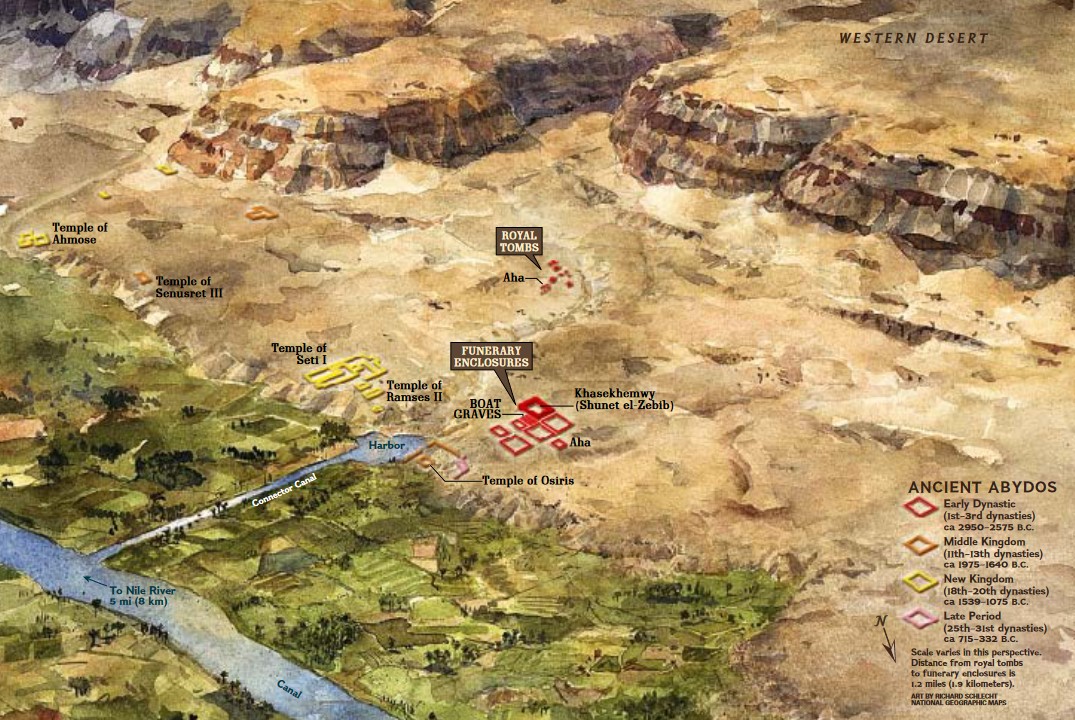
Ancient Abydos by National Geographic Society
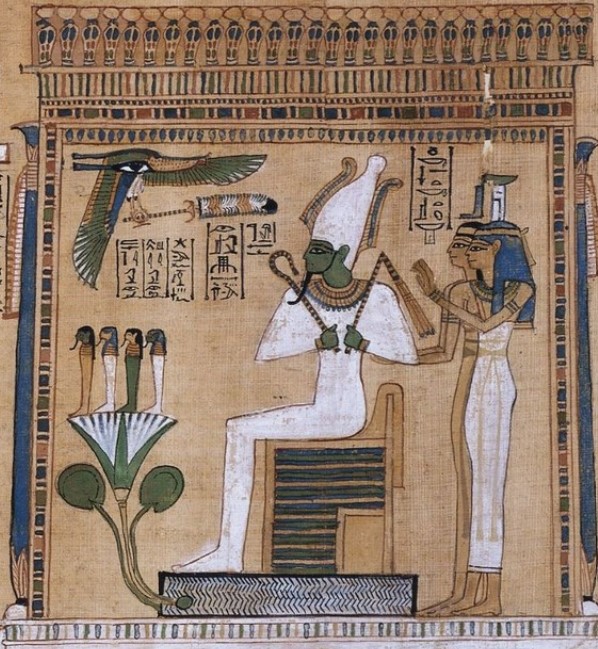
Judgment scene from the Book of the Dead (version from c.1375 BC) Osiris seated in his shrine with Isis and Nephthys. (British Museum)
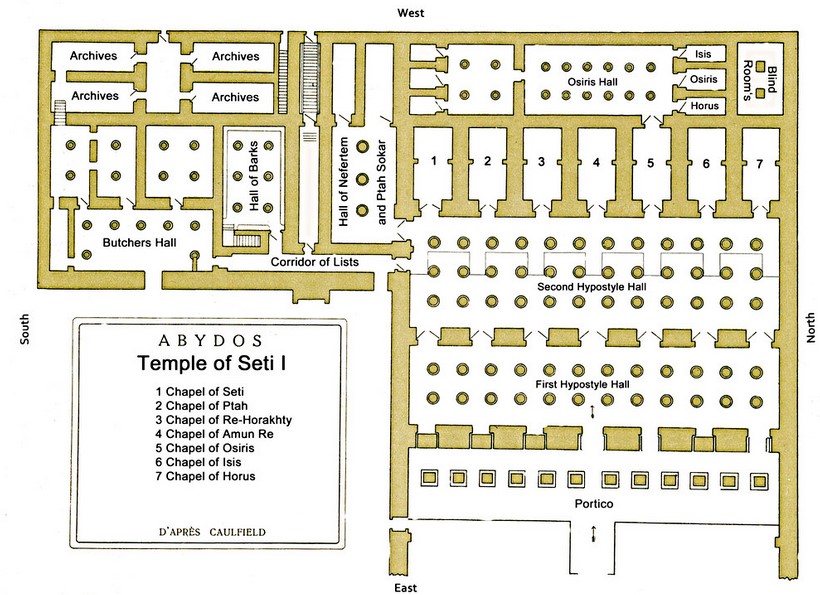
The Temple of Seti I
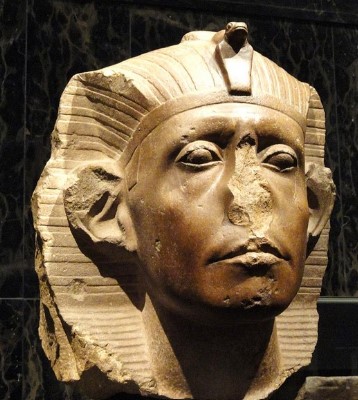
Head of Sesostris III
© andmorestory.eu - All right reserved