The Duke, Raphael, and the Hero and Leander Cup
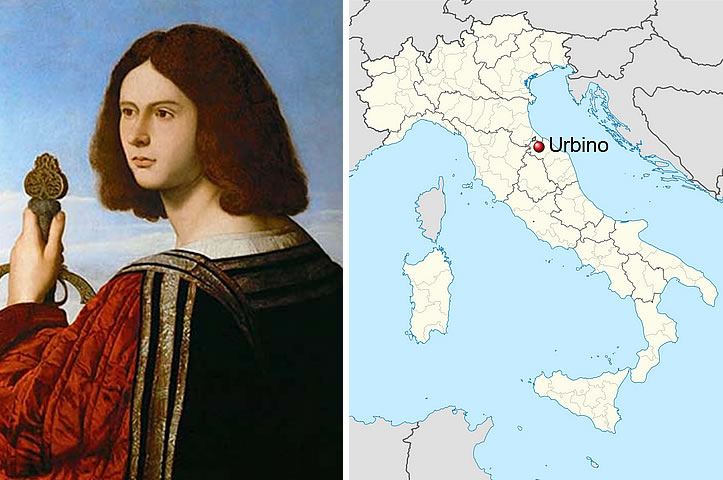
Francesco Maria I della Rovere (1490–1538) was a Renaissance Italian nobleman and commander, Duke of Urbino and Sora, as well as the nephew of Pope Julius II and Duke Federico da Montefeltro. Above all, he was one of the key figures responsible for bringing the Urbino-born Raphael Sanzio to Rome. At the age of eighteen, he became the fourth Duke and Lord of Urbino. However, only a few years later, following the death of his uncle Julius II and the election of Pope Leo X, the shifting political balance led to the loss of his duchy, which in 1516 was ceded to Lorenzo de' Medici, nephew of Pope Leo X. Francesco Maria managed to recover it only in 1521, upon the pope’s death.
The fame of Urbino in the field of maiolica began in the 16th century, and is particularly linked to the production of istoriato.
The term istoriato derives from the Latin historia, in the sense of narrative through images, and defines works in which the surface is not limited to ornamental patterns but becomes a true narrative medium, a decorative style characterized by the depiction of figurative narrative scenes — mythological, religious, historical, or literary in subject matter — applied to various artistic fields, including ceramics, mural painting, and architectural decoration. The use of the term became established during the Italian Renaissance, when the decorative arts took on a narrative and representative function inspired by contemporary pictorial models. It was during this period that istoriato maiolica became widespread, produced in centers such as Faenza, Castelli, Urbino, Deruta, and Casteldurante, where craftsmen and painters translated compositions derived from engravings and Raphael’s cartoon designs onto ceramics.
In Duchy of Urbino, such ceramics gained unusual importance and prominence, perhaps due to the establishment, after Francesco Maria della Rovere’s definitive return in 1521, of a refined court that commissioned works from Titian, was distinguished by great elegance and taste, and maintained important family connections. Consequently, local maiolica painters received significant commissions: sideboards and display pieces were required in large numbers, of varying quality and price, decorated with landscapes, fables, and historical scenes. Renowned ceramicists flourished: Nicola da Urbino, Guido Durantino, and Guido di Merlino were the most prominent names among those who ran their own workshops. There was also a host of kiln operators, turners, and decorators of varying skill levels who worked on contract, especially for large, particularly demanding commissions. Francesco Xanto Avelli, a painter of istoriato ware who seems to have always worked in others’ shops, likely belonged to this category.
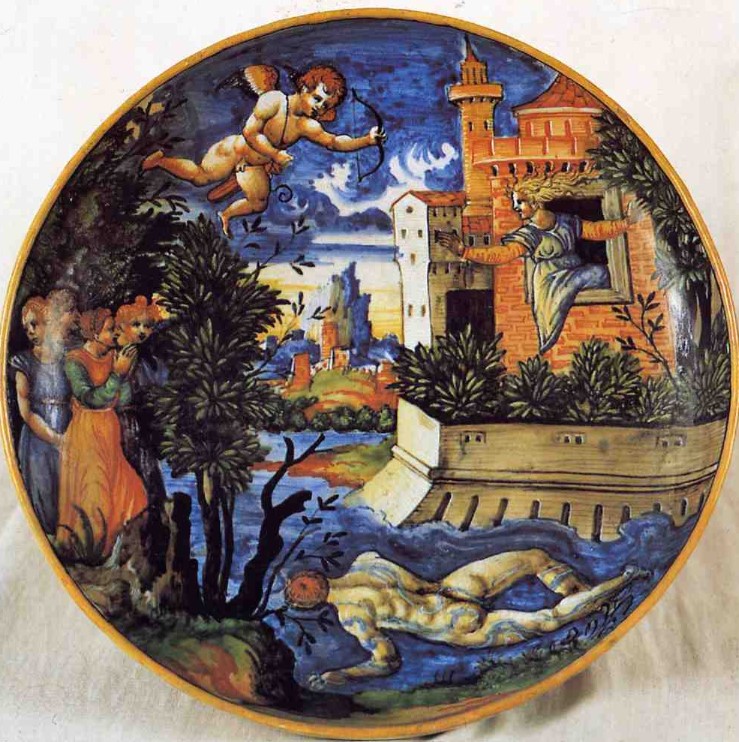
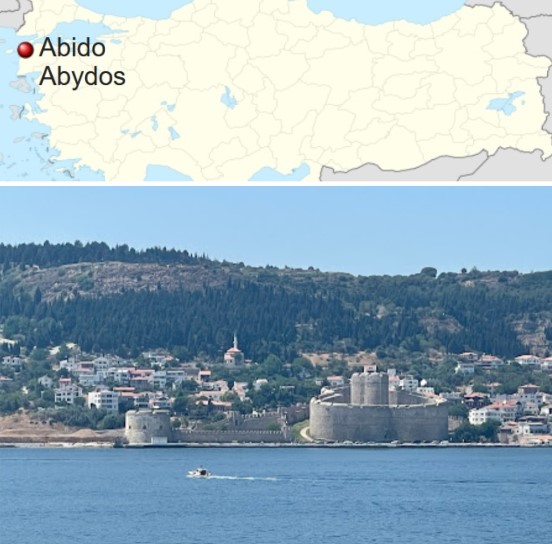
The famous 'Hero and Leander' cup (1540–1560) is thought to come from the workshop of Guido Merlini or Lanfranco. The origin of this piece is uncertain, but its production can be traced to local craftsmen active in the Urbino and Pesaro workshops in the mid-16th century. Architectural details reminiscent of the Urbino Ducal Palace can be observed. The myth of Hero and Leander is set in two cities also famous for marking the narrowest crossing of the Dardanelles (just over a mile): the ancient city of Abydos, a thriving city on the Asian shore of the Hellespont—today Cape Nagara in Turkey—and the city opposite it, Sestos, on the European side.
The Myth of Hero and Leander
Abydos is perhaps best known for the romantic and tragic legend of Hero and Leander, immortalized by ancient the Roman poet Ovid and the Greek writer Musaeus. This myth centers on the forbidden love between Hero, a virgin priestess of Aphrodite in Sestos, and Leander, a young man from Abydos. The two met during the festival of Adonis and instantly fell in love, despite being separated by the sea, Leander swam across the Dardanelles each night, guided by a light his beloved Hero would kindle as his beacon.
As winter arrived, the journey became increasingly perilous. One fateful night, during a violent storm, the wind extinguished Hero's guiding light, leaving Leander lost in the dark waters. He drowned, and his body washed ashore, where Hero found him the next morning. Heartbroken and unable to live without him, Hero threw herself from a tower, joining her lover in death.
This tragic story captivated artists, poets, and musicians for centuries, inspiring works by figures like Bernardo Tasso, Christopher Marlowe, and even Lord Byron, who famously attempted to swim across the Hellespont to test the legend. Musical compositions by composers such as Franz Liszt and Robert Schumann were also inspired by the myth, bringing Hero and Leander’s tale into the realms of literature, art, and music.
Abydos in the Trojan War and Persian Empire
Abydos was not just a setting for mythical love stories; it was a significant city even during the time of the Trojan War. Homer’s Iliad references Abydos in its list of Trojan allies, attributing control of the city to Asius, the young king of Arisbe. Originally, the city may have been Thracian in origin, according to the geographer Strabo, but it later became a Greek colony founded by Miletus around the 7th century BCE during the reign of the Lydian king Gyges.
In 514 BCE, the city fell under Persian control and served as a critical point during the expansion of the Persian Empire. Darius I burned the city as part of his campaign in 512 BCE, and later, Abydos played a key role in the infamous crossing of Xerxes I into Europe in 480 BCE. Xerxes had a bridge of boats constructed across the Hellespont at Abydos, which allowed his massive army to cross and invade Greece. This event highlighted the strategic importance of the city, positioned at the narrowest point of the Dardanelles.
Rituals and Symbolism: Xerxes’ Punishment of the Hellespont
An unusual event associated with Abydos was Xerxes’ ritual “whipping of the Hellespont,” a punishment inflicted upon the waters themselves after storms disrupted his preparations for the Greek invasion. In a dramatic and symbolic gesture, Xerxes ordered his men to lash the sea with whips, as though reprimanding the water for obstructing his grand plans. This act illustrates both the mythical and historical weight that the Hellespont held as a frontier of power, religion, and mythology.
The Peloponnesian War and the Battle of Abydos
Abydos continued to play a prominent role in Greek history, particularly during the Peloponnesian War between Athens and Sparta. The city was initially allied with Athens as part of the Delian League but switched allegiance to Sparta in 411 BCE. This betrayal set the stage for the famous Battle of Abydos in the late autumn of 411 BCE.
In this naval clash, Dorieus, a Spartan admiral, sought to support his compatriot Mindarus, who had recently suffered defeat. As Dorieus attempted to navigate the Hellespont with a fleet of 14 ships, he encountered the Athenian navy, who forced him to seek refuge along the Asian coast. The Athenians, under Alcibiades’ command, ultimately emerged victorious in the battle after a prolonged struggle, capturing 10 Spartan ships and marking a significant victory for Athens.
Abydos Under Sparta, Athens, and Macedon
In the years following the Peloponnesian War, Abydos established alliances with Sparta, serving as a loyal ally until the early 4th century BCE. King Agesilaus II of Sparta even used Abydos as a transit point during his campaigns against the satrap Pharnabazus, aiming to protect the Ionian Greek cities.
After the Peloponnesian War, Abydos gained brief periods of independence, notably in 397 BCE when it defended itself against Persian forces with the help of the Spartan general Dercylidas. However, its alliances were fluid, and by 341 BCE, Abydos once again allied itself with Athens against the rising threat of Philip II of Macedonia. Despite its resistance, Philip II ultimately conquered the city, and it later fell under the rule of Lysimachus, one of Alexander the Great’s generals, after the Macedonian conquest of Asia Minor.
Abydos’ strategic importance persisted, and it withstood a fierce siege by Philip V of Macedonia in 201 BCE. This valorous resistance highlighted the city’s resilience, as Abydos once again found itself caught in the web of larger regional powers.
Roman Influence and Decline
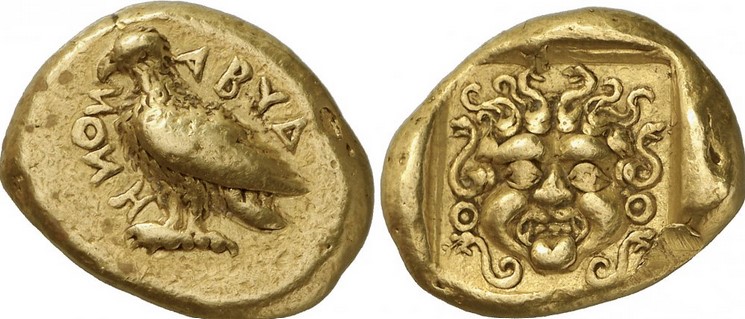
Abydos entered a new phase under Roman rule, initially resisting but eventually succumbing to the Roman general Lucius Cornelius Scipio Asiaticus in 190 BCE. Under Roman administration, Abydos became a free city and experienced a period of prosperity that lasted well into the later stages of the Roman Empire. Its strategic position made it a crucial point for commerce and navigation, and Abydos enjoyed economic stability and independence, even minting its own coins featuring symbols like eagles and depictions of Artemis and Apollo.
The city’s prominence gradually waned during the Byzantine Empire. As trade and military focus shifted, Abydos lost its strategic relevance, though it remained a customs station up to the mid-14th century. The city’s decline accelerated after it came under Ottoman control in the 15th century, and by the reign of Sultan Mehmed II, the center of gravity had shifted decisively towards the Dardanelles, leading to Abydos’ eventual decline.
This page was last edited on 21 March 2026