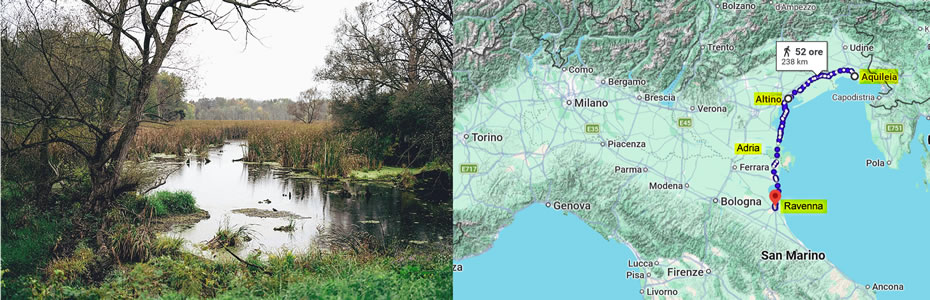
'Venetian Islands' or 'Gallic marshes'

The lowest part, which stretched along the far edge of the Adriatic, formed the Lower Venetia, known to the ancient Greeks as the 'Venetian Islands' and to the Romans as the 'Gallic marshes'. According to the Greek geographer Scymnus of Chio (?-185 BC), one and a half million inhabitants lived there, scattered across about fifty cities (Ravenna; Spina; Adria, a very ancient Etruscan port; Altinum...). The lagoons were the shortest route from Aquileia to Ravenna, which couriers swiftly reached by embarking at Altinum and passing along the shores, eventually reaching the mouth of the Po.
It was a vast area characterized by cultivated lands, commerce, and navigation: some lands were insular, surrounded by marshes, rivers, and lagoons, while others were attached to the mainland. The nature of the soil made hydraulic works necessary very early on, and indeed Strabo (c. 60 BC - 21 AD) and other ancient authors mention in Lower Venetia embankments, barriers, river channels, and land reclamation. They also recall that to go upriver, they would tow boats with ropes (towlines) used to pull boats from the bank against the current along a river or canal, and that many of their vessels sailed down the Po to its mouth, where, due to the abundance of water, it was said to form the Seven Seas. The Veneti navigated the lagoons in light boats, conducting their trade from one end to the other: on the wooded margins they hunted, on the fertile soils of the islands they practiced agriculture. Thus, the terrestrial and maritime Veneti formed a powerful nation even before Rome arose. But they had formidable and restless neighbors in the Gauls or Celts, who, having penetrated as far as the Mincio and the Po, established their settlements there, changed the customs and dialect of the inhabitants, and from there frequently made plundering raids and devastations, with varying fortunes, as far as the lands of the Veneti. In one of their incursions, they pushed beyond the Po into what is now Romagna. The Veneti then found themselves surrounded on all sides by the Gauls; the Etruscans increasingly withdrew; Rome itself, which was then rising, seemed destined to perish at the hands of the Gallic invaders.
But the most fearsome of all those leaders of barbarian hordes was Attila, called the 'Scourge of God'. The fury of Attila fell primarily on Venetia; Aquileia fell after a long resistance and was given over to the frenzy of those atrocious Tartar peoples: there was no salvation anymore except in flight. Then the inhabitants, taking to their boats, withdrew to the nearby estuary or fled into the lagoons.
Altinum, a rich and famous city, resisted, defended on one side by the lagoon, on the other at that time by the Piave River, and surrounded on all sides by high towers and walls. It was as large as Aquileia and as rich as Pompeii, with its forum, theater, odeon, basilica, baths, a large amphitheater, and monumental city gates. Altinum, which had between 20,000 and 30,000 inhabitants, was surrounded and crossed by water; it was an amphibious city, where people already moved between bridges and boats, with an imposing monumental center, luxurious villas, and a flourishing countryside behind it. It is said that for greater defense, the Altinates flooded it, but the Huns, cutting down a great number of trees, built an embankment and through it drew ever closer to the city: the inhabitants made several valiant sorties, but seeing that they would eventually have to succumb, they embarked one night with their families and also took refuge on the islands of the Lagoon.
Thus there was a general exodus from the invaded cities; a scene of grief and weeping: while men, women, the elderly, and children left their beloved homeland, the places of so many cherished memories which they saw behind them overturned, burned, and destroyed by the fury of those ferocious hordes, taking with them as much as they could of their riches, furnishings, and sacred vessels.
It is said, however, that the Altinates, fleeing before the hordes of barbarian invaders, hid their treasures underground or in a very deep well that has never been found. The same thing happened in Aquileia with the famous gold well, or in Rome with, for example, the statue of the Boxer at Rest.
• Aquileia resisted all incursions but not Attila, who, after managing to penetrate the city and devastate it, scattered salt over the ruins. Not to mention that he had also forced the legionaries he had taken prisoner to build siege engines used by the Romans and massacred or enslaved a large part of the population. And all this has remained so impressed in the historical memory of the local population that even today, it is customary to call anyone who proves particularly destructive "Attila". Part of the legend of Attila in Aquileia was not reported by Procopius but remained alive in Friulian popular tradition. And this is the legend of the gold well of Aquileia. As the story goes, not all the inhabitants had remained in the city hoping for the Huns' retreat. Many of them, in fact, had managed to flee before the enemy's sack, sailing along the river to the Island of Grado. Before fleeing, however, they had their slaves dig a deep well in which they hid all the precious objects they owned. And once the well was sealed, the slaves were drowned so that no one could discover its location, and it was never found again. According to one version of the legend, the precious treasure also included the cup used by Christ during the Last Supper, the most famous Holy Grail. For this reason, it is said that the secret of the well's location was guarded by the patriarchs and that this was the reason for the enormous prestige of the Patriarchate of Aquileia. The inhabitants of the area believed in the truth of the legend for many centuries, so much so that in all land sale contracts, they always inserted the curious clause "I sell you the land, but not the well." The seller thus, in case of discovery, ensured possession of the precious treasure.
• The "Boxer at Rest" is a Greek bronze original from the 4th century BC, found in Rome in 1885 where the remains of the Baths of Constantine were. The statue was found between the second and third foundation walls of an ancient building, at a depth of 6 meters below the platform level. The archaeologist Rodolfo Lanciani described its discovery as follows:
The most important piece of information gathered, while I was present and following the removal of the earth in which the masterpiece lay buried, is that the statue was not thrown there, or buried in haste, but was hidden and treated with the utmost care. The figure, being in a seated position, had been placed on a stone capital of the Doric order, as if on a stool, and the trench that had been opened between the lowest foundations of the Temple of the Sun, to hide the statue, had been filled with sifted earth to save the bronze surface from any possible harm. In my long career in the active field of archaeology, I have been present at many discoveries; I have experienced one surprise after another; I have sometimes, and mostly unexpectedly, encountered real masterpieces, but never a boxer; have I ever experienced an extraordinary impression similar to that created by the sight of this magnificent example of a semi-barbarian athlete, slowly emerging from the ground as if awakening from a long sleep after his valiant fights.
According to a legend, in 452 Venetian refugees fleeing from Attila escaped to Abruzzo, landed at the mouth of the Sangro River and, seeing the rock immersed in the green of the woods (now Altino), chose it as an ideal place to found their new Altinum (Chieti). The chosen rocky spur was defended by three rivers which, with their marshes, formed an effective natural defensive moat.
Altino (the Roman Altinum) today is a rural village incorporated into the municipality of Quarto d'Altino, which has just over 3,000 inhabitants. But its history is very ancient.
The origins of Altino date back to the Epipaleolithic age (8th-5th millennium BC). However, it was only in the Bronze Age (between the 15th and 13th centuries BC) that the first stable settlement occurred.
From the 7th century BC onwards, it was the main port of the Veneti on the Adriatic: a commercial hub for trade coming from the north, via the Claudia Augusta road, and from the Po Valley hinterland and, inbound, from the sea routes. Timber, oil, and wine certainly passed through it, as well as local products like wool. Around the 5th century BC, the city gained considerable importance. At that time, the sea was close by, and the city was therefore a respected commercial center.
Contact with the Romans, which occurred in the 2nd century BC, was not violent, but took the form of alliances until 131 BC, when the process of Romanization began with the construction of the Via Annia: started by the praetor Tirtus Annius Rufus, connecting Adria to Aquileia, it passed through the cities of Padua, Altinum, and Concordia Sagittaria.
The fusion thus took place in the period between 49 and 42 BC, when it obtained citizenship, becoming a Municipium enrolled in the Scaptia tribe. At the end of the 1st century BC, Italy was divided by the Roman emperor Augustus into eleven regions. Venetia et Histria was called the Tenth Region, in which Altino occupied a very important role.
Altino was also one of the most important ports in the Upper Adriatic, and its fortune was largely linked to its position and communication routes, thanks to which the city expanded with villas, temples, and public buildings, which have been identified through the numerous remains unearthed from excavation campaigns conducted on the site and thanks to aerial remote sensing carried out recently. After the Edict of Constantine (313 AD) which granted freedom of worship to Christians, Altino became a bishopric with Heliodorus I, bishop of Altino from 381 AD until 407.
The decline of the city of Altino began with the invasion by the Lombards in 452 AD. Altinum was destroyed by the Huns led by Attila, and in the 7th century its inhabitants permanently moved to the island of Torcello, where the bishopric was also transferred, thus creating the conditions for the birth of Venice. Thus began for Altino a period of environmental and climatic transformations: first exploited by the Venetians as a recovery area for building materials, then definitively abandoned to the lagoon waters which, compounded by land subsidence and the neglect of all hydraulic works, turned it into a marsh, submerging its memory until the 15th century.
This page was last edited on 21 March 2026
'Venetian Islands' or 'Gallic marshes'
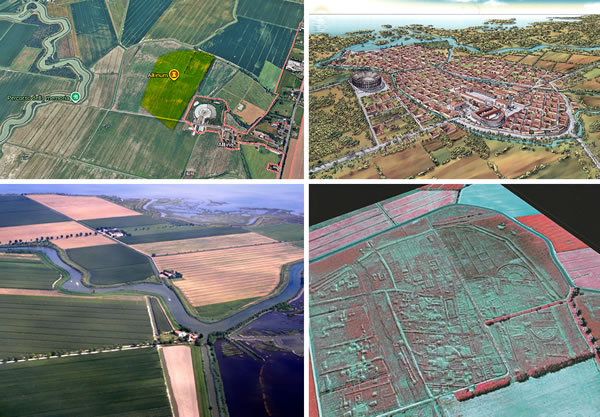
Altino (Venice, Italy)
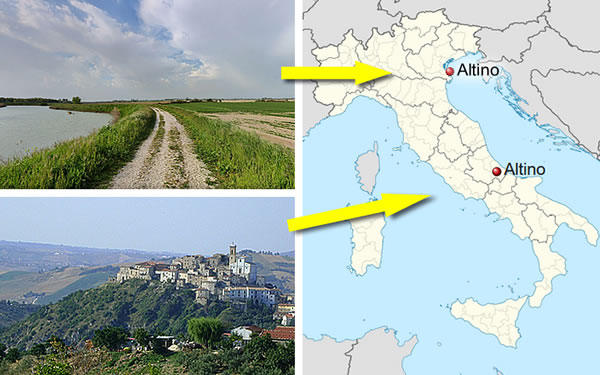
Altino (Venice, Italy) and Altino (Chieti, Italy)
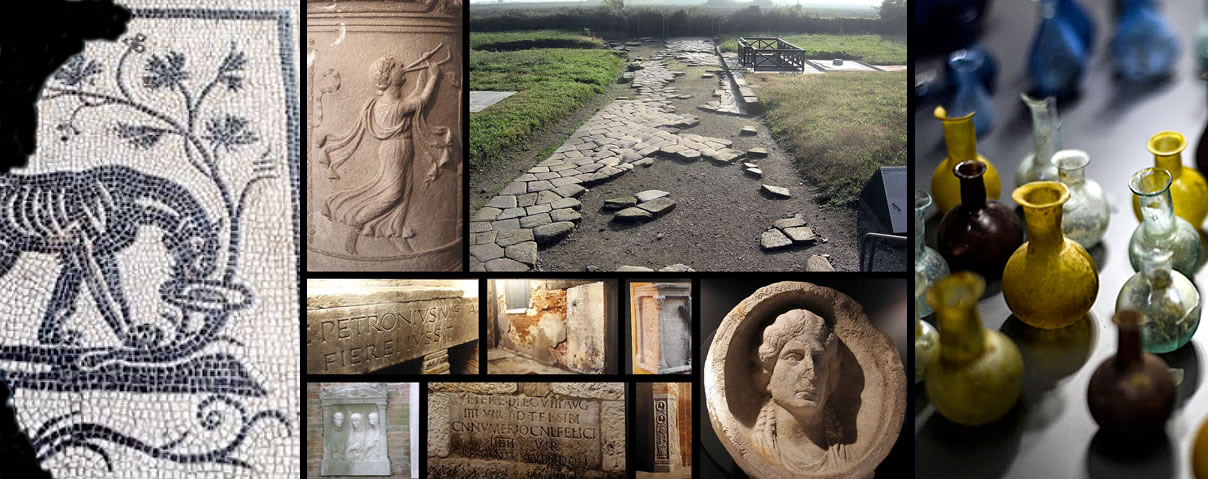
Archaeological finds found in Altino (Venice, Italy)
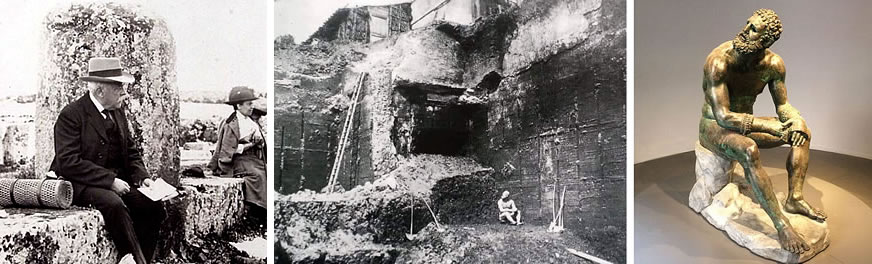
Rodolfo Lanciani and the Statue of the Boxer at Rest 128 cm high (Rome, Italy)Rodolfo Lanciani and the Statue of the Boxer at Rest 128 cm high (Rome, Italy)
© andmorestory.eu - All right reserved