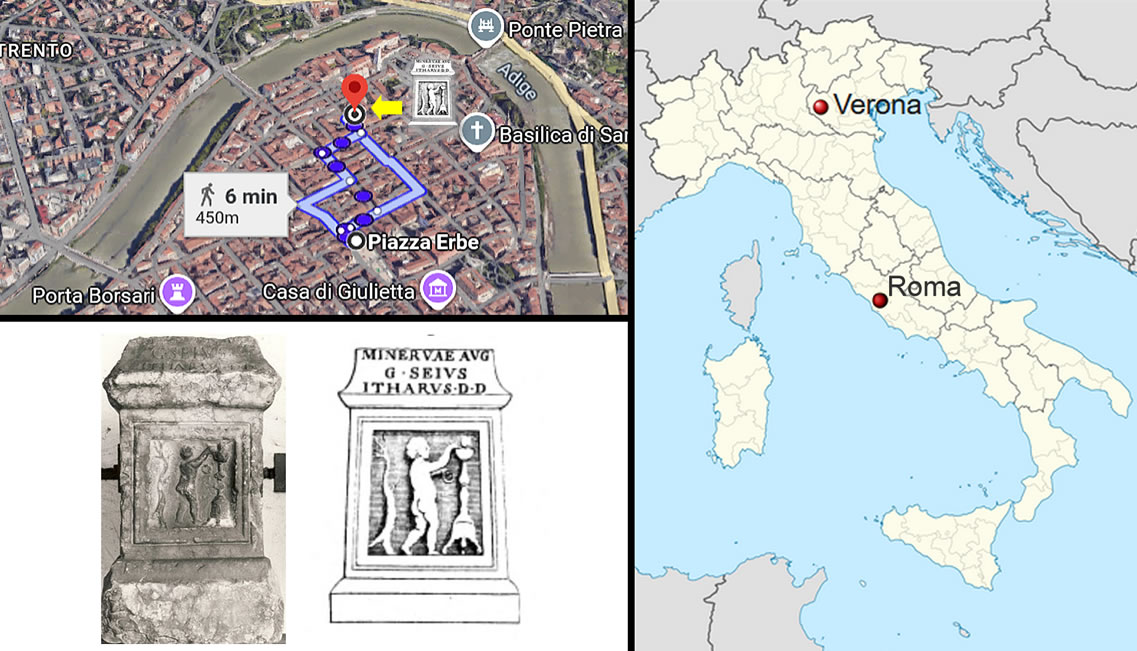
Place where it was discovered the Roman sacred arula, Verona

Rome succeeded in building an empire that would last for centuries, and while military might undoubtedly played a fundamental role, it was not the only factor that favored Romanization. When they conquered a city or village, the Romans allowed the subjugated populations to continue following their own customs and religions, simply placing them alongside their own. They immediately began to Romanize their new subjects by bringing services such as roads, sewers, and aqueducts, rebuilding settlements according to the Roman urban model: public spaces – the forum, amphitheater, baths, temples – thus became tangible proof of Rome’s power and civilization. Sometimes the Romans even preferred to rebuild a city from scratch near the conquered one, as happened with Verona.
We are in 148 BCE, a crucial moment: Rome is engaged in the south in the Third Punic War against Carthage (149–146 BCE) and is expanding eastward into the eastern Mediterranean, so much so that from 146 BCE Greece becomes a Roman protectorate. Both fronts are supported by the so-called "maritime party," which aims to make Rome a naval power in the Mediterranean. However, there is also the "farmers' party," whose interests are mainly focused on the Po Valley, where Romanization had already begun with the founding of the Via Emilia (189–187 BCE), which connected Rimini – the terminus of the Via Flaminia, itself already linked to Rome since 220 BCE – to Piacenza on the Po, turning the latter into a Roman stronghold. Expansion northward continued with the founding of Aquileia in 181 BCE, an outlet on the northern Adriatic in a territory inhabited by non-Roman peoples, almost a remote outpost at the far northeastern tip of the peninsula. To defend it, the Romans built the Via Postumia in 148 BCE, connecting the two northern ports, Genoa to the west and Aquileia to the east: a massive engineering work in a still non-Romanized area, involving invasive structures and land division. The local populations perceived it as a fully military penetration.
It is precisely along this important consular road, strategic for the Romans, that Roman Verona was born. A settlement already existed on St. Peter’s Hill, but the Romans decided to found their colony further on, inside the bend of the Adige River, because that position ensured that three-quarters of the city was naturally defended by the river and because the Via Postumia passed there: once inside the walls, past the gates, the road became the decumanus maximus. The origin of the name Verona is uncertain, and various hypotheses have been proposed over time. A suggestive legend, recorded by the chronicler Galvano Fiamma, tells that the Gallic chieftain Brennus, mythical founder of the city, baptized it "Vae Roma" ("Woe to you, Rome") after a military campaign against the Roman state. Other accounts link the name to a hypothetical emperor Verus Antonius Pius or Marcus Aurelius (Marcus Antonius Verus), also believed to be the founder of the city and its main monuments, or to an Etruscan family named Vera, according to an ancient text that later turned out to be a forgery produced at the end of the 15th century by Annius of Viterbo. Some also support an Etruscan derivation, since in Tuscany there are several place names with a similar ending, some very well known but also lesser-known and even identical: near Lamporecchio there is a place called Verona, and one can also find Verone, Verrone, and, not far away, Veròlla (formerly Verunula). In this case, the meaning could refer to "verone" understood as a terrace or balcony, a semantically fitting solution if one considers that the pre-Roman settlement stood precisely on St. Peter’s Hill, a natural terrace overlooking the plain below, on which Roman Verona would later be founded.
The first tangible sign of Rome’s power appeared with the construction of the forum – today’s Piazza delle Erbe – at the intersection of the Via Postumia (on the east-west axis) and the cardo maximus (north-south). Here, the sacred, justice, economy, and sociality as a form of meeting converge. The Capitolium was built in the second half of the 1st century BCE on the northern side of the forum: 35 meters wide and about 42 meters long, it had three rows of six columns, three cellae, and side porticoes. On three sides, a porticoed gallery also served as an archive; along its walls were displayed numerous inscriptions and bronze tablets (of which only fragments remain) containing laws, decrees, lists of magistrates and emperors, and land registry documents. Supporting the entire structure was a cryptoportico (today the archaeological area of Corte Sgarzerie) that extended for over 200 meters beneath the portico, divided into two aisles 4.5 meters wide by a spine of arches supported by 78 stone pillars and covered by barrel vaults, dimly lit by splayed windows overlooking the upper terrace. The forum also housed the curia-basilica complex, the two places par excellence dedicated to the management of public affairs and justice, while further west opened another square dominated at its center by a temple dedicated to the imperial cult. The entire Roman forum complex testifies to a full phenomenon of self-Romanization: the people of Verona felt Roman and became Roman, especially since the first contacts between Rome and Verona date back to the 3rd century BCE and were characterized from the very beginning by friendly relations and alliances.
In the Julio-Claudian age, the city reached the peak of its wealth and splendor when the last great symbolic work of Verona was built: the amphitheater, an example of daily life. The theater of Verona is Roman but built according to Greek technique, exploiting the natural slope of a hill: a non-random choice, because St. Peter’s Hill allowed the reproduction of the model of the great late-Republican sanctuaries. The theatrical complex was indeed completed by the overlying temple of Fortuna Primigenia, offering a very strong adherence to great Roman architecture. The Arena – today famous worldwide thanks to Shakespeare’s Romeo and Juliet – is the third largest amphitheater of the empire after the Colosseum and the one in Capua, but at the time of its construction it was the largest. If we look at the chronological sequence, the Arena of Verona (152×123 meters) dates back to the Julio-Claudian period, the Colosseum (187×155) to the subsequent Flavian age, while the amphitheater of Capua (165×136), although older in foundation, was expanded into the form we know today only in the 2nd century CE. In the following centuries, the inhabited area was hit by barbarian invasions, since Verona was the first bulwark of Italy against incursions from northern Europe; for this reason, Emperor Gallienus in 265 had the city walls renovated and expanded to include the Arena.
Over time, new constructions overlapped the previous ones, hiding Roman Verona. Its discovery and systematic recovery began in the first half of the 19th century, particularly with the excavations of the Roman Theater conducted by Andrea Monga between 1834 and 1844, which freed the site from medieval buildings. Further campaigns and studies continued between the 19th and 20th centuries, bringing the entire archaeological complex to light by 1970. Previously, finds had emerged only by chance, such as around 1749, when near what is now the Waldensian Evangelical Church of Verona, a Roman sacred arula was discovered, ending up in the collection of Marquis Scipione Maffei (1675–1755), a distinguished Veronese man of culture. The arula is a parallelepiped arula from the 1st century CE, with a sacred inscription and the figure of a cupid offering a sacrifice. Inside, in relief, a bucolic landscape scene is represented: on the left a tree, while a cupid performs a sacrifice, holding a wreath of leaves in his left hand and placing an object on an incense burner (acerra) located on the right side with his right hand. On the front side of the crowning is inscribed:
Minervae Aug(ustae) / G(aius) (!) Seius / Itharus d(onum) d(edit)
Gaius Seius Itharus dedicates the arula to Minerva Augusta.
The gens Seia was a modest plebeian family of equestrian rank; its members are first mentioned at the time of Cicero, and some of them held various magistracies during the late Republic and the imperial age. The nomen Seius derives from the name of Seia, the goddess of sowing.
The term acerra (or acerna) likely derives from the Latin acer (maple tree). Virgil and Ovid describe the acerra as a square-shaped box used to store incense during sacrifices, especially during festivals and funerals. During ceremonies, the acerra was carried by a young assistant (camillus), who handed it to the priest to take grains of incense and scatter them on the flames; hence the expression de acerra libare (to offer incense from the box). Like all vessels employed in sacrificial rites, it played an important role in Roman art and is often depicted being carried by officiating priests in many bas-reliefs. A servant would hold the acerra in his left hand while using his right to sprinkle incense onto the altar’s flames, hence the expression libare acerra.
Sextus Pompeius Festus, a Roman grammarian of the late 2nd century CE, wrote that in Republican Rome the acerra could also signify a portable altar (ara turicrema), on which incense was burned before the bier of the deceased during the collocatio (the laying out of the body). The Twelve Tables of Roman law restricted the use of the acerra, viewing it as an unnecessary luxury; nevertheless, the vessel survived in Roman and later in Christian liturgical traditions, evolving over time into cylindrical forms (pysides or thymiateria) used in churches. The Christian Church incorporated incense as a symbol of sanctity and divine presence starting from the 1st century CE.
Today, spices evoke primarily food seasonings, but in antiquity they had a broader meaning: ingredients for ointments, scented powders, cosmetics, incense, and medicinal drugs. The ancients distinguished them intoaromata (perfumes such as aromatic oils and incense), condimenta (preservative substances, including those for embalming), and theriaca (substances for creating antidotes to poisons). Spices were highly valued by ancient civilizations for domestic, temple, and public ceremonial use; they were considered luxury goods, on par with precious stones and silk. Their rarity stemmed from the fact that they grew in distant regions with unique climates, and transplanting them elsewhere was rarely successful, making transport by land, sea, or desert caravans necessary. Pliny observed that incense came from Arabia Felix, the southern Arabian Peninsula. Eratosthenes of Cyrene (died around 195 BCE) described the region as fertile and rich in wildlife, inhabited by four peoples – the Minaeans, Sabaeans, Qatabanians, and Hadramautians – each with its own capital. A century later, Strabo (60 BCE – 20 CE) accompanied Aelius Gallus, prefect of Egypt, on a campaign against southern Arabia in 24 BCE, writing about the wealth of the Sabaean land and the production of incense, obtained by cutting the bark of trees.
The substance was expensive because it did not grow elsewhere; Strabo also described the caravan-based “relay trade,” in which neighboring tribes continuously passed aromatic goods on until they reached Syria and Mesopotamia. In the 1st century BCE, Gaius Caesar, Augustus’s nephew and heir, was sent to the East. Pliny, in his twelfth book, recounts that Gaius Caesar was the first Roman to gather information about the incense tree and relay it to Juba, king of Mauretania. Gaius likely visited Hadramaut and perhaps set fire to the warehouses of Aden to disrupt the Arab monopoly on trade; he built large ships for the spice trade with India, opening direct routes from Egypt to India that bypassed southern Arabia. Southern Arabia had controlled the Red Sea corridor and the Incense Route for centuries, monopolizing trade from the East and Africa. Trade routes were numerous and varied: some were maritime, others mixed land-sea, and still others entirely overland, relying on rivers and oases for water. Land transport relied on camels, Arabian dromedaries, horses, mules, elephants, donkeys, and human porters.
The Incense Route connected Arabia Felix to Rome, fostering cultural and religious exchanges. The resin, called incensum in Latin, is a dried gum extracted from trees that thrive in specific conditions: limestone soil, desert climate, and trade winds. Harvesting the resin is entirely manual and takes several months; the larger pieces of resin emit the finest fragrance and retain the most essential oils, earning the nickname “white gold.” Three thousand five hundred years ago, various peoples recognized the beneficial properties of the resin: its smoke disinfected the air, and ointments containing incense were used for joints and skin. The Persian physician Avicenna recommended its internal use. The pharaohs burned incense during rituals, and in Roman times it was as valuable as gold, used as a sacrificial offering to connect earth to the sacred, and prized for its fragrance by the imperial court and aristocracy. By the mid-1st century CE, the Church incorporated incense into its rites, maintaining its use from 1570 as a symbol of solemnity and the presence of Christ. Today, incense comes from southern Arabia, Oman, the Horn of Africa, or India, and the Spice Road, recognized by UNESCO, bears witness to its historical and cultural value. From its sacred role in ancient sacrifices to its continued use in religious practices, the acerra remains a symbol of devotion and artistry.
This page was last edited on 21 March 2026
Place where it was discovered the Roman sacred arula, Verona
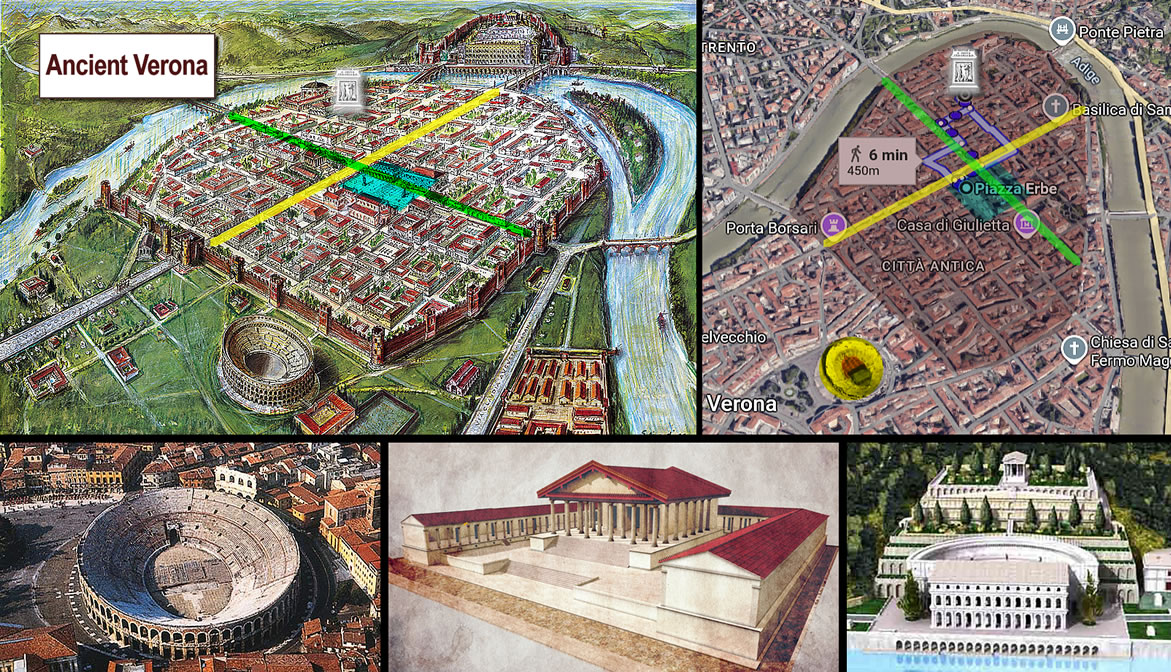
Ancient Verona on modern city
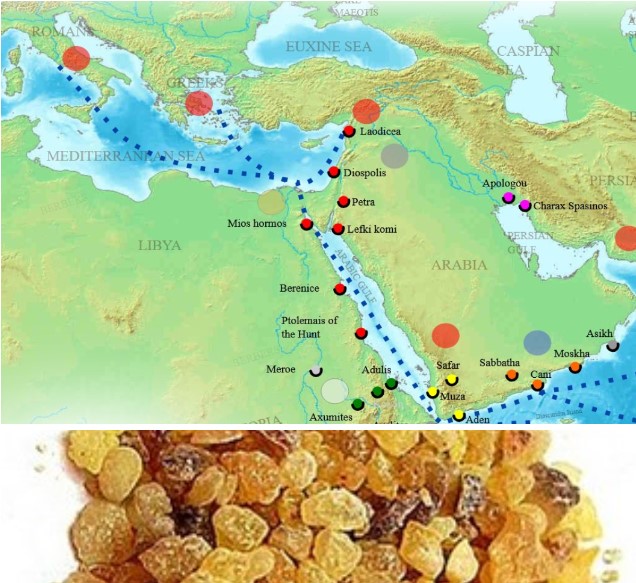
The Incense Trade (1st century CE).
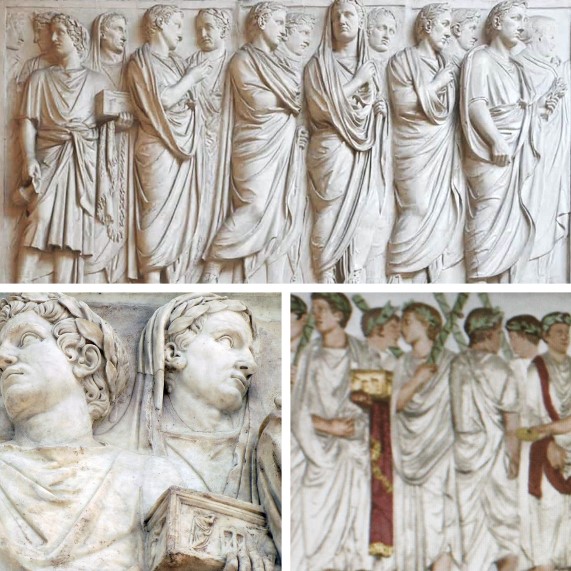
Two scenes of acerra depiction on Ara Pacis relief - A young assistant holding an acerra beside sacrificial tools. Ara Pacis, camillus, quindecemviri(?) holding acerra (box) with tripod, north procession. Ara Pacis Augustae (Altar of Augustan Peace). July 4, 13 BCE. the Roman Senate votes (in a constitutio) to honor the triumphal return of Augustus from Gaul and Hispania (France and Spain). January 30, 9 BCE. monument is dedicated. Marble - Ara Pacis Museum, Rome.
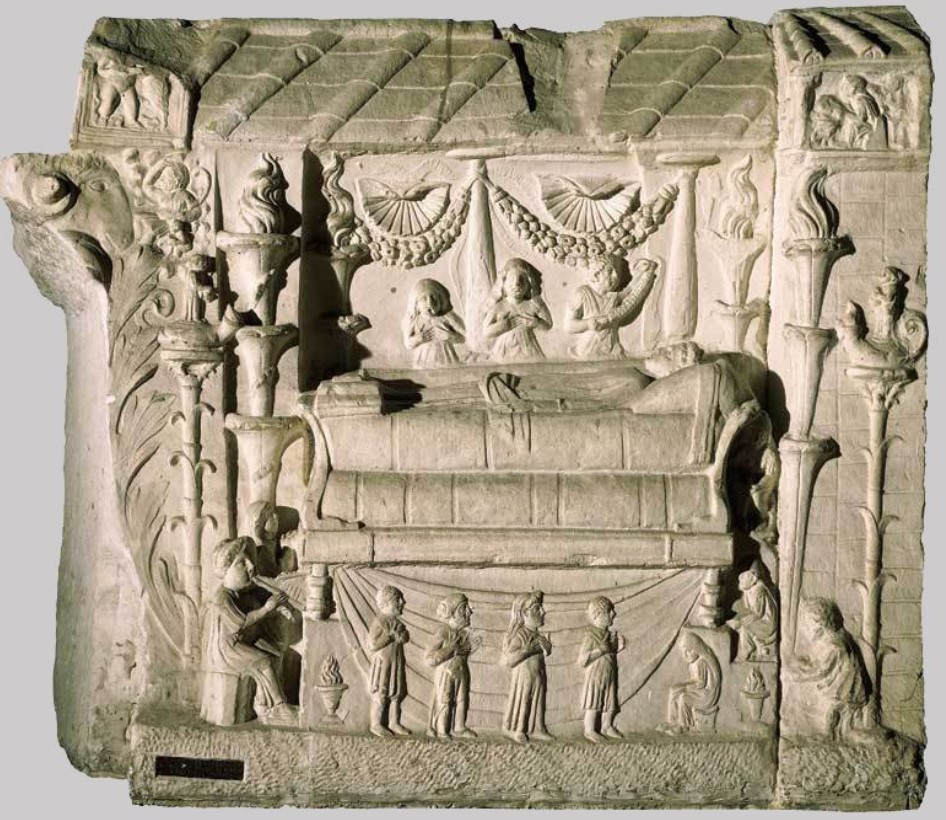
Collocatio relief from Tomb of the Haterii- Vatican Museum, Rome. A funerary scene with a deceased figure on a bed surrounded by lit candelabra, mourners, and servants. The tomb of the Haterii was a monumental Roman one built at the beginning of the 2nd century on the via Labicana (via Casilina) in Rome. It belonged to the family of Quintus Aterius Thychicus, a public works contractor (redemptor) under Domitian. The relief depicts the funeral scene exposed to view (collocatio) of a woman deceased lying on a bed surrounded by four candelabras with flames lit. Around the bed are two prefaces that accompany her with a crown, a flute player and small figures of servants or characters in prayer.
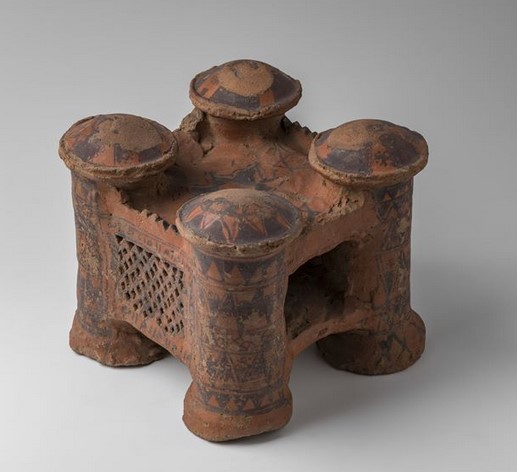
Terracotta censer (30 BCE – 395 CE) resembling a Roman military camp (castrum) - Egyptian Museum, Turin
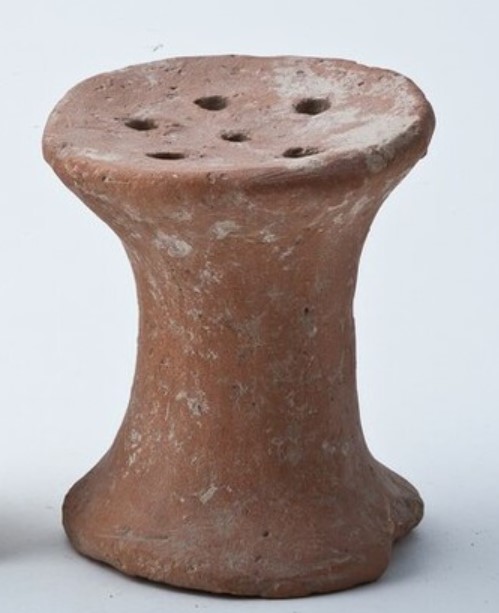
Roman-era acerra, Civic Archaeological Museum, Padria (Sassari), Italy. Over time, its design evolved into cylindrical forms (pissides or thymiateria) used in churches.
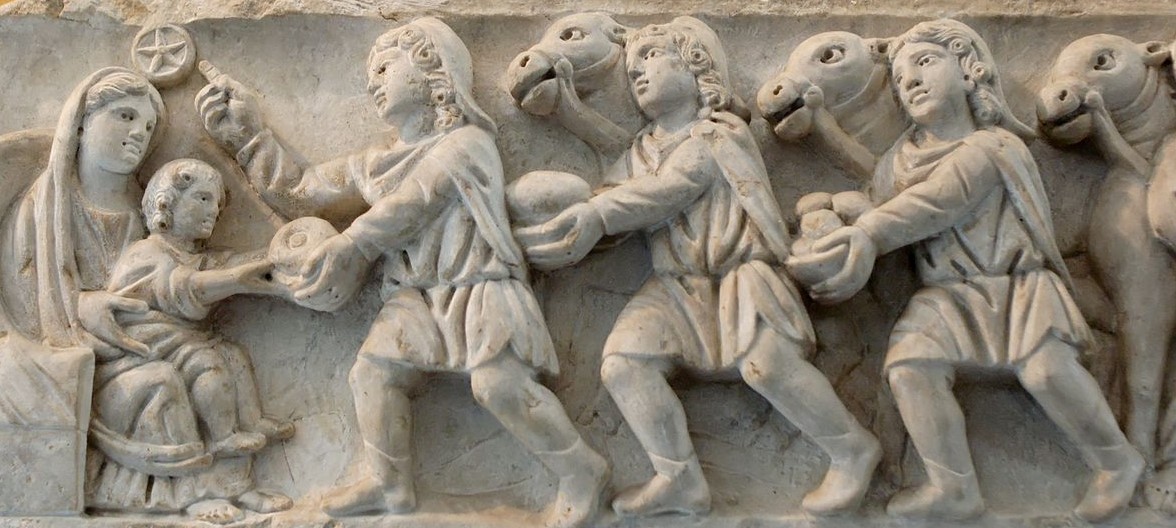
Adoration of the Magi. Panel from a Roman sarcophagus, 300-330 CE. From the cemetary of St. Agnes in Rome - Vatican Museums, Rome, Italy
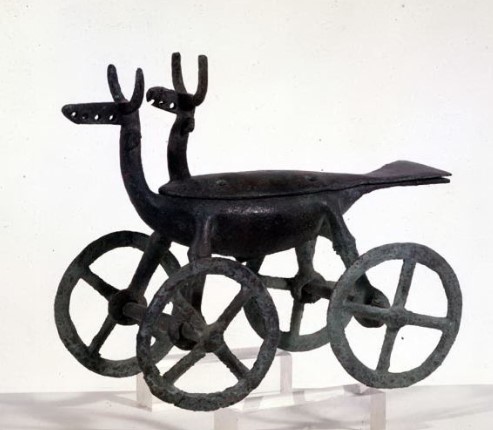
Etruscan bronze incense cart zoomorphic design (9th century BCE) from Monterozzi necropolis, Arcatelle - National Museum of Tarquinia, Italy.
© andmorestory.eu - All right reserved