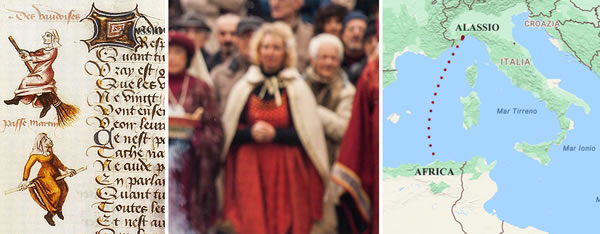
Martin Le Franc, Due streghe su scope, da Le Champion des Dames, (1451; Parigi, Bibliothèque Nationale de France) - Alassio (Savona, Italy)

The term "witch" (in Italian strega) is thought to derive from the Latin striga and stryx (from the Greek strygx), meaning "screech-owl, barn owl, night bird." Over time, however, the word came to take on the broader meaning of "practitioner of magic and spells." The folklore of seafaring peoples is particularly rich, and Italy, a maritime nation par excellence, is full of it. A fascinating example is that of the Ligurian witches of Alassio, known in dialect as bàzure.
According to legend, they were women of extraordinary beauty, but each hid a buttock covered in thick, black hair—an unmistakable sign of their diabolical paternity. Among their many terrible powers, that of metamorphosis was prominent: they could transform into long-tailed cats, goats, bats, or birds. Sometimes, the rainbow granted them these abilities: by passing under it, a witch could change sex or assume desired forms, often those of demonic beings or creatures of a fierce and horrible appearance. Furthermore, when necessary, they could take on the semblance of a deceased person or another individual, even going so far as to possess their body.
They were masters at conjuring terrifying storms, generating hail and lightning that struck the earth with fury. Their knowledge of the elements and occult forces of nature was so profound that it allowed them to stop ships in the open sea.
To take flight into the sky, they used a special ointment prepared with herbs capable of altering consciousness, such as mandrake, hemlock, aconite, henbane, belladonna, and toad skin (containing bufotenin, a strongly hallucinogenic substance). The bàzure kept this ointment in a vessel made from a goat or ox horn, and hidden from prying eyes inside the household chimney.
Being born a bàzura was a foreordained fate for the only daughters of a mother who had never borne sons; but one could also become one by acquiring the powers, if the daughter of other witches or of women consumed by hatred, despair, envy, or greed.
Often, the true bàzure were beautiful women who had enriched themselves through illicit dealings, traits that made them objects of envy and jealousy and caused them to be perceived as a threat by the community.
On stormy nights, the bàzure would gather on the beach. They would launch the fishermen's boats, hauled ashore, into the sea and, towed by horrible sea serpents, reach the African coasts. They would return in the same night from these miraculously long journeys, bringing back clusters of ripe dates of which they were fond. To torment the villagers, they would then hide the date pits in their beds, provoking terrible nightmares.
Between the 15th and the first half of the 17th century, women accused of witchcraft—in the belief that their alleged powers stemmed from a pact with the devil—were persecuted by the Catholic Church, but also by Protestant churches and some European states.
It is estimated that in Europe, between 1560 and 1660, approximately 12,000 death sentences for witchcraft were carried out, though the actual number of victims was likely much higher. Women identified as witches, after trials and torture, usually ended up at the stake in regions marked by strong conflicts between Catholics and Protestants: southern Germany, eastern France, Switzerland, England, and Italy. But witches were not solely negative figures: folk medicine, rich in ritual and often inseparable from magic, was practiced precisely by them, and many beliefs were founded upon them.
In popular mythology, the witch is a supernatural and malevolent figure, imagined with female features: an old woman with a face marked by deep wrinkles, or a real woman devoted to black magic, who directs the exceptional powers attributed to her against others. Witches are born, eat, age, and die like all other women. There are young and old ones, beautiful and ugly ones, although with age they tend to become more ill-favored than others. They possess supernatural power which they can exercise to the harm, or sometimes the benefit, of men. They spread their magic through simple contact, by administering specially prepared potions, or by performing other spells.
Most try to hide their identity to avoid hatred and marginalization; some, however, openly practice their "trade," in some ways resembling the ancient Sibyls. They can read thoughts, read palms, utter incantations, and administer specific remedies to cure illnesses, especially those of a nervous nature. They often achieve results, perhaps due to the patient's faith in them, or perhaps because they possess empirical knowledge of useful remedies in certain circumstances.
It is believed that witches form a community regulated by very secret laws, traditions, and customs. They guard recipes for practicing witchcraft, with procedures and prescriptions for every eventuality. All of this is said to be written in the "Devil's Encyclopedia," called Cjprianus or Cifrianus (writing in cipher with blood) in Upper Germany and Scandinavia, and "Black Mass" in northern Italy.
There is an almost universal belief that the witch community possesses the diabolical power of the "evil eye": any member, by staring at a person's face, could cause them illness, misfortune, or harm. Such misfortunes can be cured or nullified by turning to the same witch—for a monetary fee—or to another witch who is her enemy, who out of vengeance or spite will undo the spell.
These internal disputes are resolved in veritable criminal trials during the councils, which are held on predetermined days of the week, at the stroke of midnight, preferably at crossroads or under walnut trees. A great many witches were said to gather merrily around the walnut tree, dancing with a crowd of warlocks and devils. Their means of transport is always the same: they ride broomsticks or sheaves of wheat, flying up through chimneys.
In their ordinary appearance, witches bear no visible signs that could identify them. However, they must obey certain obligations at predetermined times and places; if someone catches them at those moments, they are seen assuming different forms and natures.
In Italy, the witch remains, as in the past, the great repository of the most ancient traditions. Her memory has been passed down through time in dialect songs, accounts of rituals, legends, superstitious practices, and folk tales.
Driven from history, witches re-emerged in legend; expelled from educated circles, they found refuge among the common people. In centuries past, during winter evenings, families would gather with their neighbors in the warmest rooms of the houses. During these vigils, everyone would do small chores while chatting about daily events, intertwining them with legendary, miraculous, or diabolical tales that had happened in the area in the past. Reality and superstition thus blended into engaging stories, populated by talking animals and cunning peasant women, murderers and executioners, devils and souls of the dead returning to terrify the living, magicians and imps, naïve and marginalized common folk, witches and sorceresses, intercessions of Jesus and the Saints.
The figures of warlocks and witches appear, under various names and aspects, in all eras and among all peoples, as entities over which civilization has never completely triumphed. They appear bold, rebellious, elusive, accompanied by the usual repertoire of leaps, shouts, whistles, and jests of every kind, ready to plunge into the abyss or rise to the clouds, to transform into horned monsters as well as dissolve into a rosy cloud.
Some of these protagonists have exerted a veritable nightmare on the Italian popular imagination, contributing to keeping the belief in hell alive among the masses even without the direct intervention of the Church, which has tolerated rather than created or encouraged such beliefs. In this case, it can be said that popular fantasy even influenced the dogma of the afterlife, specifying and embodying in frightening figures the state of punishment for souls after death. Even the Dantean representation of hell rests more on these popular visions than on strictly orthodox doctrine.
Witches animated many scary tales and fueled false beliefs:
The witch embodies the desires, fears, and other tendencies of our psyche that are incompatible with our ego.
- Carl Gustav Jung (1875-1961)
This page was last edited on 21 March 2026
Martin Le Franc, Due streghe su scope, da Le Champion des Dames, (1451; Parigi, Bibliothèque Nationale de France) - Alassio (Savona, Italy)
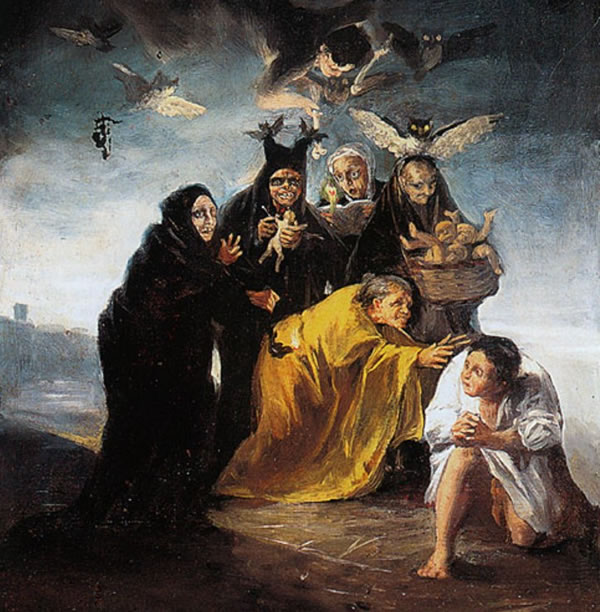
Francisco Goya (1746–1828): Witches (circa 1797-1798)
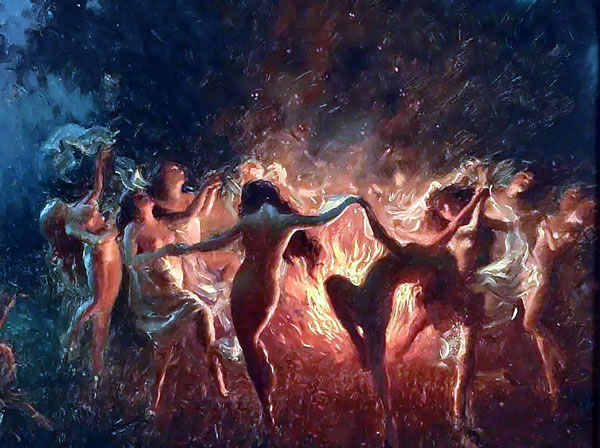
Joseph Tomanek, Fire Dance (oil on panel, 24 x 34.5 cm)
© andmorestory.eu - All right reserved