Publius Decumius, Accensus Velatus
In ancient Rome, freedmen (liberti) were enslaved people who had been manumitted (freed) by their masters, either in exchange for a ransom or as a reward for absolute loyalty. Once freed, they were able to:
• Establish a de facto union (contubernium) with a woman who was still enslaved (called a conserva), while children born from this union were known as vernae and remained slaves of the paterfamilias;
• Pass on their property to their children by inheritance, though ious laws over time required freedmen to leave a portion of their estate to their patron or the patron’s descendants;
• Add the forename (praenomen) and family name (nomen) of their former master while retaining their original name as a surname (cognomen);
• Legally own any type of property (houses, land, flocks, slaves, etc.);
• Buy and sell goods;
• Vote in popular assemblies;
• Practice any profession (small-scale trade, craftsmanship, and all forms of wage labor). The more educated among them became teachers, artists, or administrators of their patrons’ estates (for example, several senators, who were forbidden from engaging in commerce, entrusted their business affairs to trusted freedmen).
However, they were:
• Forbidden from suing their former master in either civil or criminal court;
• Required to provide their patron with a certain number of workdays each year;
• Barred from holding public office.
Thus, there were poor freedmen, well-to-do freedmen, and wealthy freedmen. The rich ones tended to imitate the lifestyle, tastes, and habits of the aristocracy. But the notables—whether senators or knights—would not admit them to their tables, did not invite them to their salons, and avoided being seen in their company.
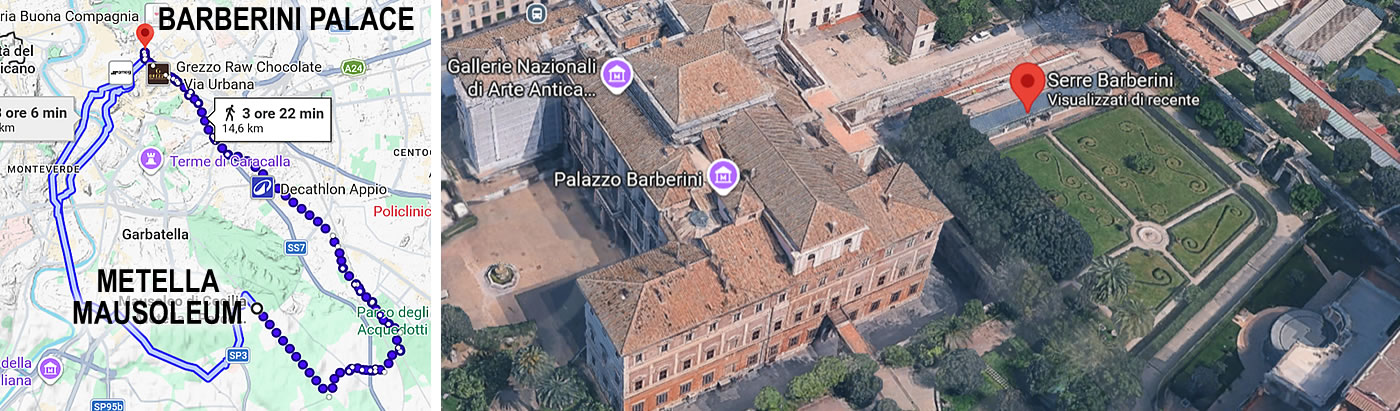
At the third milestone of the Appian Way, just outside the Capena Gate, stands the most famous and distinctive landmark of the regina viarum near the city of Rome. Its profile rises majestically over the Roman countryside and can be seen from a considerable distance. This is the Mausoleum of Caecilia Metella. The tomb was built in the Augustan age on a high podium with a square base (approximately 30 meters per side, or 100 Roman feet), originally clad in travertine slabs. On top of the podium rises a cylindrical central body, also faced with travertine blocks worked in smooth rusticated masonry, crowned by a sculpted frieze of bucrania connected by garlands in Pentelic marble. The frieze is interrupted at the midpoint of the side perpendicular to the road by a dedicatory inscription surmounted by military trophies. The top of the monument, now misshapen by medieval battlements, originally ended in a conical roof. This grand monument is dedicated to Caecilia Metella, a noble Roman woman about whom we know only what can be gleaned from the brief text carved into the inscription at the top of the tomb. A member of the gens Caecilia, a powerful plebeian family of the late Roman Republic, Caecilia was the daughter of Metellus and the wife of a Crassus. Her father, consul in 69 BCE, conquered the island of Crete and made it a Roman province, earning the agnomen Creticus.
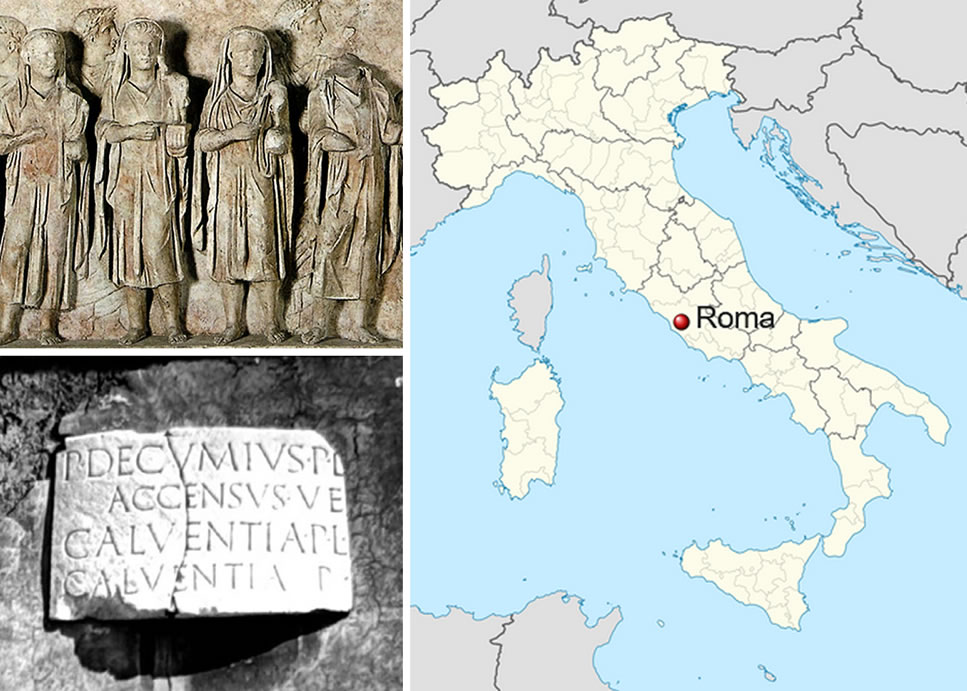
Near this very spot, in 1640, a white marble slab was discovered by chance, bearing an inscription datable to the first half of the 1st century CE:
P(ublius) Decumius P(ubli) l(libertus) [---?] / accensus ve(latus) [---?] / Calventia P(ubli) l(iberta) [---?] / Calventia P(ubli) [l(liberta)] [---?]
Publius Decumius, freedman of Publius [---?] / accensus velatus [---?] / Calventia, freedwoman of Publius [---?] / Calventia, [freedwoman] of Publius [---?]
Its convex shape suggests that it once covered a drum-shaped tomb intended for the freedman P. Decumius, who served as an accensus velatus, and for two freedwomen of the gens Calventia, both manumitted by the same patron (a certain P. Calventius). The textual structure of the inscription consists of a list of names in the nominative case (with surnames inscribed in the adjacent, now-lost block) arranged in descending hierarchical order. In the Imperial era, the accensi velati were organized into a college whose public duties remain unclear, although an inscription from the Via Nomentana (CIL VI 4012) documents that the college was responsible for maintaining minor roads. The position was held for life and was occupied both by freedmen (like P. Decumius) and by Roman citizens belonging to the equestrian order or those who had held municipal magistracies.
The term accensus (literally, “added to the census”) first appeared in the works of Cato and Plautus. It designated a citizen without sufficient wealth to belong to the formal classes, hence “added” to the census. Historically, accensi were subordinate assistants assigned to higher-ranking individuals. Over time, their functions evolved. Originating in Rome’s regal era, they constituted a distinct class of Roman citizens, part of the fifth class in Servius Tullius’s early military organization (6th century BCE). These were non-combat military personnel (inermes), valued for their utility, as Livy notes, in the Latin War (340 BCE).
The accensi,
Cato writes, were attendants; the word may be from censio ‘opinion,’ that is, from arbitrium ‘decision,’ for the accensus is present to do the arbitrium of him whose attendant he is.
(Varro, On the Latin Language, 7.58 - ca. 50 BCE)
Alongside the triarii (veteran soldiers forming the last line of defense), the young and inexperienced rorarii, and the accensi served as the final rank, wielding little power and often acting as auxiliary support with slings and stones. When not in combat, they carried messages between officers or retrieved the wounded and buried the dead.
The first vexillum was followed by the triarii, veterans of proved courage; the second by the rorarii, or ‘skirmishers,’ younger men and less distinguished; the third by the accensi, who were least to be depended upon, and were therefore placed in the rearmost line.
- Livy, History of Rome, (8.8.6 - ca. 19 BCE)
Later, accensi became unarmed support soldiers (inermes) accompanying the army. Known as light reserve infantry (accensi ad scripticii, later velites), they filled gaps in maniples and occasionally served as aides to officers.
By the late Republic and early Imperial periods, accensi transitioned to civil public officials under magistrates, often chosen from freedmen. Two categories emerged in Imperial Rome:
• Fixed-term accensi: serving for limited terms alongside magistrates, they held roles based on their patron’s tenure. Typically freedmen, they gained private rewards, sometimes even equestrian status, from their patrons.
• Permanent accensi (or accensi velati): they enjoyed more prestigious, enduring careers.
During the early Republic, they were organized as a centuria divided into decuriae. They gathered in arms on the Campus Martiu divided into centuries hierarchically defined by the census. Their name comes from the Latin word velati, which can be interpreted as “those who wear (only) the toga and do not carry weapons,” to differentiate themselves from the accensi inermes — this symbolized their non-combatant status.
By the Imperial era, they underwent an institutional evolution devoid of any connection with the armed forces and became holders of only religious duties: a competence, however, that they may have originally possessed, perhaps in castris (in the camp). In fact, they became ministers of the official Roman religious cult, under the control of the pontiffs, with the function of apparitores ad sacra, attached to the person of the supreme magistrates of the City. They were charged with ensuring that the procedures and liturgical formalities of gestures and timing were observed during the performance of certain sacra publica celebrated by consuls (e.g., the Feriae Latinae). The sacra were ceremonies of a religious character, such as the state cult (sacra publica populi Romani).
Consequently, the meaning of their name also evolved: velati can be interpreted as “those who have the habit of performing their sacred role velato capite, that is, with head covered by a cloak, according to priestly custom.” Prominent in public life, accensi were familiar figures in Roman theater, as in Plautus’s plays. They wielded minor powers and benefited personally from their patrons. In the provinces, accensi gained higher status, and those attending emperors or magistrates became prominent due to their elevated rank.
This page was last edited on 21 March 2026